Study highlights critical impact of urbanization on avian communities in the Afrotropics
July 31, 2024
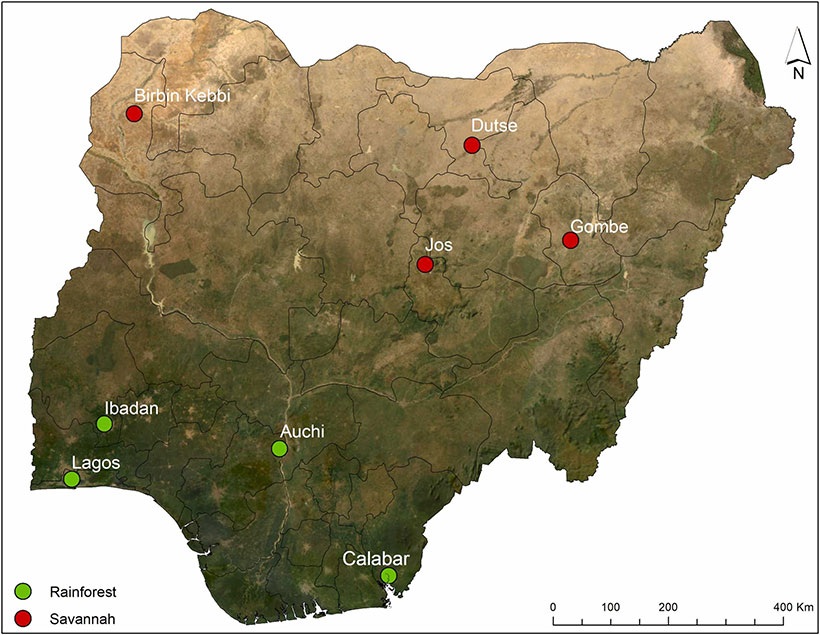
Distribution of study sites across the savannah and rainforest vegetation zones in Nigeria.
Urbanization negatively affects biodiversity worldwide, making associations between urbanization and avian communities an imperative study. The Head IITA of Forest Center, Adewale Awoyemi, recently published his third PhD paper, alongside other authors, reporting how urbanization affects bird taxonomic, functional, and phylogenetic diversity in the Afrotropics.
The authors compared bird populations in urban and non-urban areas from two vegetation zones in Nigeria: rainforest (Auchi, Calabar, Ibadan, and Lagos) and savannah (Birnin Kebbi, Dutse, Gombe, and Jos). They sampled birds and collected landscape attributes (such as pedestrians or green cover) both during the dry (November to January) and wet seasons (August to September), collecting data from 400-point count stations across the country.
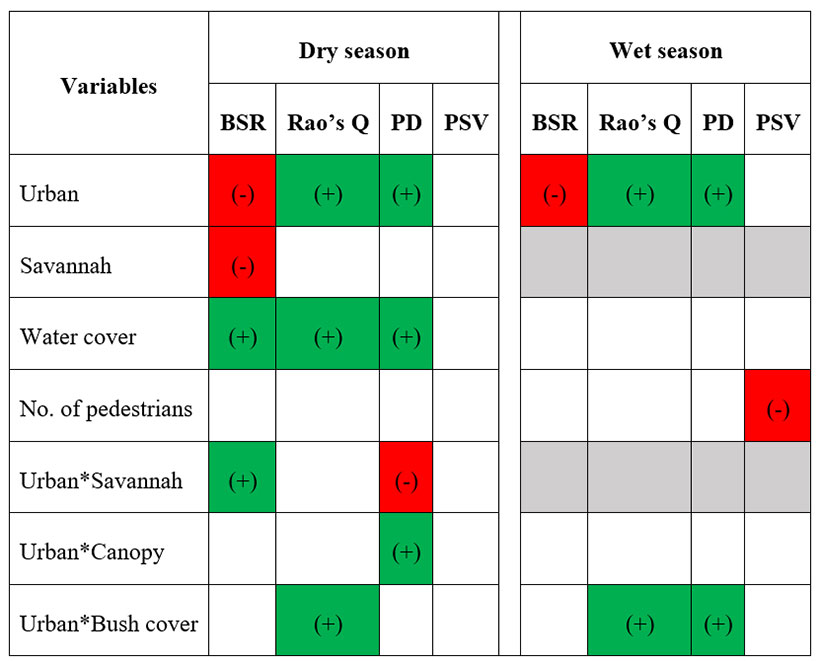
Schematic presentation of main associations between values of taxonomic diversity, functional diversity, and phylogenetic diversity for avian communities in wet and dry seasons of selected urban and non-urban habitats in Nigeria.
They recorded 8,738 birds of 237 species in their study. Of the eight studied cities, Jos recorded the highest number of bird species in the urban habitat during the dry season, while Ibadan registered the highest number of bird species during the wet season. They found that the impacts of urbanization on birds are more severe in rainforests than in savannahs.
They identified the laughing dove (Streptopelia senegalensis) as the most abundant bird species in cities during the dry season, which was present in 41% of all urban point counts studied. In contrast, the common bulbul, green-backed camaroptera, the vinaceous dove, green crombec, and the little greenbul were the most commonly recorded bird species in natural areas. Interestingly, they discovered that 65% of all the species recorded were never encountered in urban areas, indicating a devastating impact of urbanization on birds within the communities of the region.
The reduction in bird species richness was much more intense in the rainforest areas than in the savannahs, highlighting the particular vulnerability of rainforest birds to urbanization and the need for specific conservation measures in those cities. Awoyemi and his colleagues also found contrasting results among the different measured biodiversity indicators, which suggests that urbanization has a multifaceted effect on wildlife.
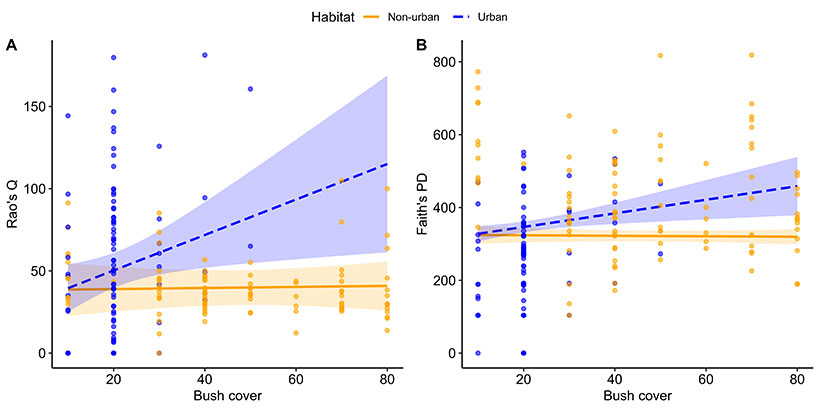
The effect of bush cover by habitat (urban vs non-urban) on functional diversity (Rao’s Q) during the dry season, and (B) the effect of canopy cover by habitat (urban vs non-urban) on phylogenetic diversity (Faith’s PD) during the dry season.
The authors also identified the importance of trees and bush cover for urban birds, as well as the crucial role of water bodies in cities during the critical dry season. They strongly recommend replicating their study in other Afrotropical areas and providing useful suggestions to help reconcile urban development and bird conservation in this rich biodiversity area.
Link to paper: https://doi.org/10.1016/j.gecco.2024.e03108
About IITA Forest Center
IITA Forest Center manages and utilizes forest resources for conservation, research, and education. The 350 hectares of Forest Reserve within the IITA-Ibadan’s 1000-hectare land support biodiversity and diverse habitats. IITA Forest is a haven for birds and is designated as an Important Bird Area (IBA) by BirdLife International. IITA Forest Center has recorded remarkable successes in the propagation and conservation of over 100 native tree species in the Tree Heritage Park, about half of which are already Red-Listed by the IUCN. In January 2022, the THP was awarded a Level II Accreditation by The ArbNet Arboretum Accreditation Program and The Morton Arboretum. The IITA Forest supports over 450 plant species, 272 birds, 236 butterflies, 48 mammals, and 28 reptiles.
Contributed by Folake Oduntan
Olamide Deborah Nwanze is a Senior Research Associate specializing in gender mainstreaming research to inform participatory and inclusive breeding, variety development, and seed systems policies regarding root, tuber, and banana (RTB) crops in the International Institute of Tropical Agriculture Headquarters, Ibadan, Nigeria. She is a PhD candidate at the University of Ibadan and holds an MSc and B. Agric in Agricultural Extension and Rural Development. Olamide is a fellow of the African Women in Agricultural Research and Development – Gender Responsive Agricultural Systems Policy (AWARD-GRASP) and the Gender Responsive Researchers Equipped for Agricultural Transformation (GREAT). She seeks to apply her gender-mainstreaming learnings, gender-responsive research, and policy development, and review expertise to facilitate women, youth, children, and vulnerable social group’s access to and adoption of agricultural Innovations that guarantee food, nutrition, income, and livelihood security in Africa. Her current roles include mentoring research fellows, development of guides and training manuals, implementation and adaptation of gender frameworks and tools, value chain actors’ engagement as citizen science partners, policy review and redesign, data management, and analysis. Her current research explores mixed methods and participatory and interdisciplinary approaches to capture and highlight gender dynamics, needs, preferences, and challenges stakeholders face within the agricultural livelihood value chain to prioritize gender-inclusive strategies in breeding programs, policy design, and implementation.
de Sousa, K., van Etten, J., Manners, R. Bello, A., Teeken, B., Olaosebikan, O., et al. 2024. The tricot approach: an agile framework for decentralized on-farm testing supported by citizen science. A retrospective. Agron. Sustain. Dev. 44, 8. https://doi.org/10.1007/s13593-023-00937-1
Madu, T., Onwuka, S., Nwafor, S., Onyemauwa, N., Ejechi, M., Ofoeze, M., Ukeje, B., Eluagu, C., Olaosebikan, O., Okoye, B., 2024. Gender-Inclusive Consumer Studies Improve Cassava Breeding in Nigeria in: Frontiers in Sociology, volume 9, number: 1224504, doi: 10.3389/fsoc.2024.1224504
Olaosebikan, O.; Bello, A.; Utoblo, O.; Okoye, B.; Olutegbe, N.; Garner, E.; Teeken, B.; Bryan, E.; Forsythe, L.; Cole, S.; Madu, T. 2023. Stressors and Resilience within the Cassava Value Chain in Nigeria: Preferred Cassava Variety Traits and Response Strategies of Men and Women to Inform Breeding. Sustainability 15, 7837. https://doi.org/10.3390/su15107837
Okoye, B., Ofoeze, M., Ejechi, M., Onwuka, S., Nwafor, S., Onyemauwa, N., Ukeje, B., Eluagu, C., Obidiegwu, J.*, Olaosebikan, O., Madu, T.* 2023. Prioritizing preferred traits in the yam value chain in Nigeria: a gender situation analysis in: Frontiers in Sociology, volume 8, number: 1232626, pages 1 – 9, ISSN 2297-7775, 2023. https://www.frontiersin.org/articles/10.3389/fsoc.2023.1232626/full
Olaosebikan, O., Bello, A. A., de Sousa, K., Ndjouenkeu, R., Adesokan, M., Alamu, E. O., Agbona, A., van Etten, J., Kegah, F. N.*, Dufour, D., Bouniol, A., Teeken, B. 2023. Consumer acceptability of cassava gari-eba food products across cultural and environmental settings using the triadic comparison of technologies approach (tricot) in: Journal of the Science of Food and Agriculture,
Teeken, B., Olaosebikan, O., Bello, A. A., Madu, T.*, Cole, S. M. 2023. Qualitative assessment on the positionality and preferences of dyads in relation to cassava-related activities: working with tricot trial citizen scientists https://hdl.handle.net/10568/138326 Type: Manual
Bouniol, A., Ceballos, H., Bello, A. A., Teeken, B., Olaosebikan, O., Owoade, D., Agbona, A., Fotso Kuate, A., Madu, T.*, Okoye, B.*, Ofoeze, M.*, Nwafor, S.*, Onyemauwa, N.*, Adinsi, L.*, Forsythe, L., Dufour, D. 2023. Varietal impact on women’s labour, workload and related drudgery in processing root, tuber and banana crops: focus on cassava in sub-Saharan Africa in: Journal of the Science of Food and Agriculture, pages 1 – 25, ISSN 0022-5142,
Bello, A. A., Agbona, A., Olaosebikan, O., Edughaen, G., Dufour, D., Bouniol, A., Iluebbey, P., Ndjouenkeu, R.*, Rabbi, I. Y., Teeken, B. 2023. Genetic and environmental effects on processing productivity and food product yield: drudgery of women’s work in: Journal of the Science of Food and Agriculture, pages 1 – 32, ISSN 0022-5142, 5
Cavicchioli, M., Zimbiti, T., Teeken, B., Nwanze, D.O., Liani, M., Parkes, E. & Bello, A. 2023. IITA-Gender Responsive Breeding Training Report. Genetic Resources Center, IITA-HQ, Ibadan, 21-23 September, 2022. Ibadan, Nigeria: IITA, (34 p.).https://hdl.handle.net/10568/131368
Agbona, A. Peteti P., Teeken B., Olaosebikan O. Bello, A. A., Parkes, E., Rabbi, I. Y., Mueller, L., Egesi, C., Kulakow, P. 2022. Data Management in Multi-disciplinary African RTB Crop Breeding Programs. In: Williamson, H.F., Leonelli, S. (eds) Towards Responsible Plant Data Linkage: Data Challenges for Agricultural Research and Development. Springer, Cham. https://doi.org/10.1007/978-3-031-13276-6_5
Lora Forsythe, Pricilla Marimo, Sarah Mayanja, Olamide D. Olaosebikan, Esme Stuart, Bela Teeken, Benjamin Okoye, Tessy Madu, (2021). Cross-product Gender Analysis of RTBfoods Step 2 Gendered Food Mapping on RTB Products. Understanding the Drivers of Trait Preferences and the Development of Multi-user RTB Product Profiles, WP1. London, UK: RTBfoods Field Scientific Report, 30 p.
Teeken, B., Garner, E., Agbona, A., Balogun, I., Olaosebikan, O., Bello, A., Madu, T., Okoye, B., Egesi, C., Kulakow, P. and Tufan, H.A. 2021. Beyond “Women’s Traits”: Exploring How Gender, Social Difference, and Household Characteristics Influence Trait Preferences. Frontiers Sustainable Food Systems 5:740926. https://doi.org/10.3389/fsufs.2021.740926
Teeken, B., Agbona, A., Bello, A., Olaosebikan, O., Alamu, E., Adesokan, M., Awoyale, W., Madu, T., Okoye, B., Chijioke, U., Owoade, D., Okoro, M., Bouniol, A., Dufour, D., Hershey, C., Rabbi, I., Maziya‐Dixon, B., Egesi, C., Tufan, H. and Kulakow, P. (020. Understanding cassava varietal preferences through pairwise ranking of gari‐eba and fufu prepared by local farmer–processors. Int J Food Sci Technol.https://doi.org/10.1111/ijfs.14862
Bela Teeken, Olamide Olaosebikan, Ireti Balogun, Benjamin Okoye, Tessy Madu, Steven Cole, Abolore Bello, Elizabeth Parkes. (2020). Piloting the G+ customer and product profile tools for gender-responsive cassava breeding in Nigeria. Nigeria: International Institute of Tropical Agriculture (IITA). https://hdl.handle.net/20.500.11766/13000