
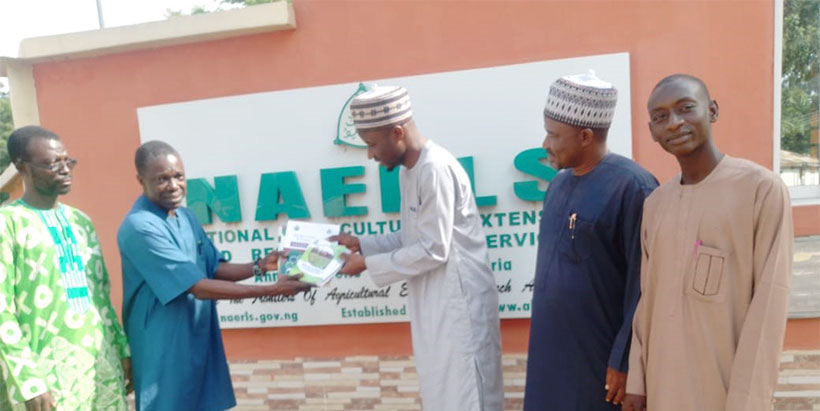
In a bid to solicit for support and increase awareness on the importance of underutilized legumes, the President of the Society for Underutilized Legumes (SUL), Dr Taofeek Tope Adegboyega who also represented the IITA Chapter, recently visited the National Agricultural Extension and Research Liaison Services (NAERLS), Ahmadu Bello University, Zaria, to advocate for enhanced support from stakeholders towards the promotion of underutilized legumes in Nigerian farming systems. Discussions during the visit focused on ways to leverage the untapped potential of indigenous legumes to improve food and nutrition security, and economic stability for smallholder farmers in Nigeria.
Raising the critical need to diversify agriculture, particularly by promoting and incorporating lesser-utilized legume varieties such as Bambara groundnut, African yam bean, and pigeon pea, Dr Adegboyega called for alignment of activities among stakeholders from the academia, national research systems and agricultural research organisation.
According to him, these legumes hold immense promise for enriching soil fertility, increasing farmer resilience to climate challenges, and offering more nutritious food options for Nigerian communities.
Emphasizing that these underutilized crops, often overlooked, have high potential for local and international markets, “Nigeria has a vast array of indigenous legume species with immense agricultural and nutritional value. However, due to limited research and support, they remain underutilized. By bringing together resources, expertise, and commitment from various stakeholders, we can unlock the potential of these crops to benefit both farmers and consumers,” he stated.
The NAERLS Assistant Director of Research, Planning, and M&E, Prof. Paul Bolorunduro, who received the visiting team on behalf of the NAERLS management, expressed strong support for this initiative, highlighting that one of the institute’s missions is to promote sustainable agricultural practices that align with local ecological conditions.
“Working with SUL is a key step in ensuring these crops receive the attention they deserve, potentially leading to new research programs, farmer education, and improved seed varieties,” he remarked.
Dr Adegboyega’s visit signals a new chapter in agricultural advocacy for underutilized crops in Nigeria. With coordinated efforts, stakeholders -including government agencies, research institutions, private sector partners, and non-governmental organizations—can impact millions through support the initiative. Enhanced research, training programs for farmers, and market development were identified as essential steps to integrate these crops into the national agricultural framework.
As the global and local demand for sustainable, climate-resilient crops continues to grow, SUL’s leadership is committed to placing underutilized legumes at the forefront of agricultural development in Nigeria. This partnership with NAERLS marks the beginning of a coordinated campaign to support these valuable crops’ cultivation, commercialization, and consumption, offering a promising path toward a more resilient and diversified agricultural sector.
Contributed by Kafilat Abiodun Odesola
Contributed by
Recent stories