
TAAT collaborates with CORAF on implementation assessment of Harmonized Regional Seed Regulation
June 26, 2019
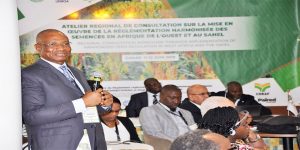
Major actors of the seed industry in West Africa met in the Senegalese capital, Dakar, on 11-12 June to assess progress made in implementing the harmonized regional seed regulation.
The Harmonized Regional Seed Regulation was adopted in 2008 by the Economic Community of West African States (ECOWAS) and in 2009 by the West African Economic and Monetary Union (WAEMU).
 The primary goal is to create a favorable environment for the growth of the seed industry. All ECOWAS member countries, including Chad and Mauritania, have adopted the law.
The meeting was organized jointly by the Policy Enabler Compact of the Technologies for African Agricultural Transformation (TAAT) and the West and Central African Council for Agricultural Research and Development (CORAF).
Sponsored by the African Development Bank (AfDB) as part of its Feed Africa initiative, TAAT’s main objective is to improve the business of agriculture across Africa by raising agricultural productivity, mitigating risks, and promoting diversification and processing in 18 agricultural value chains within eight Priority Intervention Areas.
The TAAT Policy Enabler Compact is led by the African Agricultural Technology Foundation (AATF). The compact operates to strengthen economic, trade, and institutional policies that contribute to higher productivity, competitiveness, and processing intensity across value chains and agroecological zones by working closely with national and regional partners.
The Dakar meeting assessed the state of implementation, identifying bottlenecks as well as developing a road map to speed up implementation.
Specifically, the discussions addressed five broad areas namely certification for variety dissemination, quality control and certification of seeds, phytosanitary certification of seeds, institutional arrangements for the implementation of the seed policy, and private sector participation in the implementation of seed policy.
The close to 50 participants at the workshop were drawn from the national seed systems of the 17 participating countries, the regional economic communities, smallholder farmer organizations, research institutions, and funding partners.
Representatives from the Common Market for Eastern and Southern Africa (COMESA), the Southern African Development Community (SADC), and the East African Community (EAC) were also invited to share their experiences.
As a key technical partner of ECOWAS and other regional economic commissions, ECOWAS designated CORAF in 2013 to facilitate and coordinate the implementation of the harmonized regional regulation for seeds and seedlings in the Member States.
AATF, on the other hand, was founded in 2003 to address Africa’s food security outlook through agricultural technology. AATF responds to the need for an effective mechanism that would facilitate and support negotiation for access to technologies and the provision of appropriate partnerships to manage the development and deployment of innovative technologies for smallholder farmers in sub-Saharan Africa.
The primary goal is to create a favorable environment for the growth of the seed industry. All ECOWAS member countries, including Chad and Mauritania, have adopted the law.
The meeting was organized jointly by the Policy Enabler Compact of the Technologies for African Agricultural Transformation (TAAT) and the West and Central African Council for Agricultural Research and Development (CORAF).
Sponsored by the African Development Bank (AfDB) as part of its Feed Africa initiative, TAAT’s main objective is to improve the business of agriculture across Africa by raising agricultural productivity, mitigating risks, and promoting diversification and processing in 18 agricultural value chains within eight Priority Intervention Areas.
The TAAT Policy Enabler Compact is led by the African Agricultural Technology Foundation (AATF). The compact operates to strengthen economic, trade, and institutional policies that contribute to higher productivity, competitiveness, and processing intensity across value chains and agroecological zones by working closely with national and regional partners.
The Dakar meeting assessed the state of implementation, identifying bottlenecks as well as developing a road map to speed up implementation.
Specifically, the discussions addressed five broad areas namely certification for variety dissemination, quality control and certification of seeds, phytosanitary certification of seeds, institutional arrangements for the implementation of the seed policy, and private sector participation in the implementation of seed policy.
The close to 50 participants at the workshop were drawn from the national seed systems of the 17 participating countries, the regional economic communities, smallholder farmer organizations, research institutions, and funding partners.
Representatives from the Common Market for Eastern and Southern Africa (COMESA), the Southern African Development Community (SADC), and the East African Community (EAC) were also invited to share their experiences.
As a key technical partner of ECOWAS and other regional economic commissions, ECOWAS designated CORAF in 2013 to facilitate and coordinate the implementation of the harmonized regional regulation for seeds and seedlings in the Member States.
AATF, on the other hand, was founded in 2003 to address Africa’s food security outlook through agricultural technology. AATF responds to the need for an effective mechanism that would facilitate and support negotiation for access to technologies and the provision of appropriate partnerships to manage the development and deployment of innovative technologies for smallholder farmers in sub-Saharan Africa.
Dr Jonas Chianu of AfDB leading discussions at the workshop. (Photo by TAAT/Atayi Opaluwah)
Contributed by
Recent stories
No items found