NEWS

Tanzania Ministry of Education honors IITA woman scientist
March 7, 2025

“We were placed on earth to fulfill a purpose, and that purpose is what gives meaning to our lives. You were sent to the world to make an impact and a difference.” – Myles Munroe

This quote gives meaning following the Tanzania Ministry of Education, Science, and Technology’s presentation of the High-Level Recognition Award in Science, Technology, and Innovations to Dr Kiddo Mtunda, a seasoned plant breeder from IITACGIAR.

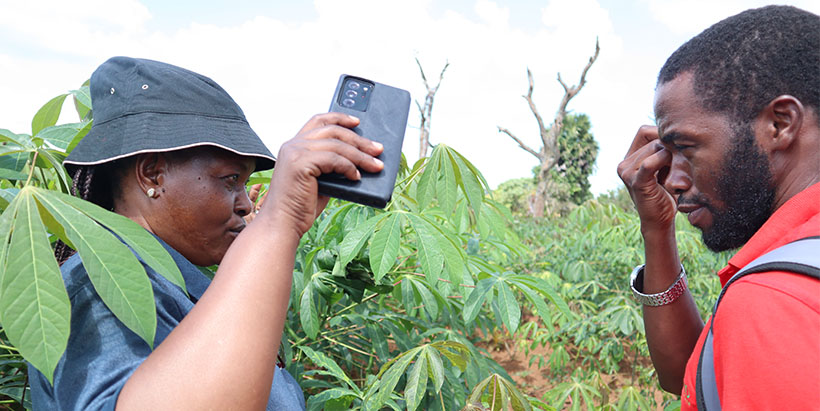
Dr Kiddo Mtunda on a cassava field with a team member.

The award ceremony attended by the Deputy Prime Minister and Minister of Energy, Honorable Dr Doto Mashaka Biteko took place during the 9th Science, Technology, and Innovation Conference and Exhibition (STICE), hosted by the Tanzania Commission for Science and Technology (COSTECH) at the Julius Nyerere International Conference Centre in Dar es Salaam from 2nd to 4th December 2024.

With the theme, “Harnessing science, technology and innovations for climate resilience and competitive economy,” the conference focused on sharing research and innovation results, displaying scientific and technological development, and discussing how STI can contribute to the country’s socio-economic development in achieving the Sustainable Development Goals (SDGs).

Dr Mtunda was recognized for her contribution to the country’s agriculture sector by developing improved varieties and disseminating them to farmers.

“In my life, I chose fighting hunger through science, technology, and innovations,” Dr Mtunda expressed. She noted that she felt honored and delighted to receive that noble recognition and award from the Government of Tanzania.

This proves the “With Science We Can” campaign under CGIAR, emphasizing the importance of scientific research and innovation in tackling issues such as climate change, food insecurity, and biodiversity loss.
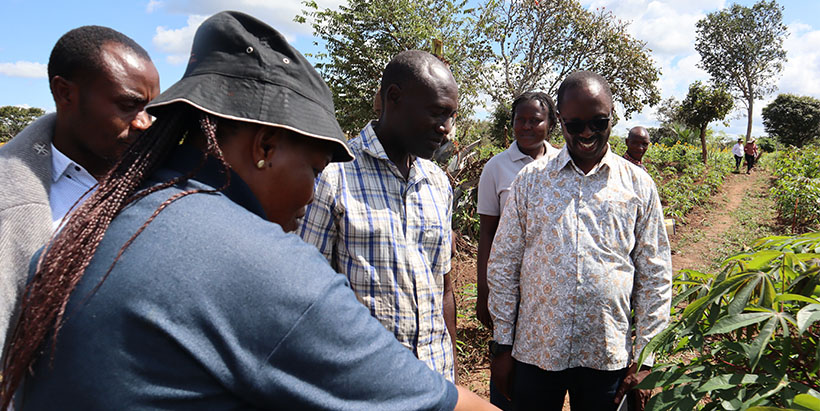
Dr Kiddo Mtunda during a field survey with other researchers.

Dr Mtunda is the Technical Lead for the Muhogo Bora Project, which is scaling up the Building an Economically Sustainable and Integrated Cassava Seed System (BASICS II) model in Tanzania’s Western and Central zones. The project has trained 242 cassava seed entrepreneurs, 130 extension staff, and more than 5,000 farm families, indirectly benefiting 164,000 individuals through access to clean cassava planting materials.

With over 20 years of experience in agricultural research, Dr Mtunda has made significant progress in developing and promoting innovative technologies to enhance the productivity of root and tuber crops, particularly cassava and sweet potato. Her efforts have directly contributed to the release of 15 improved crop varieties in Tanzania – nine cassava and six bio-fortified sweet potato varieties. These varieties, including Vitamin A-enriched, orange-fleshed sweet potatoes, have boosted agricultural yields and addressed critical nutritional deficiencies among communities.

One of her most notable initiatives, “Fast-tracking access to improved and popular varieties of root crops,” directly benefited more than 229,000 households in Tanzania and Uganda by providing access to high-yielding and disease-resistant varieties.

While working with the Tanzania Agricultural Research Institute (TARI), Dr Mtunda was actively involved in the development of seed systems of root and tuber crops in Tanzania, collaborating closely with the Tanzania Official Seed Certification Institute (TOSCI), International Institute of Tropical Agriculture (IITA), International Potato Center (CIP), and other key stakeholders in the seed industry. Her science, technology, and innovation successes became possible through capacity strengthening and support from the Government of Tanzania, IITA, Alliance for Green Revolution in Africa (AGRA), CIP, and development partners.

Dr Mtunda’s influence extends beyond research; she has played an important role in  Tanzania’s agricultural development and contributed to the National Cassava Development Strategy and National Biofortification Guidelines. Her work as a Borlaug LEAP Fellow and Vice President of the International Society for Tropical Root Crops – Africa Branch (ISTRC-AB) between 2017 and 2020 has cemented her reputation as a leader in agricultural innovation.

As she continues her work at IITA, scaling up innovative seed systems and empowering farmers, Dr Mtunda’s legacy as a leader in agricultural science remains an inspiration for Women and Girls in Science for future generations

Contributed by Gloriana Ndibalema


Contributed by

Recent stories

No items found

Leave a Reply

Your email address will not be published. Required fields are marked *

Scroll to Top
Olaosebikan, Olamide

Olamide Deborah Nwanze is a Senior Research Associate specializing in gender mainstreaming research to inform participatory and inclusive breeding, variety development, and seed systems policies regarding root, tuber, and banana (RTB) crops in the International Institute of Tropical Agriculture Headquarters, Ibadan, Nigeria. She is a PhD candidate at the University of Ibadan and holds an MSc and B. Agric in Agricultural Extension and Rural Development. Olamide is a fellow of the African Women in Agricultural Research and Development – Gender Responsive Agricultural Systems Policy (AWARD-GRASP) and the Gender Responsive Researchers Equipped for Agricultural Transformation (GREAT). She seeks to apply her gender-mainstreaming learnings, gender-responsive research, and policy development, and review expertise to facilitate women, youth, children, and vulnerable social group’s access to and adoption of agricultural Innovations that guarantee food, nutrition, income, and livelihood security in Africa. Her current roles include mentoring research fellows, development of guides and training manuals, implementation and adaptation of gender frameworks and tools, value chain actors’ engagement as citizen science partners, policy review and redesign, data management, and analysis. Her current research explores mixed methods and participatory and interdisciplinary approaches to capture and highlight gender dynamics, needs, preferences, and challenges stakeholders face within the agricultural livelihood value chain to prioritize gender-inclusive strategies in breeding programs, policy design, and implementation.

At IITA, she contributes to the implementation of the CGIAR Accelerated Breeding Initiative and Genetic Innovation Programs; participatory and gender research within the NextGen CassavaHarvestPlusRTBFoods, and Tricot-ClimMob 1000Farms Projects; and gender knowledge communication via the G-LENS webinar series, video documentary, policy briefspublications, and blogs.


Recent publications

de Sousa, K., van Etten, J., Manners, R. Bello, A., Teeken, B., Olaosebikan, O., et al. 2024. The tricot approach: an agile framework for decentralized on-farm testing supported by citizen science. A retrospective. Agron. Sustain. Dev. 44, 8. https://doi.org/10.1007/s13593-023-00937-1

Madu, T., Onwuka, S., Nwafor, S., Onyemauwa, N., Ejechi, M., Ofoeze, M., Ukeje, B., Eluagu, C., Olaosebikan, O., Okoye, B., 2024. Gender-Inclusive Consumer Studies Improve Cassava Breeding in Nigeria in: Frontiers in Sociology, volume 9, number: 1224504, doi: 10.3389/fsoc.2024.1224504

Olaosebikan, O.; Bello, A.; Utoblo, O.; Okoye, B.; Olutegbe, N.; Garner, E.; Teeken, B.; Bryan, E.; Forsythe, L.; Cole, S.; Madu, T. 2023.  Stressors and Resilience within the Cassava Value Chain in Nigeria: Preferred Cassava Variety Traits and Response Strategies of Men and Women to Inform Breeding. Sustainability 15, 7837. https://doi.org/10.3390/su15107837

Okoye, B., Ofoeze, M., Ejechi, M., Onwuka, S., Nwafor, S., Onyemauwa, N., Ukeje, B., Eluagu, C., Obidiegwu, J.*, Olaosebikan, O., Madu, T.* 2023. Prioritizing preferred traits in the yam value chain in Nigeria: a gender situation analysis in: Frontiers in Sociology, volume 8, number: 1232626, pages 1 – 9, ISSN 2297-7775, 2023. https://www.frontiersin.org/articles/10.3389/fsoc.2023.1232626/full

Olaosebikan, O., Bello, A. A., de Sousa, K., Ndjouenkeu, R., Adesokan, M., Alamu, E. O., Agbona, A., van Etten, J., Kegah, F. N.*, Dufour, D., Bouniol, A., Teeken, B. 2023. Consumer acceptability of cassava gari-eba food products across cultural and environmental settings using the triadic comparison of technologies approach (tricot) in: Journal of the Science of Food and Agriculture,

Teeken, B., Olaosebikan, O., Bello, A. A., Madu, T.*, Cole, S. M. 2023. Qualitative assessment on the positionality and preferences of dyads in relation to cassava-related activities: working with tricot trial citizen scientists https://hdl.handle.net/10568/138326 Type: Manual

Bouniol, A., Ceballos, H., Bello, A. A., Teeken, B., Olaosebikan, O., Owoade, D., Agbona, A., Fotso Kuate, A., Madu, T.*, Okoye, B.*, Ofoeze, M.*, Nwafor, S.*, Onyemauwa, N.*, Adinsi, L.*, Forsythe, L., Dufour, D. 2023. Varietal impact on women’s labour, workload and related drudgery in processing root, tuber and banana crops: focus on cassava in sub-Saharan Africa in: Journal of the Science of Food and Agriculture, pages 1 – 25, ISSN 0022-5142,

Bello, A. A., Agbona, A., Olaosebikan, O., Edughaen, G., Dufour, D., Bouniol, A., Iluebbey, P., Ndjouenkeu, R.*, Rabbi, I. Y., Teeken, B. 2023. Genetic and environmental effects on processing productivity and food product yield: drudgery of women’s work in: Journal of the Science of Food and Agriculture, pages 1 – 32, ISSN 0022-5142, 5

Cavicchioli, M., Zimbiti, T., Teeken, B., Nwanze, D.O., Liani, M., Parkes, E. & Bello, A. 2023. IITA-Gender Responsive Breeding Training Report. Genetic Resources Center, IITA-HQ, Ibadan, 21-23 September, 2022. Ibadan, Nigeria: IITA, (34 p.).https://hdl.handle.net/10568/131368

Agbona, A. Peteti P., Teeken B., Olaosebikan O. Bello, A. A., Parkes, E., Rabbi, I. Y., Mueller, L., Egesi, C., Kulakow, P. 2022. Data Management in Multi-disciplinary African RTB Crop Breeding Programs. In: Williamson, H.F., Leonelli, S. (eds) Towards Responsible Plant Data Linkage: Data Challenges for Agricultural Research and Development. Springer, Cham. https://doi.org/10.1007/978-3-031-13276-6_5

Lora Forsythe, Pricilla Marimo, Sarah Mayanja, Olamide D. Olaosebikan, Esme Stuart, Bela Teeken, Benjamin Okoye, Tessy Madu, (2021). Cross-product Gender Analysis of RTBfoods Step 2 Gendered Food Mapping on RTB Products. Understanding the Drivers of Trait Preferences and the Development of Multi-user RTB Product Profiles, WP1. London, UK: RTBfoods Field Scientific Report, 30 p.

Teeken, B., Garner, E., Agbona, A., Balogun, I., Olaosebikan, O., Bello, A., Madu, T., Okoye, B., Egesi, C., Kulakow, P. and Tufan, H.A. 2021. Beyond “Women’s Traits”: Exploring How Gender, Social Difference, and Household Characteristics Influence Trait Preferences. Frontiers Sustainable Food Systems 5:740926. https://doi.org/10.3389/fsufs.2021.740926

Teeken, B., Agbona, A., Bello, A., Olaosebikan, O., Alamu, E., Adesokan, M., Awoyale, W., Madu, T., Okoye, B., Chijioke, U., Owoade, D., Okoro, M., Bouniol, A., Dufour, D., Hershey, C., Rabbi, I., Maziya‐Dixon, B., Egesi, C., Tufan, H. and Kulakow, P. (020. Understanding cassava varietal preferences through pairwise ranking of gari‐eba and fufu prepared by local farmer–processors. Int J Food Sci Technol. https://doi.org/10.1111/ijfs.14862

Bela Teeken, Olamide Olaosebikan, Ireti Balogun, Benjamin Okoye, Tessy Madu, Steven Cole, Abolore Bello, Elizabeth Parkes. (2020). Piloting the G+ customer and product profile tools for gender-responsive cassava breeding in Nigeria. Nigeria: International Institute of Tropical Agriculture (IITA). https://hdl.handle.net/20.500.11766/13000