
IITA NEWS

The rural woman – a powerful force that can drive global progress
October 15, 2020
IITA joins the rest of the world to spotlight the people who feed the world—women. We can recognize a rural woman from a distance. Her clothing is usually different from the urban woman’s; it is loose-fitting, mismatched, and often, this woman carries a baby with a few toddlers and grown offspring surrounding her. Most people would praise her by calling her “strong.” Indeed, she is strong, for only a strong woman can raise seven children, till the land, and take care of her other chores! But the rural woman is much more than the above stereotypes. António Guterres, the UN Secretary-General, describes the rural woman as she truly is. “An early adopter of new agricultural techniques, a first responder in crises, and an entrepreneur of green energy; rural women are a powerful force that can drive global progress.” The rural woman – a powerful force that can drive global progress Some facts about rural women and girls:
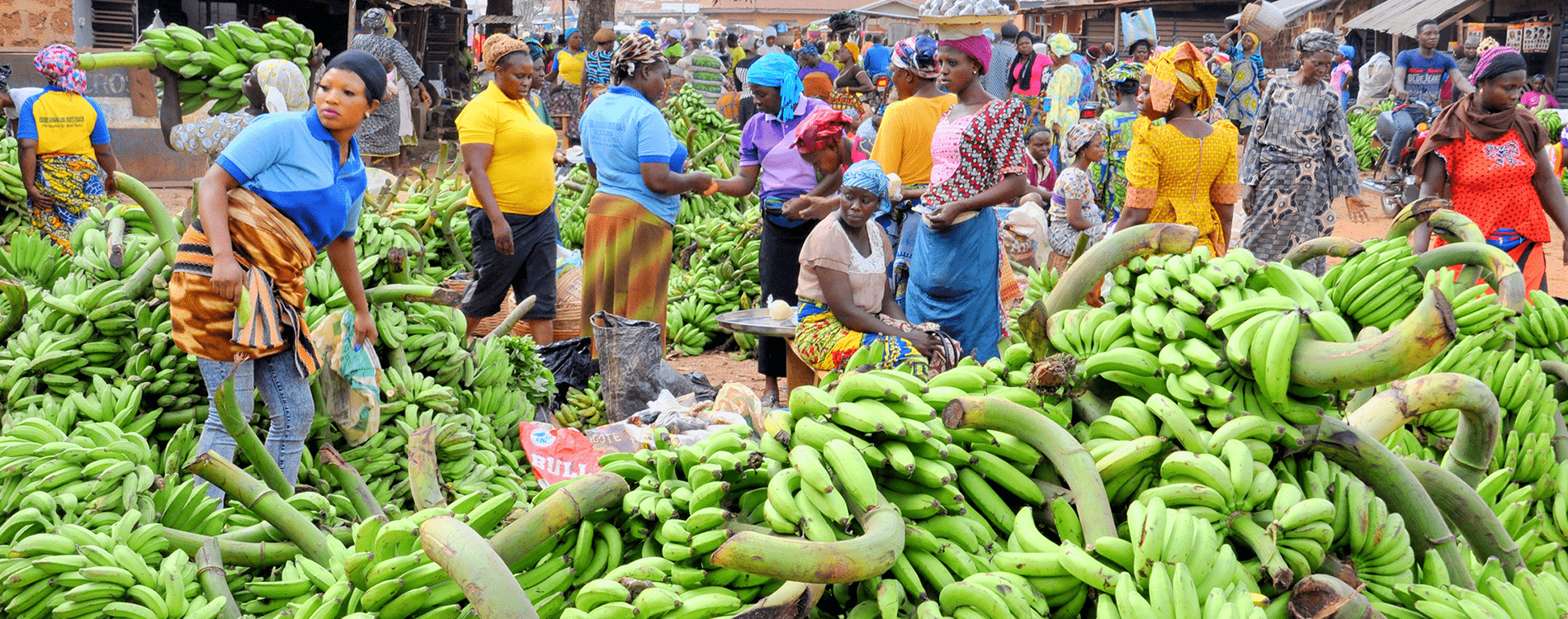
  • Women and girls play a crucial role in ensuring the sustainability of rural households and communities.
  • Women produce up to 80% of foodstuffs for household consumption and sale in local markets.
  • Over 60% of all employed women in sub-Saharan Africa work in agriculture.
  • Women account for a substantial proportion of the agricultural labor force, including informal work, and perform the bulk of unpaid care and domestic work within families and households in rural areas.
  • They contribute to agricultural production, food security and nutrition, land and natural resource management, and building climate resilience.
IITA board member Rhoda Tumusiime and Steven Cole, an IITA senior scientist and Gender Research Coordinator, authored an opinion editorial titled Gendering Agriculture, so Women Take the Lead in Feeding Africa. They call upon Africa to reflect more on the role women play in food and nutrition security and land and water management. Among other measures, Tumusiime and Cole recommend designing gender-responsive actions that can strengthen women’s ability to provide food for their families and broader communities. IITA, through its gender research strategy, aims to bring an end to gender-blind agriculture research and policies. “Women farmers are disadvantaged by a range of factors, such as laws, policies, gender-blind development programs, and entrenched norms and power imbalances within and outside their homes and communities,” Tumusiime and Cole state. Women and girls in rural areas suffer disproportionately from multidimensional poverty. While extreme poverty has declined globally, the world’s 1 billion people who continue to live in unacceptable conditions of poverty are mostly in rural areas. Poverty rates in rural areas across most regions are higher than those in urban areas. Yet smallholder agriculture produces nearly 80% of food in Asia and sub-Saharan Africa and supports the livelihoods of some 2.5 billion people. Women farmers are as productive and enterprising as their male counterparts but cannot access land, credit, agricultural inputs, markets, and high-value, agrifood chains and obtain lower prices for their crops. Gender-accommodative policies confirm that gender constraints exist and can propose ways to work around them for the benefit of women. To promote women agripreneurship and gender-responsive policies, IITA, with funding from the International Fund for Agricultural Development (IFAD), launched 80 research fellowships for young African scholars under a project called Enhancing Capacity to Apply Research (CARE). CARE focuses on young female professionals and students acquiring a master’s or doctoral degree. Grantees are offered training on research methodology, data management, scientific writing, and the production of research evidence for policymaking. It is a three-year project, which aims to build an understanding of poverty reduction, employment impact, and factors influencing youth engagement in agribusiness and rural farm and non-farm economies. For example, in southern Benin, graduate student Grace Chabi looked at why young agricultural entrepreneurs are predominately male. Among her policy recommendations is a call to remove gender biases from land ownership, credit, and employment practices. Policies should also facilitate female agripreneurship networks and target funding to agribusinesses owned by women. IITA’s gender-transformative approach addresses the root causes of gender inequalities to sustain meaningful change for female and male youth in agriculture. Rural women are already feeding the world. We all need to join hands and improve their capacity to produce more efficiently. This requires gender-accommodative policies and research, alleviating the care burden and sharing it between men and women, and access to credit, land, and new technologies. But today, we shine the light on the rural woman and celebrate her.

Contributed by

Related news

No items found

Leave a Reply

Your email address will not be published. Required fields are marked *

Scroll to Top
Olaosebikan, Olamide

Olamide Deborah Nwanze is a Senior Research Associate specializing in gender mainstreaming research to inform participatory and inclusive breeding, variety development, and seed systems policies regarding root, tuber, and banana (RTB) crops in the International Institute of Tropical Agriculture Headquarters, Ibadan, Nigeria. She is a PhD candidate at the University of Ibadan and holds an MSc and B. Agric in Agricultural Extension and Rural Development. Olamide is a fellow of the African Women in Agricultural Research and Development – Gender Responsive Agricultural Systems Policy (AWARD-GRASP) and the Gender Responsive Researchers Equipped for Agricultural Transformation (GREAT). She seeks to apply her gender-mainstreaming learnings, gender-responsive research, and policy development, and review expertise to facilitate women, youth, children, and vulnerable social group’s access to and adoption of agricultural Innovations that guarantee food, nutrition, income, and livelihood security in Africa. Her current roles include mentoring research fellows, development of guides and training manuals, implementation and adaptation of gender frameworks and tools, value chain actors’ engagement as citizen science partners, policy review and redesign, data management, and analysis. Her current research explores mixed methods and participatory and interdisciplinary approaches to capture and highlight gender dynamics, needs, preferences, and challenges stakeholders face within the agricultural livelihood value chain to prioritize gender-inclusive strategies in breeding programs, policy design, and implementation.

At IITA, she contributes to the implementation of the CGIAR Accelerated Breeding Initiative and Genetic Innovation Programs; participatory and gender research within the NextGen CassavaHarvestPlusRTBFoods, and Tricot-ClimMob 1000Farms Projects; and gender knowledge communication via the G-LENS webinar series, video documentary, policy briefspublications, and blogs.


Recent publications

de Sousa, K., van Etten, J., Manners, R. Bello, A., Teeken, B., Olaosebikan, O., et al. 2024. The tricot approach: an agile framework for decentralized on-farm testing supported by citizen science. A retrospective. Agron. Sustain. Dev. 44, 8. https://doi.org/10.1007/s13593-023-00937-1

Madu, T., Onwuka, S., Nwafor, S., Onyemauwa, N., Ejechi, M., Ofoeze, M., Ukeje, B., Eluagu, C., Olaosebikan, O., Okoye, B., 2024. Gender-Inclusive Consumer Studies Improve Cassava Breeding in Nigeria in: Frontiers in Sociology, volume 9, number: 1224504, doi: 10.3389/fsoc.2024.1224504

Olaosebikan, O.; Bello, A.; Utoblo, O.; Okoye, B.; Olutegbe, N.; Garner, E.; Teeken, B.; Bryan, E.; Forsythe, L.; Cole, S.; Madu, T. 2023.  Stressors and Resilience within the Cassava Value Chain in Nigeria: Preferred Cassava Variety Traits and Response Strategies of Men and Women to Inform Breeding. Sustainability 15, 7837. https://doi.org/10.3390/su15107837

Okoye, B., Ofoeze, M., Ejechi, M., Onwuka, S., Nwafor, S., Onyemauwa, N., Ukeje, B., Eluagu, C., Obidiegwu, J.*, Olaosebikan, O., Madu, T.* 2023. Prioritizing preferred traits in the yam value chain in Nigeria: a gender situation analysis in: Frontiers in Sociology, volume 8, number: 1232626, pages 1 – 9, ISSN 2297-7775, 2023. https://www.frontiersin.org/articles/10.3389/fsoc.2023.1232626/full

Olaosebikan, O., Bello, A. A., de Sousa, K., Ndjouenkeu, R., Adesokan, M., Alamu, E. O., Agbona, A., van Etten, J., Kegah, F. N.*, Dufour, D., Bouniol, A., Teeken, B. 2023. Consumer acceptability of cassava gari-eba food products across cultural and environmental settings using the triadic comparison of technologies approach (tricot) in: Journal of the Science of Food and Agriculture,

Teeken, B., Olaosebikan, O., Bello, A. A., Madu, T.*, Cole, S. M. 2023. Qualitative assessment on the positionality and preferences of dyads in relation to cassava-related activities: working with tricot trial citizen scientists https://hdl.handle.net/10568/138326 Type: Manual

Bouniol, A., Ceballos, H., Bello, A. A., Teeken, B., Olaosebikan, O., Owoade, D., Agbona, A., Fotso Kuate, A., Madu, T.*, Okoye, B.*, Ofoeze, M.*, Nwafor, S.*, Onyemauwa, N.*, Adinsi, L.*, Forsythe, L., Dufour, D. 2023. Varietal impact on women’s labour, workload and related drudgery in processing root, tuber and banana crops: focus on cassava in sub-Saharan Africa in: Journal of the Science of Food and Agriculture, pages 1 – 25, ISSN 0022-5142,

Bello, A. A., Agbona, A., Olaosebikan, O., Edughaen, G., Dufour, D., Bouniol, A., Iluebbey, P., Ndjouenkeu, R.*, Rabbi, I. Y., Teeken, B. 2023. Genetic and environmental effects on processing productivity and food product yield: drudgery of women’s work in: Journal of the Science of Food and Agriculture, pages 1 – 32, ISSN 0022-5142, 5

Cavicchioli, M., Zimbiti, T., Teeken, B., Nwanze, D.O., Liani, M., Parkes, E. & Bello, A. 2023. IITA-Gender Responsive Breeding Training Report. Genetic Resources Center, IITA-HQ, Ibadan, 21-23 September, 2022. Ibadan, Nigeria: IITA, (34 p.).https://hdl.handle.net/10568/131368

Agbona, A. Peteti P., Teeken B., Olaosebikan O. Bello, A. A., Parkes, E., Rabbi, I. Y., Mueller, L., Egesi, C., Kulakow, P. 2022. Data Management in Multi-disciplinary African RTB Crop Breeding Programs. In: Williamson, H.F., Leonelli, S. (eds) Towards Responsible Plant Data Linkage: Data Challenges for Agricultural Research and Development. Springer, Cham. https://doi.org/10.1007/978-3-031-13276-6_5

Lora Forsythe, Pricilla Marimo, Sarah Mayanja, Olamide D. Olaosebikan, Esme Stuart, Bela Teeken, Benjamin Okoye, Tessy Madu, (2021). Cross-product Gender Analysis of RTBfoods Step 2 Gendered Food Mapping on RTB Products. Understanding the Drivers of Trait Preferences and the Development of Multi-user RTB Product Profiles, WP1. London, UK: RTBfoods Field Scientific Report, 30 p.

Teeken, B., Garner, E., Agbona, A., Balogun, I., Olaosebikan, O., Bello, A., Madu, T., Okoye, B., Egesi, C., Kulakow, P. and Tufan, H.A. 2021. Beyond “Women’s Traits”: Exploring How Gender, Social Difference, and Household Characteristics Influence Trait Preferences. Frontiers Sustainable Food Systems 5:740926. https://doi.org/10.3389/fsufs.2021.740926

Teeken, B., Agbona, A., Bello, A., Olaosebikan, O., Alamu, E., Adesokan, M., Awoyale, W., Madu, T., Okoye, B., Chijioke, U., Owoade, D., Okoro, M., Bouniol, A., Dufour, D., Hershey, C., Rabbi, I., Maziya‐Dixon, B., Egesi, C., Tufan, H. and Kulakow, P. (020. Understanding cassava varietal preferences through pairwise ranking of gari‐eba and fufu prepared by local farmer–processors. Int J Food Sci Technol. https://doi.org/10.1111/ijfs.14862

Bela Teeken, Olamide Olaosebikan, Ireti Balogun, Benjamin Okoye, Tessy Madu, Steven Cole, Abolore Bello, Elizabeth Parkes. (2020). Piloting the G+ customer and product profile tools for gender-responsive cassava breeding in Nigeria. Nigeria: International Institute of Tropical Agriculture (IITA). https://hdl.handle.net/20.500.11766/13000