
Top Tanzanian officials seek ONE-CGIAR collaboration on scaling research technologies
June 13, 2020
The Permanent Secretary (PS) at the Tanzania Prime Minister’s Office (PMO), Ms Dorothy Mwaluko, has identified the scaling up of innovative technologies from research to farmers as a major challenge to the growth of the agriculture sector in the country and therefore a priority area of collaboration with ONE CGIAR.
The PS noted that farmers in the country continue to use traditional farming practices, which are also not profitable. As a result, they remain poor, and the growth of the country’s agriculture sector remains slow.
The PS said this while speaking to a delegation from CGIAR-IITA and the Alliance of Bioversity and CIAT (ABC). The team paid a courtesy call to present on ONE CGIAR and its activities in Tanzania, along with the successes and challenges.
The team also gave a presentation on how ONE CGIAR can assist the country in its efforts to address some of the challenges posed by COVID-19 to the country’s agriculture sector and food and nutrition security.
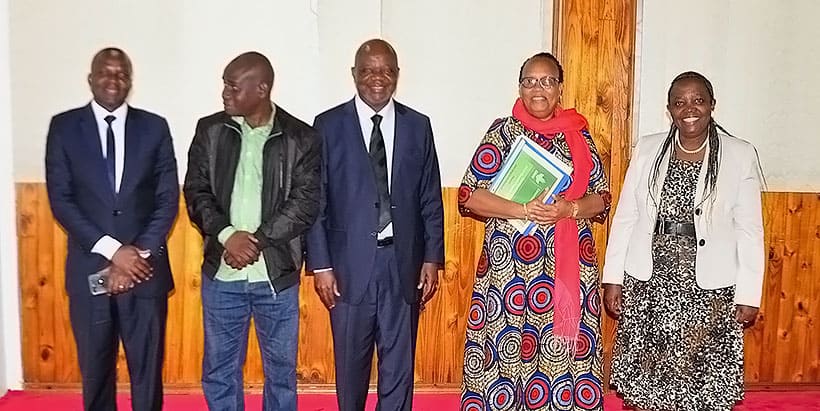 IITA-Eastern Africa Hub Director Victor Manyong led the team, which comprised IITA’s Head of Resource Mobilization and Uganda Country Representative, Regina Kapinga and the Regional Communication Officer for Eastern Africa, Catherine Njuguna. ABC was represented by Mr Fadhili Kasubiti, a Seed Development Specialist based at Tanzania Agriculture Research Institute (TARI)-Selian, in Arusha.
The PS was assisted by the Head of Resource Mobilization of the country’s Agriculture Sector Development Program (ASDP2), Mr Zakaria Muyengi. ASDP2 is the country’s blueprint for developing the agriculture sector, contributing to the country’s overall economic development, and is based in the PM’s Office.
The PS said more conversations were needed to explore further how her office and CGIAR centers can work together to contribute to the ASDP2, particularly in the scaling of technologies from research.
On his part, Manyong thanked the PS for the opportunity to share on ONE CGIAR with its 15 centers, 10 of which are active in Tanzania with many ready-to-go technologies for scaling to smallholder farmers in the country.
IITA-Eastern Africa Hub Director Victor Manyong led the team, which comprised IITA’s Head of Resource Mobilization and Uganda Country Representative, Regina Kapinga and the Regional Communication Officer for Eastern Africa, Catherine Njuguna. ABC was represented by Mr Fadhili Kasubiti, a Seed Development Specialist based at Tanzania Agriculture Research Institute (TARI)-Selian, in Arusha.
The PS was assisted by the Head of Resource Mobilization of the country’s Agriculture Sector Development Program (ASDP2), Mr Zakaria Muyengi. ASDP2 is the country’s blueprint for developing the agriculture sector, contributing to the country’s overall economic development, and is based in the PM’s Office.
The PS said more conversations were needed to explore further how her office and CGIAR centers can work together to contribute to the ASDP2, particularly in the scaling of technologies from research.
On his part, Manyong thanked the PS for the opportunity to share on ONE CGIAR with its 15 centers, 10 of which are active in Tanzania with many ready-to-go technologies for scaling to smallholder farmers in the country.
IITA-Eastern Africa Hub Director Victor Manyong led the team, which comprised IITA’s Head of Resource Mobilization and Uganda Country Representative, Regina Kapinga and the Regional Communication Officer for Eastern Africa, Catherine Njuguna. ABC was represented by Mr Fadhili Kasubiti, a Seed Development Specialist based at Tanzania Agriculture Research Institute (TARI)-Selian, in Arusha.
The PS was assisted by the Head of Resource Mobilization of the country’s Agriculture Sector Development Program (ASDP2), Mr Zakaria Muyengi. ASDP2 is the country’s blueprint for developing the agriculture sector, contributing to the country’s overall economic development, and is based in the PM’s Office.
The PS said more conversations were needed to explore further how her office and CGIAR centers can work together to contribute to the ASDP2, particularly in the scaling of technologies from research.
On his part, Manyong thanked the PS for the opportunity to share on ONE CGIAR with its 15 centers, 10 of which are active in Tanzania with many ready-to-go technologies for scaling to smallholder farmers in the country.
One CGIAR impact in Tanzania
Regina Kapinga made the presentation highlighting ONE CGIAR and the activities of the various centers in Tanzania. She said all CGIAR centers were keen to ensure they were aligned to government priorities in all the countries they were working. She said ONE CGIAR contributes to five impact areas which are related to the United Nations’ 2030 Sustainable Development Goals (SDGs). These are on poverty reduction, nutrition and food security, gender equality, climate adaptation, and environmental health. All these were also priorities in the ASDP2. She further explained all CGIAR centers in Tanzania are hosted through an MoU with TARI, the Tanzania Livestock Research Institute (TALIRI), the Tanzania Forestry Research Institute (TAFORI), or the relevant research body. They were now seeking collaboration with PMO which coordinates ASDP2. Kapinga also highlighted some of the achievements of ONE CGIAR in Tanzania including the development and release of improved varieties of essential staple crops with new, positive traits such as vitamin A-rich orange maize, orange flesh sweet potato, drought-tolerant maize, and iron-rich beans. Others are the development of the Tanzania livestock masterplan, the commercialization of the beans value chain, fertilizer trees, development and scaling of Aflasafe technology to keep foods safe from the poisonous aflatoxin, the Tanzania youth agripreneur program for youth job creation , and various policy studies.Way forward
As a follow-up, the party agreed to have further meetings. The CGIAR delegation also met the whole ASDP2 team led by its national coordinator Dr Salim Nandone. Manyong also invited the PS and the ASDP2 team to the IITA offices in Dar es Salaam, Tanzania, to continue the discussions and to meet other CGIAR centers hosted at IITA, including CIP, ICRISAT, ILRI, IRRI, and ICRAF. The PS accepted the invitation.Contributed by
Recent stories
No items found