
IITA NEWS

Unprecedented stopover of national symbol, Uhuru torch, highlights IITA’s accomplishments in Tanzania
June 2, 2023

IITA Tanzania management team was privileged to host the national Uhuru torch for the first time on 27 May at its Youth Incubation Center in Kwembe, Dar es Salaam.

The Uhuru torch has been a national symbol of freedom and hope since 1961.

The Uhuru torch is a national symbol in Tanzania depicting freedom, equality, integrity, respect for human dignity, peace, hope, and strengthening union between mainland Tanzania and Zanzibar. The lighting of the Uhuru torch was made on National Independence Day on 9 December 1961 by the first president Mwl Julius Nyerere and later taken to the top of Mount Kilimanjaro as a symbol of national illumination. The Uhuru torch aimed to enlighten and awaken the sense of nationalism, to illuminate the nation by saying “no” to poverty, inequality, illiteracy, diseases, ethnicity, and racialism. Since then, the torch has been carried through the country every year from March to October, passing through all districts to enhance development activities. To underscore its importance, the government budgets the cost for the nationwide run under the president’s office, which also appoints the torch-running team and its leaders.

The Uhuru torch rally leading official, Abdalla Shaibu Kaimu, was happy after witnessing the efforts undertaken by IITA in nurturing and empowering youths, particularly in imparting them with knowledge and skills on agribusiness.
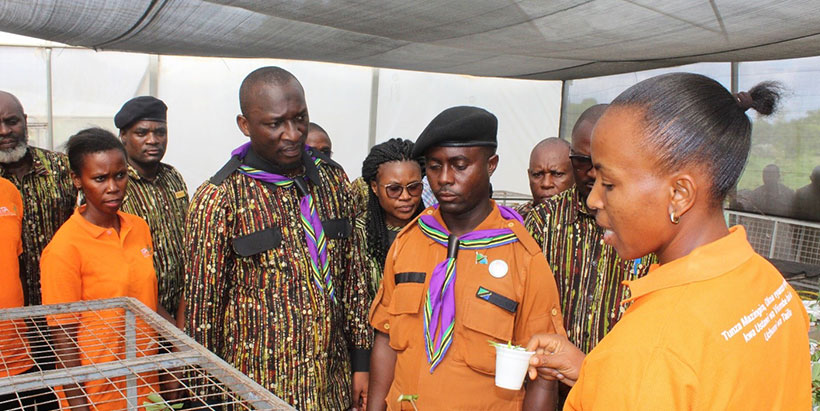
 IITA research assistant Edda Mushi (right) speaking with guests about a new cassava propagation technology (the petiole bud). Photo: IITA/Hadi
IITA research assistant Edda Mushi (right) speaking with guests about a new cassava propagation technology (the petiole bud). Photo: IITA/Hadi

“The Uhuru Torch Race has visited this project, and we sincerely acknowledge the remarkable work accomplished by IITA. We are deeply grateful for their efforts in fostering the development of youths by equipping them with diverse skills, including understanding the importance of improved seeds and other agricultural aspects that enhance their agribusiness activities. Uhuru torch commends you for your outstanding contributions to this endeavor,” Kaimu noted.

On behalf of IITA management, IITA Youth Coordinator Veronica Kebwe noted that the Institute commenced the youth program to empower youth aged 18-35 to participate actively in agribusiness. Through the program, youth receive comprehensive training on various opportunities within agriculture value chains, including production, processing, and marketing, to address the unemployment challenges facing many youths globally.

“This program is significant within IITA and is designed to engage postgraduate students and youths with limited educational backgrounds. Our core activities involve providing theoretical and practical training to youth in value chains of cassava, maize, sorghum, poultry, fish, and vegetable farming,” Kebwe noted.

“Additionally, we empower youth by allocating areas within our center for their agribusiness pursuits. We also link them with financial institutions through the district council to get loans,” Kebwe added.

Baraka Nicholous, a beneficiary from the IITA Kwembe Center, engaged in worm production, requested the government’s continued support to enable the Institute to succeed in the youth empowerment initiatives.

Participants walking around to inspect various projects in IITA Youth Incubation Center. Photo: IITA/Hadi

“Thanks to the training and support provided by IITA, we have made significant progress. Currently, we can produce poultry feed and have established a good link with our customers, but we also managed to provide education to the community. This visit from the Uhuru torch rally brings enormous significance, providing us with a valuable opportunity to promote our center and attract more youth,” Nicholous noted.

Chairperson of the Iloyi Youth Group, Leonia Sahani, noted that their group received entrepreneurship training from IITA in 2021, enabling them to create jobs.

“Previously, we had been producing bread and biscuits using wheat flour. However, our encounter with IITA opened up new possibilities as we acquired knowledge and skills in utilizing cassava flour for value addition. We successfully produce various types of cakes, including small cakes, wedding cakes, and birthday cakes, using cassava flour as an ingredient. This has made our products different, earning us more income,” Sahani noted.

 Contributed by Hadi Rashidi


Contributed by

Recent stories

No items found

Leave a Reply

Your email address will not be published. Required fields are marked *

Scroll to Top
Olaosebikan, Olamide

Olamide Deborah Nwanze is a Senior Research Associate specializing in gender mainstreaming research to inform participatory and inclusive breeding, variety development, and seed systems policies regarding root, tuber, and banana (RTB) crops in the International Institute of Tropical Agriculture Headquarters, Ibadan, Nigeria. She is a PhD candidate at the University of Ibadan and holds an MSc and B. Agric in Agricultural Extension and Rural Development. Olamide is a fellow of the African Women in Agricultural Research and Development – Gender Responsive Agricultural Systems Policy (AWARD-GRASP) and the Gender Responsive Researchers Equipped for Agricultural Transformation (GREAT). She seeks to apply her gender-mainstreaming learnings, gender-responsive research, and policy development, and review expertise to facilitate women, youth, children, and vulnerable social group’s access to and adoption of agricultural Innovations that guarantee food, nutrition, income, and livelihood security in Africa. Her current roles include mentoring research fellows, development of guides and training manuals, implementation and adaptation of gender frameworks and tools, value chain actors’ engagement as citizen science partners, policy review and redesign, data management, and analysis. Her current research explores mixed methods and participatory and interdisciplinary approaches to capture and highlight gender dynamics, needs, preferences, and challenges stakeholders face within the agricultural livelihood value chain to prioritize gender-inclusive strategies in breeding programs, policy design, and implementation.

At IITA, she contributes to the implementation of the CGIAR Accelerated Breeding Initiative and Genetic Innovation Programs; participatory and gender research within the NextGen CassavaHarvestPlusRTBFoods, and Tricot-ClimMob 1000Farms Projects; and gender knowledge communication via the G-LENS webinar series, video documentary, policy briefspublications, and blogs.


Recent publications

de Sousa, K., van Etten, J., Manners, R. Bello, A., Teeken, B., Olaosebikan, O., et al. 2024. The tricot approach: an agile framework for decentralized on-farm testing supported by citizen science. A retrospective. Agron. Sustain. Dev. 44, 8. https://doi.org/10.1007/s13593-023-00937-1

Madu, T., Onwuka, S., Nwafor, S., Onyemauwa, N., Ejechi, M., Ofoeze, M., Ukeje, B., Eluagu, C., Olaosebikan, O., Okoye, B., 2024. Gender-Inclusive Consumer Studies Improve Cassava Breeding in Nigeria in: Frontiers in Sociology, volume 9, number: 1224504, doi: 10.3389/fsoc.2024.1224504

Olaosebikan, O.; Bello, A.; Utoblo, O.; Okoye, B.; Olutegbe, N.; Garner, E.; Teeken, B.; Bryan, E.; Forsythe, L.; Cole, S.; Madu, T. 2023.  Stressors and Resilience within the Cassava Value Chain in Nigeria: Preferred Cassava Variety Traits and Response Strategies of Men and Women to Inform Breeding. Sustainability 15, 7837. https://doi.org/10.3390/su15107837

Okoye, B., Ofoeze, M., Ejechi, M., Onwuka, S., Nwafor, S., Onyemauwa, N., Ukeje, B., Eluagu, C., Obidiegwu, J.*, Olaosebikan, O., Madu, T.* 2023. Prioritizing preferred traits in the yam value chain in Nigeria: a gender situation analysis in: Frontiers in Sociology, volume 8, number: 1232626, pages 1 – 9, ISSN 2297-7775, 2023. https://www.frontiersin.org/articles/10.3389/fsoc.2023.1232626/full

Olaosebikan, O., Bello, A. A., de Sousa, K., Ndjouenkeu, R., Adesokan, M., Alamu, E. O., Agbona, A., van Etten, J., Kegah, F. N.*, Dufour, D., Bouniol, A., Teeken, B. 2023. Consumer acceptability of cassava gari-eba food products across cultural and environmental settings using the triadic comparison of technologies approach (tricot) in: Journal of the Science of Food and Agriculture,

Teeken, B., Olaosebikan, O., Bello, A. A., Madu, T.*, Cole, S. M. 2023. Qualitative assessment on the positionality and preferences of dyads in relation to cassava-related activities: working with tricot trial citizen scientists https://hdl.handle.net/10568/138326 Type: Manual

Bouniol, A., Ceballos, H., Bello, A. A., Teeken, B., Olaosebikan, O., Owoade, D., Agbona, A., Fotso Kuate, A., Madu, T.*, Okoye, B.*, Ofoeze, M.*, Nwafor, S.*, Onyemauwa, N.*, Adinsi, L.*, Forsythe, L., Dufour, D. 2023. Varietal impact on women’s labour, workload and related drudgery in processing root, tuber and banana crops: focus on cassava in sub-Saharan Africa in: Journal of the Science of Food and Agriculture, pages 1 – 25, ISSN 0022-5142,

Bello, A. A., Agbona, A., Olaosebikan, O., Edughaen, G., Dufour, D., Bouniol, A., Iluebbey, P., Ndjouenkeu, R.*, Rabbi, I. Y., Teeken, B. 2023. Genetic and environmental effects on processing productivity and food product yield: drudgery of women’s work in: Journal of the Science of Food and Agriculture, pages 1 – 32, ISSN 0022-5142, 5

Cavicchioli, M., Zimbiti, T., Teeken, B., Nwanze, D.O., Liani, M., Parkes, E. & Bello, A. 2023. IITA-Gender Responsive Breeding Training Report. Genetic Resources Center, IITA-HQ, Ibadan, 21-23 September, 2022. Ibadan, Nigeria: IITA, (34 p.).https://hdl.handle.net/10568/131368

Agbona, A. Peteti P., Teeken B., Olaosebikan O. Bello, A. A., Parkes, E., Rabbi, I. Y., Mueller, L., Egesi, C., Kulakow, P. 2022. Data Management in Multi-disciplinary African RTB Crop Breeding Programs. In: Williamson, H.F., Leonelli, S. (eds) Towards Responsible Plant Data Linkage: Data Challenges for Agricultural Research and Development. Springer, Cham. https://doi.org/10.1007/978-3-031-13276-6_5

Lora Forsythe, Pricilla Marimo, Sarah Mayanja, Olamide D. Olaosebikan, Esme Stuart, Bela Teeken, Benjamin Okoye, Tessy Madu, (2021). Cross-product Gender Analysis of RTBfoods Step 2 Gendered Food Mapping on RTB Products. Understanding the Drivers of Trait Preferences and the Development of Multi-user RTB Product Profiles, WP1. London, UK: RTBfoods Field Scientific Report, 30 p.

Teeken, B., Garner, E., Agbona, A., Balogun, I., Olaosebikan, O., Bello, A., Madu, T., Okoye, B., Egesi, C., Kulakow, P. and Tufan, H.A. 2021. Beyond “Women’s Traits”: Exploring How Gender, Social Difference, and Household Characteristics Influence Trait Preferences. Frontiers Sustainable Food Systems 5:740926. https://doi.org/10.3389/fsufs.2021.740926

Teeken, B., Agbona, A., Bello, A., Olaosebikan, O., Alamu, E., Adesokan, M., Awoyale, W., Madu, T., Okoye, B., Chijioke, U., Owoade, D., Okoro, M., Bouniol, A., Dufour, D., Hershey, C., Rabbi, I., Maziya‐Dixon, B., Egesi, C., Tufan, H. and Kulakow, P. (020. Understanding cassava varietal preferences through pairwise ranking of gari‐eba and fufu prepared by local farmer–processors. Int J Food Sci Technol. https://doi.org/10.1111/ijfs.14862

Bela Teeken, Olamide Olaosebikan, Ireti Balogun, Benjamin Okoye, Tessy Madu, Steven Cole, Abolore Bello, Elizabeth Parkes. (2020). Piloting the G+ customer and product profile tools for gender-responsive cassava breeding in Nigeria. Nigeria: International Institute of Tropical Agriculture (IITA). https://hdl.handle.net/20.500.11766/13000