
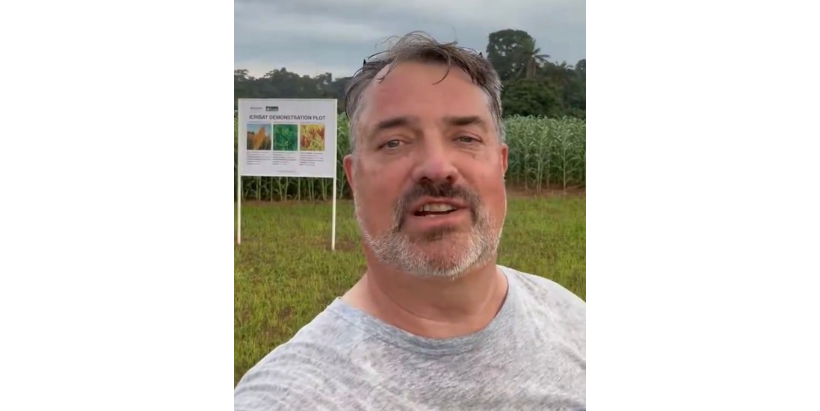
A young Canadian researcher once learned Hausa in northern Nigeria to breed better legumes. Nearly four decades later, Dr Stanford Blade returns to Ibadan to reflect on what truly lasts in agricultural science.
For Dr Stanford Blade, walking back into the research fields at IITA, the memories did not arrive gradually. They came all at once.
“I could still feel the sweat on my brow,” Blade recalled, thinking back to the heat, the dust, and the painstaking manual work of planting, harvesting, and taking field notes in the late 1980s.
Blade was in Ibadan to attend high-level leadership meetings for CGIAR. Today, he is Deputy Director General–Research and Innovation at ICRISAT (International Crops Research Institute for the Semi-Arid Tropics) in India. But his trajectory as an international agricultural scientist was forged right here on IITA’s soil.
His journey began in 1987, when he arrived as a Commonwealth scholar to conduct doctoral research in Africa. Under the mentorship of pioneering legume breeder Dr B.B. Singh, Blade plunged into the study of cowpea and traditional intercropping systems.
For the young scientist, it proved to be far more than an academic exercise. It was an education in how agricultural research works when scientists step out of the station and into the reality of smallholder farming.
Learning from the field and from farmers
Blade’s early work focused on selecting cowpea varieties that could thrive alongside staple cereals like millet and sorghum. After completing his PhD, he moved to Kano as an IITA postdoctoral scientist, running trials across West Africa, including Ghana, Niger, Burkina Faso, and Cameroon.
Northern Nigeria, in particular, reshaped how he thought about plant science.
Rather than making breeding decisions solely inside research stations under optimal, fertilized conditions, Blade and his team brought local farmers directly into the trial rows.
It was an early implementation of participatory plant breeding. Farmers were invited to evaluate experimental lines using their own criteria—prioritizing traits researchers might overlook, such as how easily pods could be harvested without shattering, cooking times, pest tolerance during storage, or the quality of leftover haulm used as vital livestock fodder during the dry season.
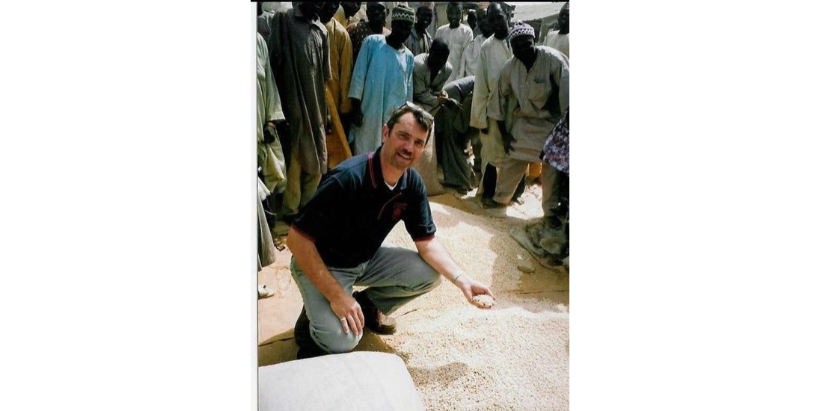
“The experience reinforced an essential truth: farmers are not merely end-users at the finish line of a pipeline. They are co-designers of agricultural solutions.”
“I like the interaction with farmers,” Dr Blade said simply.
That collaboration also required meeting farmers on their own terms. Dr Blade learned some Hausa so he could communicate more effectively with the local farmers he worked with in northern Nigeria.
The experience reinforced an essential truth: farmers possess generations of deep ecological and market knowledge that must shape what breeders develop.
For Dr Blade, that realization was also personal. He had grown up on a dairy farm in Alberta, Canada, and still considers himself a farmer’s son. While the Sahel and Sudan savannas were worlds away from the Canadian prairies, the fundamental instincts of the people working the land were identical.
“I learned a lot about the farming systems in West Africa,” he said. “Farming is farming—people want reliability, yield, and crops that feed their families and make economic sense.”
When cowpea research reaches the table
The most rewarding moment of Blade’s recent return to IITA was witnessing the long tail of that early fieldwork.
Decades after he and Bir Bahadur Singh tested hardy lines under the arid conditions of Kano, many of those selections are still thriving in farmers’ fields. Several were formally released through Nigeria’s national agricultural system under the SAMPEA (Samaru Pea) designation—a series of improved varieties that have cushioned millions of households against food insecurity and pest outbreaks.
For a plant scientist, seeing those seeds in open markets offers a profound measure of success.
“The value of the research was no longer confined to a journal paper, a trial plot, or a breeding ledger,” Dr Blade reflected. “It had moved into national systems and onto people’s tables. That makes you happy.”
This delayed payoff, Dr Blade notes, is what makes agricultural science unique. Plant breeding operates on generational timelines. A cross made by a young scientist in 1990 might only reach peak adoption in 2015. A field methodology established decades ago becomes the foundation upon which today’s genomic tools build.
A career anchored in community
Dr Blade’s ties to IITA deepened over the years.
After returning to Canada to work as a grain legume breeder, he was recruited back in 2003 to serve as IITA’s Deputy Director General for Research, steering the Institute’s continental scientific portfolio. Later, even while serving as Dean of the Faculty of Agricultural, Life and Environmental Sciences at the University of Alberta and sitting on international boards, he remained an active champion of African agricultural development.
Yet when Dr Blade walks the tree-lined paths of IITA’s Ibadan campus today, his fondest memories are not of boardrooms or administrative milestones, they are of the community.
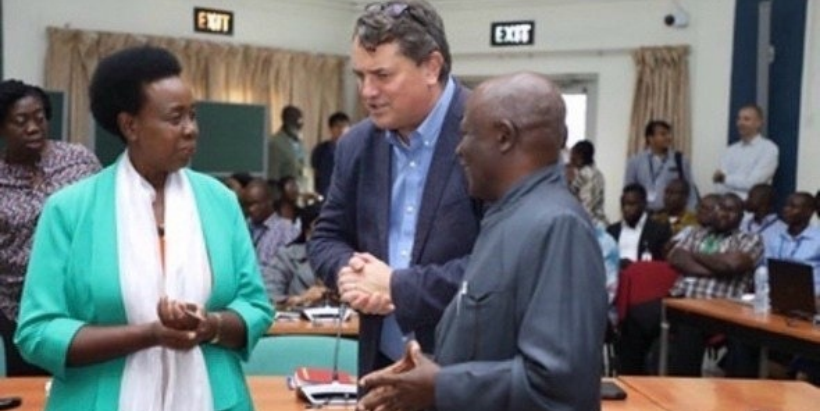
He remembers Friday family pizza nights, children of researchers from 20 different countries playing together, and the dedicated field technicians who kept trials running through unpredictable weather. During his visit, veteran staff members still stopped him on campus paths to ask after his wife and children.
He calls the feeling “happy nostalgia”—a reminder that world-class research institutes are ultimately held together by enduring human relationships.
Looking 50 years ahead
As IITA approaches 60 years of agricultural impact, Blade points out that the challenges confronting the next generation of researchers will look vastly different from the ones he encountered with a clipboard in 1987.
Climate volatility, rapid urbanization, changing dietary demands, and soil degradation require researchers to discard single-crop silos.
His advice to young scientists is to drastically widen their horizon:
“They will have a different mindset,” Dr Blade said. “They must be thinking not only about a 5-year project cycle, but 20 or 50 years into the future. They need to think about the whole food system—from genomics and climate resilience to post-harvest processing, nutrition, and market incentives.”
That long view brings Dr Blade’s own journey full circle.
He came to Nigeria as a young researcher focused on cowpea agronomy. The journey took him across West Africa, into institutional leadership, and eventually to the global stage. Yet the core philosophy governing his work never changed.
Nearly four decades after he first planted cowpea trials in the Nigerian heat, Dr Stanford Blade returned with a simple conviction: science only succeeds when it listens to the last mile users—smallholder farmers.
The scientists have changed. The institution has changed. The tools have changed.
But the fundamental question remains the same: Can science make a meaningful difference in the lives of the people who feed the world?
For Dr Blade, the answer will always be found in the field.