
Women’s achievements celebrated
March 10, 2019
The important role of women in agricultural production is a given, with research showing that women’s contribution to farm work is as high as between 60% and 90% of the total farm tasks performed.
Despite the dominant and important role women play in agricultural production, they are hardly given any attention in the area of training and awareness about improved technologies. This locks them in a vicious cycle of poverty that places them at a disadvantage in
terms of income and resource empowerment.
In working with beneficiaries in different countries, IITA intervenes to raise the stature and conditions of women through capacity building, exhibitions, practical demonstrations, and provision of various technologies, including planting materials. The interventions are all geared towards improving their standard of living and building their capacities to contribute to economic development. These have also equipped them with knowledge on financial management and increased their level of productivity.
The International Women’s Day is an annual global event held every year on 8 March that aims to celebrate achievements of women across nations while campaigning for greater progress towards gender equality. IITA used the opportunity to highlight some of the impact and successes recorded while working with these amazing women. IITA’s research and development efforts have benefited many women. The institute is at the forefront of empowering women to ‘have a voice’ and to take part in making decisions about their and their families’ lives.
 The Improved Seeds for Better Agriculture (SEMEAR) project, which aims to reach 100,000 households, 35% of them women, had been providing training, attracting more than 3,677 farmers and extension agents (2,237 men and 1,440 women). Within a short period, SEMEAR has made a difference in the lives of its beneficiaries.
Due to SEMEAR’s interventions, Cecilia João, a cowpea farmer has increased her cowpea yields five times; and in a couple of years, her life took a turn for the better. With one child and another on the way, Cecilia considers the IITA/ SEMEAR project as a blessing. “This project has made me feel proud to be a farmer because being one truly represents food for my own children,” Cecilia professes. “An empty sack cannot stand upright,” she adds, referring to the importance of having sufficient food.
In South Kivu, DRC, women’s opportunities to gain skills in enterprise development and participate in formal savings opportunities are severely limited due to high rates of gender-based violence (GBV). An IITA project tried to understand and improve women’s financial capabilities in the community. It supports women and girls in eastern DRC in their fight against violence, poverty, and inequality. Through this initiative, they facilitate access to microfinance services for women who have experienced GBV; increase women’s ability in the household and support collective action mechanisms to increase solidarity and improve savings activities, of which 26 women from two villages benefited. The outcome of the project showed that training of both men and women using financial capabilities approaches has supported significant changes and improvements in women’s ability to make important finance-related decisions in the household.
Since 2014, IITA has been implementing the integrated approach to improve the nutrition status of women and children, through nutrition-sensitive agriculture in Eastern Luapula, and Northern Province of Zambia. The project, supported by Scaling-up Nutrition (SUN), aims to enhance the nutrition and health status of 12,000 children under 2 years and 3,000 pregnant women in poor smallholder farming communities in the targeted province. The project conducted training on the production of nutrient-dense crops, best agronomic practices, cooking methods, diet diversification and basic nutrition. About 95% of those surveyed perceived that the training sessions particularly assisted the pregnant women to grow different types of nutritious crops, contributing to the reduction of stunting among their children.
Another impact made by IITA on women empowerment was the awareness training for members and the spouses of the cassava community processing centers (CCPCs) to improve the gender equity and nutrition in the Democratic Republic of Congo (DRC). More than 165 individuals, 100 of whom were women, participated and benefited. The training demonstrated the need to intensify and address gender within agricultural projects to achieve better outcomes for production and wider development outcomes. This has led to a better understanding about how IITA and its partners can incorporate gender transformative approaches that significantly change gender relations and improve the plight of women.
All these impacts and many others have helped to support gender equality and women empowerment, as they are key to attaining positive development and accelerating economic growth.
The Improved Seeds for Better Agriculture (SEMEAR) project, which aims to reach 100,000 households, 35% of them women, had been providing training, attracting more than 3,677 farmers and extension agents (2,237 men and 1,440 women). Within a short period, SEMEAR has made a difference in the lives of its beneficiaries.
Due to SEMEAR’s interventions, Cecilia João, a cowpea farmer has increased her cowpea yields five times; and in a couple of years, her life took a turn for the better. With one child and another on the way, Cecilia considers the IITA/ SEMEAR project as a blessing. “This project has made me feel proud to be a farmer because being one truly represents food for my own children,” Cecilia professes. “An empty sack cannot stand upright,” she adds, referring to the importance of having sufficient food.
In South Kivu, DRC, women’s opportunities to gain skills in enterprise development and participate in formal savings opportunities are severely limited due to high rates of gender-based violence (GBV). An IITA project tried to understand and improve women’s financial capabilities in the community. It supports women and girls in eastern DRC in their fight against violence, poverty, and inequality. Through this initiative, they facilitate access to microfinance services for women who have experienced GBV; increase women’s ability in the household and support collective action mechanisms to increase solidarity and improve savings activities, of which 26 women from two villages benefited. The outcome of the project showed that training of both men and women using financial capabilities approaches has supported significant changes and improvements in women’s ability to make important finance-related decisions in the household.
Since 2014, IITA has been implementing the integrated approach to improve the nutrition status of women and children, through nutrition-sensitive agriculture in Eastern Luapula, and Northern Province of Zambia. The project, supported by Scaling-up Nutrition (SUN), aims to enhance the nutrition and health status of 12,000 children under 2 years and 3,000 pregnant women in poor smallholder farming communities in the targeted province. The project conducted training on the production of nutrient-dense crops, best agronomic practices, cooking methods, diet diversification and basic nutrition. About 95% of those surveyed perceived that the training sessions particularly assisted the pregnant women to grow different types of nutritious crops, contributing to the reduction of stunting among their children.
Another impact made by IITA on women empowerment was the awareness training for members and the spouses of the cassava community processing centers (CCPCs) to improve the gender equity and nutrition in the Democratic Republic of Congo (DRC). More than 165 individuals, 100 of whom were women, participated and benefited. The training demonstrated the need to intensify and address gender within agricultural projects to achieve better outcomes for production and wider development outcomes. This has led to a better understanding about how IITA and its partners can incorporate gender transformative approaches that significantly change gender relations and improve the plight of women.
All these impacts and many others have helped to support gender equality and women empowerment, as they are key to attaining positive development and accelerating economic growth.
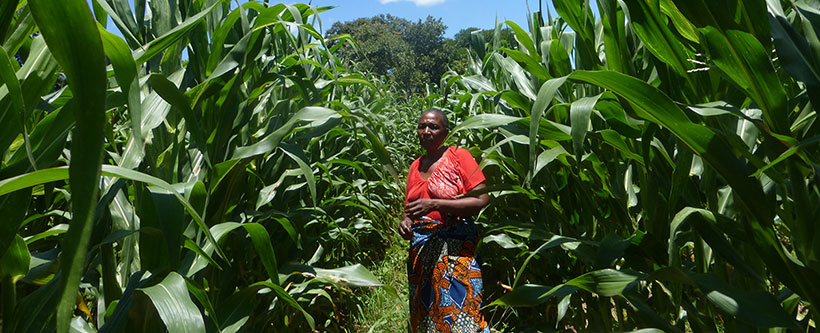
SUN project participant in her maize field.
Contributed by
Recent stories
No items found