
IITA NEWS

World Migratory Bird Day 2022: Dimming the lights for birds at night
May 13, 2022

Every year, people work together on global awareness campaigns for the safety and conservation of migratory birds. Through the United Nations (UN) World Migratory Bird Day (WMBD) observance celebrated on the second Saturdays in May and October, bird-lovers commit to preserving bird habitats and support efforts to boost their survival. The theme for this year, centered around Light Pollution, aims to call everyone’s attention to the effects of increasing artificial lights on migratory birds, calling us to “Dim the Lights for Birds at Night!”
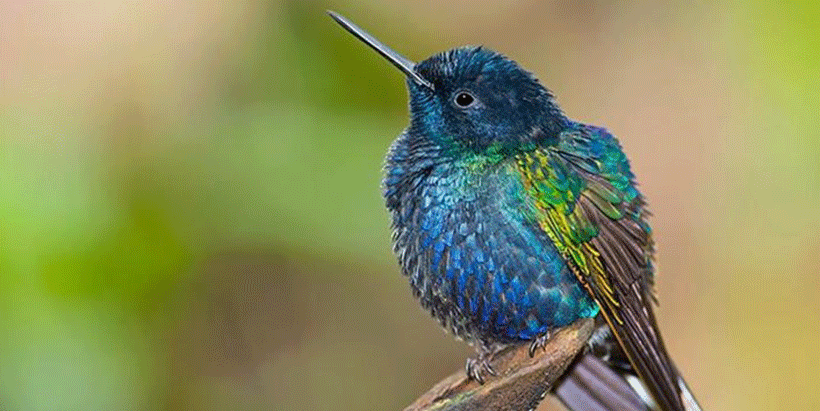
The hummingbird is the smallest migrating bird, flying up to 600 miles nonstop

We leave lights on for our security and illumination. However, industrial and residential lights shimmering from mega-cities at night pose a significant threat to migratory birds. Migrating birds prepare themselves for long travel away from their homes during winter to warmer regions where food and shelter abound. They prepare themselves for the long flight by storing body fat as fuel for the journey.

About 4,000 bird species migrate across continents; some travel as far as 16,000 miles. The smallest migrating bird, the hummingbird, weighs an average of 1/8 ounce and travels as fast as 30 miles per hour, flying up to 600 miles nonstop. The bluethroat thrush could leave African winter quarters at dusk and reach Heligoland at dawn.
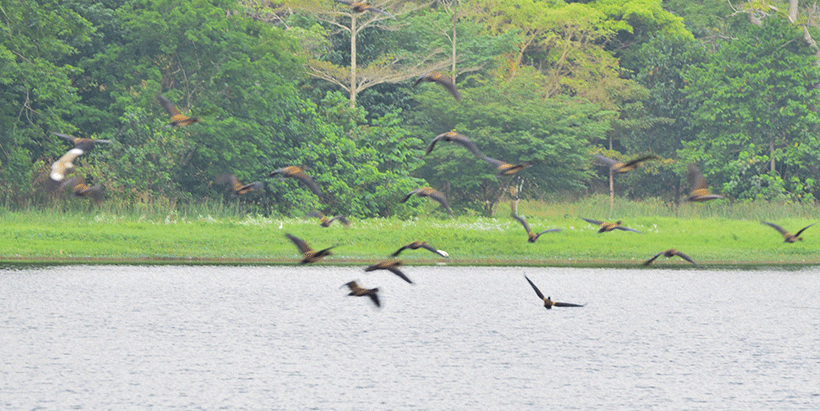
World Migratory Bird Day (WMBD) is observed on the second Saturdays in May and October.

Migratory birds could take off from areas perfectly safe and dark and travel through industrial cities with enormous bright lights. The brightness often disorients birds when they fly at night, causing collisions with buildings, perturbed internal clocks, and decreased ability to make long-distance travels.

Many birds migrate at night when the air is cooler, away from the visible glare of many predators. Our artificial lights should not pose further threats to these migratory creatures who contribute their quota to the planet’s eco-biological stability.

Let’s join hands to dim the lights for the traveling birds making their night journeys. This will contribute to keeping the birds safe through their migratory seasons!!!

Contributed by Folake Oduntan


Contributed by

Related news

No items found

Leave a Reply

Your email address will not be published. Required fields are marked *

Scroll to Top
Olaosebikan, Olamide

Olamide Deborah Nwanze is a Senior Research Associate specializing in gender mainstreaming research to inform participatory and inclusive breeding, variety development, and seed systems policies regarding root, tuber, and banana (RTB) crops in the International Institute of Tropical Agriculture Headquarters, Ibadan, Nigeria. She is a PhD candidate at the University of Ibadan and holds an MSc and B. Agric in Agricultural Extension and Rural Development. Olamide is a fellow of the African Women in Agricultural Research and Development – Gender Responsive Agricultural Systems Policy (AWARD-GRASP) and the Gender Responsive Researchers Equipped for Agricultural Transformation (GREAT). She seeks to apply her gender-mainstreaming learnings, gender-responsive research, and policy development, and review expertise to facilitate women, youth, children, and vulnerable social group’s access to and adoption of agricultural Innovations that guarantee food, nutrition, income, and livelihood security in Africa. Her current roles include mentoring research fellows, development of guides and training manuals, implementation and adaptation of gender frameworks and tools, value chain actors’ engagement as citizen science partners, policy review and redesign, data management, and analysis. Her current research explores mixed methods and participatory and interdisciplinary approaches to capture and highlight gender dynamics, needs, preferences, and challenges stakeholders face within the agricultural livelihood value chain to prioritize gender-inclusive strategies in breeding programs, policy design, and implementation.

At IITA, she contributes to the implementation of the CGIAR Accelerated Breeding Initiative and Genetic Innovation Programs; participatory and gender research within the NextGen CassavaHarvestPlusRTBFoods, and Tricot-ClimMob 1000Farms Projects; and gender knowledge communication via the G-LENS webinar series, video documentary, policy briefspublications, and blogs.


Recent publications

de Sousa, K., van Etten, J., Manners, R. Bello, A., Teeken, B., Olaosebikan, O., et al. 2024. The tricot approach: an agile framework for decentralized on-farm testing supported by citizen science. A retrospective. Agron. Sustain. Dev. 44, 8. https://doi.org/10.1007/s13593-023-00937-1

Madu, T., Onwuka, S., Nwafor, S., Onyemauwa, N., Ejechi, M., Ofoeze, M., Ukeje, B., Eluagu, C., Olaosebikan, O., Okoye, B., 2024. Gender-Inclusive Consumer Studies Improve Cassava Breeding in Nigeria in: Frontiers in Sociology, volume 9, number: 1224504, doi: 10.3389/fsoc.2024.1224504

Olaosebikan, O.; Bello, A.; Utoblo, O.; Okoye, B.; Olutegbe, N.; Garner, E.; Teeken, B.; Bryan, E.; Forsythe, L.; Cole, S.; Madu, T. 2023.  Stressors and Resilience within the Cassava Value Chain in Nigeria: Preferred Cassava Variety Traits and Response Strategies of Men and Women to Inform Breeding. Sustainability 15, 7837. https://doi.org/10.3390/su15107837

Okoye, B., Ofoeze, M., Ejechi, M., Onwuka, S., Nwafor, S., Onyemauwa, N., Ukeje, B., Eluagu, C., Obidiegwu, J.*, Olaosebikan, O., Madu, T.* 2023. Prioritizing preferred traits in the yam value chain in Nigeria: a gender situation analysis in: Frontiers in Sociology, volume 8, number: 1232626, pages 1 – 9, ISSN 2297-7775, 2023. https://www.frontiersin.org/articles/10.3389/fsoc.2023.1232626/full

Olaosebikan, O., Bello, A. A., de Sousa, K., Ndjouenkeu, R., Adesokan, M., Alamu, E. O., Agbona, A., van Etten, J., Kegah, F. N.*, Dufour, D., Bouniol, A., Teeken, B. 2023. Consumer acceptability of cassava gari-eba food products across cultural and environmental settings using the triadic comparison of technologies approach (tricot) in: Journal of the Science of Food and Agriculture,

Teeken, B., Olaosebikan, O., Bello, A. A., Madu, T.*, Cole, S. M. 2023. Qualitative assessment on the positionality and preferences of dyads in relation to cassava-related activities: working with tricot trial citizen scientists https://hdl.handle.net/10568/138326 Type: Manual

Bouniol, A., Ceballos, H., Bello, A. A., Teeken, B., Olaosebikan, O., Owoade, D., Agbona, A., Fotso Kuate, A., Madu, T.*, Okoye, B.*, Ofoeze, M.*, Nwafor, S.*, Onyemauwa, N.*, Adinsi, L.*, Forsythe, L., Dufour, D. 2023. Varietal impact on women’s labour, workload and related drudgery in processing root, tuber and banana crops: focus on cassava in sub-Saharan Africa in: Journal of the Science of Food and Agriculture, pages 1 – 25, ISSN 0022-5142,

Bello, A. A., Agbona, A., Olaosebikan, O., Edughaen, G., Dufour, D., Bouniol, A., Iluebbey, P., Ndjouenkeu, R.*, Rabbi, I. Y., Teeken, B. 2023. Genetic and environmental effects on processing productivity and food product yield: drudgery of women’s work in: Journal of the Science of Food and Agriculture, pages 1 – 32, ISSN 0022-5142, 5

Cavicchioli, M., Zimbiti, T., Teeken, B., Nwanze, D.O., Liani, M., Parkes, E. & Bello, A. 2023. IITA-Gender Responsive Breeding Training Report. Genetic Resources Center, IITA-HQ, Ibadan, 21-23 September, 2022. Ibadan, Nigeria: IITA, (34 p.).https://hdl.handle.net/10568/131368

Agbona, A. Peteti P., Teeken B., Olaosebikan O. Bello, A. A., Parkes, E., Rabbi, I. Y., Mueller, L., Egesi, C., Kulakow, P. 2022. Data Management in Multi-disciplinary African RTB Crop Breeding Programs. In: Williamson, H.F., Leonelli, S. (eds) Towards Responsible Plant Data Linkage: Data Challenges for Agricultural Research and Development. Springer, Cham. https://doi.org/10.1007/978-3-031-13276-6_5

Lora Forsythe, Pricilla Marimo, Sarah Mayanja, Olamide D. Olaosebikan, Esme Stuart, Bela Teeken, Benjamin Okoye, Tessy Madu, (2021). Cross-product Gender Analysis of RTBfoods Step 2 Gendered Food Mapping on RTB Products. Understanding the Drivers of Trait Preferences and the Development of Multi-user RTB Product Profiles, WP1. London, UK: RTBfoods Field Scientific Report, 30 p.

Teeken, B., Garner, E., Agbona, A., Balogun, I., Olaosebikan, O., Bello, A., Madu, T., Okoye, B., Egesi, C., Kulakow, P. and Tufan, H.A. 2021. Beyond “Women’s Traits”: Exploring How Gender, Social Difference, and Household Characteristics Influence Trait Preferences. Frontiers Sustainable Food Systems 5:740926. https://doi.org/10.3389/fsufs.2021.740926

Teeken, B., Agbona, A., Bello, A., Olaosebikan, O., Alamu, E., Adesokan, M., Awoyale, W., Madu, T., Okoye, B., Chijioke, U., Owoade, D., Okoro, M., Bouniol, A., Dufour, D., Hershey, C., Rabbi, I., Maziya‐Dixon, B., Egesi, C., Tufan, H. and Kulakow, P. (020. Understanding cassava varietal preferences through pairwise ranking of gari‐eba and fufu prepared by local farmer–processors. Int J Food Sci Technol. https://doi.org/10.1111/ijfs.14862

Bela Teeken, Olamide Olaosebikan, Ireti Balogun, Benjamin Okoye, Tessy Madu, Steven Cole, Abolore Bello, Elizabeth Parkes. (2020). Piloting the G+ customer and product profile tools for gender-responsive cassava breeding in Nigeria. Nigeria: International Institute of Tropical Agriculture (IITA). https://hdl.handle.net/20.500.11766/13000