
IITA NEWS

Tapping Africa’s ‘green gold’ for food and livelihoods
October 1, 2009

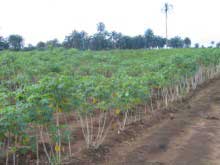
A cassava farm in Tanzania.

Jonathan Shenyagwa had high hopes when he planted 80 acres of cassava last year on his farm in Ml andizi in the Coast Region, 60km from Dar es Salaam, Tanzania’s capital.

“I harvested and took part of my cassava crop to the nearest processing centre to be made into cassava flour. They charged me Tsh600 per kilogramme (about half a dollar) and the market price was Tsh380 a kilo! It was a total loss,” he says.

“I did not harvest the rest of my crop to avoid even more losses.”

Many farmers like Shenyagwa, who are attempting to gain more from the crop than just food, are frustrated because of the lack of awareness on the potential of cassava.

Building farmers’ capacities and confidence

Shenyagwa is taking part in a set of three h ands-on training sessions on cassava processing, packaging, and labelling for markets, and business planning for entrepreneurs. The activity is taking place from September 28 to October 9, in Tanzania.
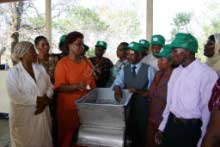
Dr Bussie Dixon demonstrates how to use a simple mechanical grater to make high quality cassava flour and starch. The grated cassava is then pressed, dried and milled to make the flour

The training is being held as part of capacity-building activities of IITA’s “Unleashing the Power of the Cassava in Africa (UPoCA)” project, which is funded by USAID. The project was initiated in response to the global food crisis last year.

The training introduces new ways of processing and using cassava such as the production of starch, high quality flour and new food recipes for rural and urban populations and the creation of income generation opportunities.

Dr Bussie Maziya-Dixon, IITA food scientist based in Nigeria, says that “Cassava flour can be used to make cakes, doughnuts, bread, biscuits and other products, either on its own or mixed with wheat, saving developing countries precious foreign exchange by reducing importation of wheat, while creating income alternatives for poor farmer households.” Dixon is also one of the training resource persons.

Project implementers believe that the cultivation of cassava – traditionally regarded as a poor man’s crop – could go a long way in enhancing the food security and nutrition of millions in Africa.

Additionally, cassava could also help boost the economies of sub-Saharan countries being a source of much-needed foreign exchange from the export of value-added derived products such as high quality flour, dried chips and starch for industrial use.

A poor man’s crop? No, green gold!

According to Dr Braima James, the UPoCA project manager based in Sierra Leone, the crop that has in most of the countries been associated with poverty and subsistence farming, has great potential for creating wealth and driving rural development.
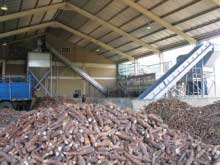
Mounds of cassava waiting to be processed at a glucose syrup factory in Nigeria.

James, who is heading the training team in Tanzania, adds that the aim is to promote cassava production and utilisation to fuel economic growth especially in the rural areas.

“The tuberous cassava roots are not only daily staples for over 200 million people in sub-Saharan Africa, but are also rich in starch that can be extracted for use in making other food products, textile, paper, cosmetics and pharmaceuticals.

Cassava and its derivatives are also used to make glucose syrup, adhesives, ethanol and alcohol, livestock feed and biodiesel fuel,” he adds.

James says cassava, ironically, is referred to as a poor man’s crop because of its diverse uses and unique characteristics. It is a hardy crop that does well during times of drought and in poor soils, and requires little inputs such as fertiliser. The whole plant is useful from the leaves, and stems to the roots.

“I do not know what is wrong with us in Africa. We are just sitting on our ‘green gold’,” says Dixon.

“It is about time we stopped thinking of cassava as a poor man’s crop and promoted it to its rightful place as a foreign exchange earner alongside coffee, tea and cotton,” she emphasizes.

Processing, health and yield concerns

Dr Adebayo Abass, IITA food scientist based in Dar es Salaam, says that processing the bulky, perishable crop is an obstacle to its full commercialisation in sub-Saharan Africa.

He adds that as cassava roots start rotting within 48 hours, they must be processed into a more stable form immediately after harvest, which is labour-intensive.
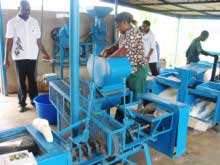
Mechanized processing technology would help motivate farmers, especially women, to cultivate and use more of the crop for value-added products.

“To motivate farmers, especially the women who are the main processors of food in the village, to grow and process their cassava, we need to provide them with labour-saving implements such as graters, peelers, and crushers. We also need to link them to markets.”

Abass also cautions that cassava for human consumption has to be processed extremely well due to the high level of cyanide in some varieties.

“When a person is exposed to high levels of cyanide over a long period, he or she becomes susceptible to diseases such as goiter and Konzo. The risk is even higher for those with poor nutrition. Women and children are particularly vulnerable,” he says. “The cyanide levels are particularly high during drought, so extra care should be taken when processing cassava.”

Prolonged exposure to cyanide in cassava also stunts children’s growth.

Low yield is another bane of cassava production in Africa. According to Dr James, general production levels in the continent are sub-par.

“On-farm yields are mostly below 10 t/ha, compared to 25-40 t/ha in Asia and South America and on experimental farms.”

“To address this, UPoCA is also providing farmers with improved cassava varieties to increase production, while equipping them with the knowledge and skills on related enterprises that help mop up expected gluts in production and reduce post-harvest losses,” he says.

He calls upon the governments of cassava-producing countries in Africa to fast-track appropriate agricultural policies to spur the food security and poverty reduction potential of cassava.

Not giving up

Shenyagwa has not given up hope on his cassava. In fact, with the UPoCA training, he is now more determined to exploit the benefits from the crop after learning new ways of processing commercially-viable food products.

He hopes to use the knowledge from the training to set up a processing plant on his farm using equipment he had received from the University of Dar es Salaam.

He also says he will share his knowledge and skills with his neighbours to motivate them to grow and process cassava.

“If Tanzania could made good use of cassava, it would no longer be a poor country.”

###

For more information, please contact:

Dr Braima James, b.james@cgiar.org
UPoCA Project Manager
IITA – Sierra Leone

Catherine Njuguna, c.njuguna@cgiar.org
Regional Corporate Communications Officer (East Africa)
IITA – Tanzania

Jeffrey T Oliver, o.jeffrey@cgiar.org
Corporate Communications Officer (International)

Communication Office
IITA-Headquarters
Ibadan, Nigeria

URL: www.iita.org

About IITA
Africa has complex problems that plague agriculture and people’s lives. We develop agricultural solutions with our partners to tackle hunger and poverty. Our award winning research for development (R4D) is based on focused, authoritative thinking anchored on the development needs of sub-Saharan Africa. We work with partners in Africa and beyond to reduce producer and consumer risks, enhance crop quality and productivity, and generate wealth from agriculture. IITA is an international non-profit R4D organization founded in 1967, governed by a Board of Trustees, and supported primarily by the CGIAR.


Contributed by

Recent stories

No items found

Leave a Reply

Your email address will not be published. Required fields are marked *

Scroll to Top
Olaosebikan, Olamide

Olamide Deborah Nwanze is a Senior Research Associate specializing in gender mainstreaming research to inform participatory and inclusive breeding, variety development, and seed systems policies regarding root, tuber, and banana (RTB) crops in the International Institute of Tropical Agriculture Headquarters, Ibadan, Nigeria. She is a PhD candidate at the University of Ibadan and holds an MSc and B. Agric in Agricultural Extension and Rural Development. Olamide is a fellow of the African Women in Agricultural Research and Development – Gender Responsive Agricultural Systems Policy (AWARD-GRASP) and the Gender Responsive Researchers Equipped for Agricultural Transformation (GREAT). She seeks to apply her gender-mainstreaming learnings, gender-responsive research, and policy development, and review expertise to facilitate women, youth, children, and vulnerable social group’s access to and adoption of agricultural Innovations that guarantee food, nutrition, income, and livelihood security in Africa. Her current roles include mentoring research fellows, development of guides and training manuals, implementation and adaptation of gender frameworks and tools, value chain actors’ engagement as citizen science partners, policy review and redesign, data management, and analysis. Her current research explores mixed methods and participatory and interdisciplinary approaches to capture and highlight gender dynamics, needs, preferences, and challenges stakeholders face within the agricultural livelihood value chain to prioritize gender-inclusive strategies in breeding programs, policy design, and implementation.

At IITA, she contributes to the implementation of the CGIAR Accelerated Breeding Initiative and Genetic Innovation Programs; participatory and gender research within the NextGen CassavaHarvestPlusRTBFoods, and Tricot-ClimMob 1000Farms Projects; and gender knowledge communication via the G-LENS webinar series, video documentary, policy briefspublications, and blogs.


Recent publications

de Sousa, K., van Etten, J., Manners, R. Bello, A., Teeken, B., Olaosebikan, O., et al. 2024. The tricot approach: an agile framework for decentralized on-farm testing supported by citizen science. A retrospective. Agron. Sustain. Dev. 44, 8. https://doi.org/10.1007/s13593-023-00937-1

Madu, T., Onwuka, S., Nwafor, S., Onyemauwa, N., Ejechi, M., Ofoeze, M., Ukeje, B., Eluagu, C., Olaosebikan, O., Okoye, B., 2024. Gender-Inclusive Consumer Studies Improve Cassava Breeding in Nigeria in: Frontiers in Sociology, volume 9, number: 1224504, doi: 10.3389/fsoc.2024.1224504

Olaosebikan, O.; Bello, A.; Utoblo, O.; Okoye, B.; Olutegbe, N.; Garner, E.; Teeken, B.; Bryan, E.; Forsythe, L.; Cole, S.; Madu, T. 2023.  Stressors and Resilience within the Cassava Value Chain in Nigeria: Preferred Cassava Variety Traits and Response Strategies of Men and Women to Inform Breeding. Sustainability 15, 7837. https://doi.org/10.3390/su15107837

Okoye, B., Ofoeze, M., Ejechi, M., Onwuka, S., Nwafor, S., Onyemauwa, N., Ukeje, B., Eluagu, C., Obidiegwu, J.*, Olaosebikan, O., Madu, T.* 2023. Prioritizing preferred traits in the yam value chain in Nigeria: a gender situation analysis in: Frontiers in Sociology, volume 8, number: 1232626, pages 1 – 9, ISSN 2297-7775, 2023. https://www.frontiersin.org/articles/10.3389/fsoc.2023.1232626/full

Olaosebikan, O., Bello, A. A., de Sousa, K., Ndjouenkeu, R., Adesokan, M., Alamu, E. O., Agbona, A., van Etten, J., Kegah, F. N.*, Dufour, D., Bouniol, A., Teeken, B. 2023. Consumer acceptability of cassava gari-eba food products across cultural and environmental settings using the triadic comparison of technologies approach (tricot) in: Journal of the Science of Food and Agriculture,

Teeken, B., Olaosebikan, O., Bello, A. A., Madu, T.*, Cole, S. M. 2023. Qualitative assessment on the positionality and preferences of dyads in relation to cassava-related activities: working with tricot trial citizen scientists https://hdl.handle.net/10568/138326 Type: Manual

Bouniol, A., Ceballos, H., Bello, A. A., Teeken, B., Olaosebikan, O., Owoade, D., Agbona, A., Fotso Kuate, A., Madu, T.*, Okoye, B.*, Ofoeze, M.*, Nwafor, S.*, Onyemauwa, N.*, Adinsi, L.*, Forsythe, L., Dufour, D. 2023. Varietal impact on women’s labour, workload and related drudgery in processing root, tuber and banana crops: focus on cassava in sub-Saharan Africa in: Journal of the Science of Food and Agriculture, pages 1 – 25, ISSN 0022-5142,

Bello, A. A., Agbona, A., Olaosebikan, O., Edughaen, G., Dufour, D., Bouniol, A., Iluebbey, P., Ndjouenkeu, R.*, Rabbi, I. Y., Teeken, B. 2023. Genetic and environmental effects on processing productivity and food product yield: drudgery of women’s work in: Journal of the Science of Food and Agriculture, pages 1 – 32, ISSN 0022-5142, 5

Cavicchioli, M., Zimbiti, T., Teeken, B., Nwanze, D.O., Liani, M., Parkes, E. & Bello, A. 2023. IITA-Gender Responsive Breeding Training Report. Genetic Resources Center, IITA-HQ, Ibadan, 21-23 September, 2022. Ibadan, Nigeria: IITA, (34 p.).https://hdl.handle.net/10568/131368

Agbona, A. Peteti P., Teeken B., Olaosebikan O. Bello, A. A., Parkes, E., Rabbi, I. Y., Mueller, L., Egesi, C., Kulakow, P. 2022. Data Management in Multi-disciplinary African RTB Crop Breeding Programs. In: Williamson, H.F., Leonelli, S. (eds) Towards Responsible Plant Data Linkage: Data Challenges for Agricultural Research and Development. Springer, Cham. https://doi.org/10.1007/978-3-031-13276-6_5

Lora Forsythe, Pricilla Marimo, Sarah Mayanja, Olamide D. Olaosebikan, Esme Stuart, Bela Teeken, Benjamin Okoye, Tessy Madu, (2021). Cross-product Gender Analysis of RTBfoods Step 2 Gendered Food Mapping on RTB Products. Understanding the Drivers of Trait Preferences and the Development of Multi-user RTB Product Profiles, WP1. London, UK: RTBfoods Field Scientific Report, 30 p.

Teeken, B., Garner, E., Agbona, A., Balogun, I., Olaosebikan, O., Bello, A., Madu, T., Okoye, B., Egesi, C., Kulakow, P. and Tufan, H.A. 2021. Beyond “Women’s Traits”: Exploring How Gender, Social Difference, and Household Characteristics Influence Trait Preferences. Frontiers Sustainable Food Systems 5:740926. https://doi.org/10.3389/fsufs.2021.740926

Teeken, B., Agbona, A., Bello, A., Olaosebikan, O., Alamu, E., Adesokan, M., Awoyale, W., Madu, T., Okoye, B., Chijioke, U., Owoade, D., Okoro, M., Bouniol, A., Dufour, D., Hershey, C., Rabbi, I., Maziya‐Dixon, B., Egesi, C., Tufan, H. and Kulakow, P. (020. Understanding cassava varietal preferences through pairwise ranking of gari‐eba and fufu prepared by local farmer–processors. Int J Food Sci Technol. https://doi.org/10.1111/ijfs.14862

Bela Teeken, Olamide Olaosebikan, Ireti Balogun, Benjamin Okoye, Tessy Madu, Steven Cole, Abolore Bello, Elizabeth Parkes. (2020). Piloting the G+ customer and product profile tools for gender-responsive cassava breeding in Nigeria. Nigeria: International Institute of Tropical Agriculture (IITA). https://hdl.handle.net/20.500.11766/13000