
NEWS

How crop innovation is addressing the impact of the climate crisis in Africa
February 21, 2021

In a just-published op-ed, Martin Kropff, Director General, International Maize and Wheat Improvement Center (CIMMYT) and Nteranya Sanginga, Director General, International Institute of Tropical Agriculture (IITA), talk about CGIAR centers’ investment on long-term breeding to increase genetic gains in an important food crop like maize using many new tools and technologies.

In the op-ed, Kropff and Sanginga make the case for increasing investments in crop improvement and seed systems innovation to cope with the climate variability crisis in sub-Saharan Africa. They said “It is not enough to lower carbon emissions. African farmers need to adapt quickly to rising temperatures, drawn-out droughts and sharp, devastating floods. With higher-yielding, multiple stress tolerant maize varieties, smallholder farmers have the opportunity to not only combat climatic variabilities, diseases and pests, but can also effectively diversify their farms. This will enable them in turn to have better adaptation to the changing climates and access to well-balanced and affordable diets.”
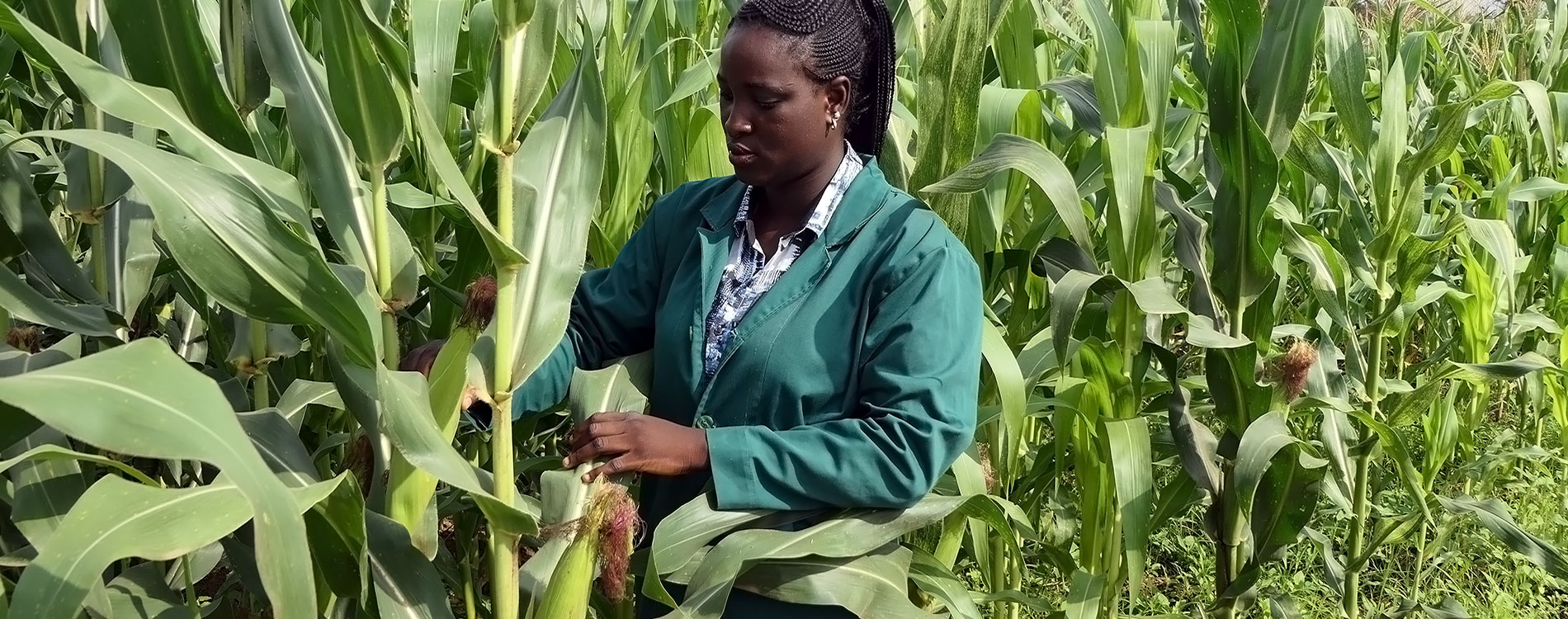
CGIAR has been leading technological innovation and deployment to transform food systems for many decades. CIMMYT and IITA are the two CGIAR research centers undertaking innovative maize research and development work in the stress-prone environments of Africa.

CIMMYT and IITA have spearheaded the successful development of improved climate-adaptive maize varieties for sub-Saharan Africa implemented through joint projects such as the Drought Tolerant Maize for Africa (DTMA) and Stress Tolerant Maize for Africa (STMA) in partnership with diverse national and private sector partners in the major maize-producing countries in Eastern, Southern, and West Africa.

Under the 10-year DTMA initiative started in 2007, about 160 affordable and scalable maize varieties have been released. High-yielding, multiple stress-tolerant, maize varieties using CIMMYT/IITA maize germplasm released after 2007 are estimated to be grown on 5 million hectares in 2020 in sub-Saharan Africa, benefiting over 8.6 million smallholder farmers in 13 countries across sub-Saharan Africa, where 176 million people depend on maize for nutrition and economic well-being.

The adoption of drought-tolerant (DT) maize varieties has helped lift millions of people above the poverty line across the continent. This innovation was mentioned by Bill Gates in his new book launched this week: How to Avoid a Climate Disaster: The Solutions We Have and the Breakthroughs We Need. Bill Gates had singled out CGIAR as being “at the forefront of supporting the world to feed itself through research including developing improved higher-yielding varieties of important staples such as maize and rice.”

Besides climate-adaptive improved maize varieties, both CIMMYT and IITA have developed maize varieties biofortified with provitamin A; vitamin A deficiency is highly prevalent in populations across sub-Saharan Africa. These biofortified maize varieties, developed in partnership with HarvestPlus, are being deployed in targeted countries in sub-Saharan Africa in partnership with national programs and seed company partners.

Knopff and Sanginga also thanked the Bill & Melinda Gates Foundation for its generous support for the long-running research. They said that “Bill Gates, who recognizes the essential role of CGIAR in ‘feeding our future’, also acknowledges that current levels of investment do not even amount to half of what is needed.”

They therefore called for faster deployment of scientific innovations in food, land, and water systems, at a larger scale, and at reduced cost, having greater impact where they are needed the most.

The authors also emphasized that “Investments in maize breeding and seed system innovations must expand to keep up with the capacity to withstand climate variability in sub-Saharan Africa, the world’s most chronically undernourished region, and provide food and nutritional security to millions of maize-dependent and resource-constrained smallholders and consumers,” emphasizing that “as climate change intensifies, so should agricultural innovations. It is time for a ‘business unusual’ approach.”

CGIAR is celebrating the 50th anniversary of its founding this year, and has unveiled its roadmap for a new 10-year strategy at the online 2021 Climate Adaptation Summit in January.

The new sustainable research strategy puts climate change at the heart of its mission, with an emphasis on the realignment of food systems worldwide, targeting five impact areas: nutrition, poverty, inclusivity, climate adaptation and mitigation, and environmental health.

Through food system transformation, resilient agri-food systems, and genetic innovations CGIAR’s ambition is to meet and go beyond the Sustainable Development Goals (SDGs). UN Secretary-General Antonio Guterres has called for a concerted global effort to radically realign food systems to achieve the 17 SDGs by 2030.

Read the full op-ed here: Successful Crop Innovation Is Mitigating Climate Crisis Impact in Africa | Inter Press Service (ipsnews.net)


Contributed by

Recent stories

No items found

Leave a Reply

Your email address will not be published. Required fields are marked *

Scroll to Top
Olaosebikan, Olamide

Olamide Deborah Nwanze is a Senior Research Associate specializing in gender mainstreaming research to inform participatory and inclusive breeding, variety development, and seed systems policies regarding root, tuber, and banana (RTB) crops in the International Institute of Tropical Agriculture Headquarters, Ibadan, Nigeria. She is a PhD candidate at the University of Ibadan and holds an MSc and B. Agric in Agricultural Extension and Rural Development. Olamide is a fellow of the African Women in Agricultural Research and Development – Gender Responsive Agricultural Systems Policy (AWARD-GRASP) and the Gender Responsive Researchers Equipped for Agricultural Transformation (GREAT). She seeks to apply her gender-mainstreaming learnings, gender-responsive research, and policy development, and review expertise to facilitate women, youth, children, and vulnerable social group’s access to and adoption of agricultural Innovations that guarantee food, nutrition, income, and livelihood security in Africa. Her current roles include mentoring research fellows, development of guides and training manuals, implementation and adaptation of gender frameworks and tools, value chain actors’ engagement as citizen science partners, policy review and redesign, data management, and analysis. Her current research explores mixed methods and participatory and interdisciplinary approaches to capture and highlight gender dynamics, needs, preferences, and challenges stakeholders face within the agricultural livelihood value chain to prioritize gender-inclusive strategies in breeding programs, policy design, and implementation.

At IITA, she contributes to the implementation of the CGIAR Accelerated Breeding Initiative and Genetic Innovation Programs; participatory and gender research within the NextGen CassavaHarvestPlusRTBFoods, and Tricot-ClimMob 1000Farms Projects; and gender knowledge communication via the G-LENS webinar series, video documentary, policy briefspublications, and blogs.


Recent publications

de Sousa, K., van Etten, J., Manners, R. Bello, A., Teeken, B., Olaosebikan, O., et al. 2024. The tricot approach: an agile framework for decentralized on-farm testing supported by citizen science. A retrospective. Agron. Sustain. Dev. 44, 8. https://doi.org/10.1007/s13593-023-00937-1

Madu, T., Onwuka, S., Nwafor, S., Onyemauwa, N., Ejechi, M., Ofoeze, M., Ukeje, B., Eluagu, C., Olaosebikan, O., Okoye, B., 2024. Gender-Inclusive Consumer Studies Improve Cassava Breeding in Nigeria in: Frontiers in Sociology, volume 9, number: 1224504, doi: 10.3389/fsoc.2024.1224504

Olaosebikan, O.; Bello, A.; Utoblo, O.; Okoye, B.; Olutegbe, N.; Garner, E.; Teeken, B.; Bryan, E.; Forsythe, L.; Cole, S.; Madu, T. 2023.  Stressors and Resilience within the Cassava Value Chain in Nigeria: Preferred Cassava Variety Traits and Response Strategies of Men and Women to Inform Breeding. Sustainability 15, 7837. https://doi.org/10.3390/su15107837

Okoye, B., Ofoeze, M., Ejechi, M., Onwuka, S., Nwafor, S., Onyemauwa, N., Ukeje, B., Eluagu, C., Obidiegwu, J.*, Olaosebikan, O., Madu, T.* 2023. Prioritizing preferred traits in the yam value chain in Nigeria: a gender situation analysis in: Frontiers in Sociology, volume 8, number: 1232626, pages 1 – 9, ISSN 2297-7775, 2023. https://www.frontiersin.org/articles/10.3389/fsoc.2023.1232626/full

Olaosebikan, O., Bello, A. A., de Sousa, K., Ndjouenkeu, R., Adesokan, M., Alamu, E. O., Agbona, A., van Etten, J., Kegah, F. N.*, Dufour, D., Bouniol, A., Teeken, B. 2023. Consumer acceptability of cassava gari-eba food products across cultural and environmental settings using the triadic comparison of technologies approach (tricot) in: Journal of the Science of Food and Agriculture,

Teeken, B., Olaosebikan, O., Bello, A. A., Madu, T.*, Cole, S. M. 2023. Qualitative assessment on the positionality and preferences of dyads in relation to cassava-related activities: working with tricot trial citizen scientists https://hdl.handle.net/10568/138326 Type: Manual

Bouniol, A., Ceballos, H., Bello, A. A., Teeken, B., Olaosebikan, O., Owoade, D., Agbona, A., Fotso Kuate, A., Madu, T.*, Okoye, B.*, Ofoeze, M.*, Nwafor, S.*, Onyemauwa, N.*, Adinsi, L.*, Forsythe, L., Dufour, D. 2023. Varietal impact on women’s labour, workload and related drudgery in processing root, tuber and banana crops: focus on cassava in sub-Saharan Africa in: Journal of the Science of Food and Agriculture, pages 1 – 25, ISSN 0022-5142,

Bello, A. A., Agbona, A., Olaosebikan, O., Edughaen, G., Dufour, D., Bouniol, A., Iluebbey, P., Ndjouenkeu, R.*, Rabbi, I. Y., Teeken, B. 2023. Genetic and environmental effects on processing productivity and food product yield: drudgery of women’s work in: Journal of the Science of Food and Agriculture, pages 1 – 32, ISSN 0022-5142, 5

Cavicchioli, M., Zimbiti, T., Teeken, B., Nwanze, D.O., Liani, M., Parkes, E. & Bello, A. 2023. IITA-Gender Responsive Breeding Training Report. Genetic Resources Center, IITA-HQ, Ibadan, 21-23 September, 2022. Ibadan, Nigeria: IITA, (34 p.).https://hdl.handle.net/10568/131368

Agbona, A. Peteti P., Teeken B., Olaosebikan O. Bello, A. A., Parkes, E., Rabbi, I. Y., Mueller, L., Egesi, C., Kulakow, P. 2022. Data Management in Multi-disciplinary African RTB Crop Breeding Programs. In: Williamson, H.F., Leonelli, S. (eds) Towards Responsible Plant Data Linkage: Data Challenges for Agricultural Research and Development. Springer, Cham. https://doi.org/10.1007/978-3-031-13276-6_5

Lora Forsythe, Pricilla Marimo, Sarah Mayanja, Olamide D. Olaosebikan, Esme Stuart, Bela Teeken, Benjamin Okoye, Tessy Madu, (2021). Cross-product Gender Analysis of RTBfoods Step 2 Gendered Food Mapping on RTB Products. Understanding the Drivers of Trait Preferences and the Development of Multi-user RTB Product Profiles, WP1. London, UK: RTBfoods Field Scientific Report, 30 p.

Teeken, B., Garner, E., Agbona, A., Balogun, I., Olaosebikan, O., Bello, A., Madu, T., Okoye, B., Egesi, C., Kulakow, P. and Tufan, H.A. 2021. Beyond “Women’s Traits”: Exploring How Gender, Social Difference, and Household Characteristics Influence Trait Preferences. Frontiers Sustainable Food Systems 5:740926. https://doi.org/10.3389/fsufs.2021.740926

Teeken, B., Agbona, A., Bello, A., Olaosebikan, O., Alamu, E., Adesokan, M., Awoyale, W., Madu, T., Okoye, B., Chijioke, U., Owoade, D., Okoro, M., Bouniol, A., Dufour, D., Hershey, C., Rabbi, I., Maziya‐Dixon, B., Egesi, C., Tufan, H. and Kulakow, P. (020. Understanding cassava varietal preferences through pairwise ranking of gari‐eba and fufu prepared by local farmer–processors. Int J Food Sci Technol. https://doi.org/10.1111/ijfs.14862

Bela Teeken, Olamide Olaosebikan, Ireti Balogun, Benjamin Okoye, Tessy Madu, Steven Cole, Abolore Bello, Elizabeth Parkes. (2020). Piloting the G+ customer and product profile tools for gender-responsive cassava breeding in Nigeria. Nigeria: International Institute of Tropical Agriculture (IITA). https://hdl.handle.net/20.500.11766/13000