
RUNRES project to avail animal feed for farmers in Rwanda
November 2, 2020
The Rural-Urban Nexus, establishing a nutrient loop to improve city-region food system resilience (RUNRES), project team presented the three project-funded innovation plans to Mayor Thadee Tuyizere of Kamonyi District. The innovation plans will help manage and process urban organic waste in the district, where the project is being implemented, to produce important animal feed and organic manure ingredients.
IITA-Rwanda Country Representative and RUNRES Project Leader Marc Schut, Country Project Coordinator Speciose Kantengwa, and the leaders of the three innovation plans already funded by the RUNRES project attended the meeting on 9 October.
 The plans include the large-scale composting plant by the Company for Environment Protection and Development (COPED), a company experienced in waste collection and transport in Kigali. Their innovation will focus on sorting waste from households and separating organic and inorganic waste to produce quality manure from organic waste.
Another innovation is the cassava peels processing into animal feeds by Akanoze Nyamiyaga Ltd, which usually produces cassava flour for ugali. Akanoze will be processing cassava peels to produce high-quality animal feed ingredients (carbohydrate).
Maggot Farm Production Ltd will implement the final innovation, black soldier fly (larvae) biowaste processing to animal feed ingredients (larvae as a protein source) for livestock farmers.
The presentations received an enthusiastic response from the Mayor. He urged the project to work efficiently to execute the activities because “they are important projects that will support the district’s efforts in agricultural transformation and household waste management.”
“We really needed these innovations in waste management. Mainly the fly larvae will help in providing food for fish farming. Furthermore, the processing of organic waste and cassava peels are also very important because we have lacked animal feed for farmers in our district,” the Mayor said.
The project leader also explained that RUNRES would work on human waste recycling, but this part of the project is still under review.
“For human waste, we have to go step by step as we do not want to do it in a way that can cause any trouble for health reasons. We are trying to get feedback from the Government (National Ethics committee) before we start producing anything from human waste in a very responsible way,” RUNRES Project Leader Schut said.
Schut continued: “This innovation will be processed to produce manure for farmers to use in their fields. So we are still checking health matters that can go along with this process so that we ensure that all procedures to produce this manure are followed.”
The RUNRES project in Rwanda has US$280,000 to fund all the four innovation plans to be implemented in Kamonyi District.
The project aims to turn waste into valuable products, mainly organic manure and animal feed. Achieving this will help improve human and environmental health through enhanced sanitation, crop/livestock productivity, food security, and household income while practicing a resource sustaining circular economy model (recycling and reusing waste in production).
The Project is funded by the Swiss Agency for Development and Cooperation (SDC) and implemented by IITA in collaboration with ETH Zurich University in Switzerland. The first phase of the four-year project began in May 2019 and is executed in the Democratic Republic of Congo, Ethiopia, Rwanda, and South Africa. Successful implementation could lead to a second phase in 2023 to scale up results from the first phase.
The plans include the large-scale composting plant by the Company for Environment Protection and Development (COPED), a company experienced in waste collection and transport in Kigali. Their innovation will focus on sorting waste from households and separating organic and inorganic waste to produce quality manure from organic waste.
Another innovation is the cassava peels processing into animal feeds by Akanoze Nyamiyaga Ltd, which usually produces cassava flour for ugali. Akanoze will be processing cassava peels to produce high-quality animal feed ingredients (carbohydrate).
Maggot Farm Production Ltd will implement the final innovation, black soldier fly (larvae) biowaste processing to animal feed ingredients (larvae as a protein source) for livestock farmers.
The presentations received an enthusiastic response from the Mayor. He urged the project to work efficiently to execute the activities because “they are important projects that will support the district’s efforts in agricultural transformation and household waste management.”
“We really needed these innovations in waste management. Mainly the fly larvae will help in providing food for fish farming. Furthermore, the processing of organic waste and cassava peels are also very important because we have lacked animal feed for farmers in our district,” the Mayor said.
The project leader also explained that RUNRES would work on human waste recycling, but this part of the project is still under review.
“For human waste, we have to go step by step as we do not want to do it in a way that can cause any trouble for health reasons. We are trying to get feedback from the Government (National Ethics committee) before we start producing anything from human waste in a very responsible way,” RUNRES Project Leader Schut said.
Schut continued: “This innovation will be processed to produce manure for farmers to use in their fields. So we are still checking health matters that can go along with this process so that we ensure that all procedures to produce this manure are followed.”
The RUNRES project in Rwanda has US$280,000 to fund all the four innovation plans to be implemented in Kamonyi District.
The project aims to turn waste into valuable products, mainly organic manure and animal feed. Achieving this will help improve human and environmental health through enhanced sanitation, crop/livestock productivity, food security, and household income while practicing a resource sustaining circular economy model (recycling and reusing waste in production).
The Project is funded by the Swiss Agency for Development and Cooperation (SDC) and implemented by IITA in collaboration with ETH Zurich University in Switzerland. The first phase of the four-year project began in May 2019 and is executed in the Democratic Republic of Congo, Ethiopia, Rwanda, and South Africa. Successful implementation could lead to a second phase in 2023 to scale up results from the first phase.
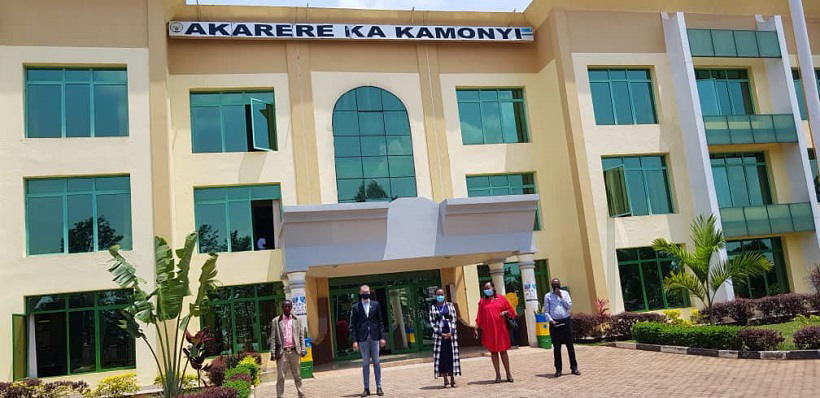
The RUNRES team at the Kamonyi District office.
 RUNRES team discussing the innovation
plans with Mayor Thadee Tuyizere
RUNRES team discussing the innovation
plans with Mayor Thadee Tuyizere
Contributed by
Recent stories
No items found