
Supporting farmers in Tanzania to cope with climate change
July 24, 2018
“Soil erosion is a big problem in this area and we are therefore demonstrating construction of contour ridges along the hillsides. We are also demonstrating the use of tie ridges as well as chololo to help conserve water in the fields for the crops and the use of improved varieties of sorghum, pearl millet, cowpea, and Bambara nut. These are hardy crops that tolerate drought and are therefore suitable for semi-arid conditions,” says Dr Fidelis Myaka, a Senior Field Manager at IITA.
 IITA has established three demonstration sites in Dodoma region to showcase to farmers appropriate Climate Smart Agriculture (CSA) practices for arid and semi-arid areas. CSA practices aim at increasing agriculture production and resilience to climate change while reducing agriculture’s contribution to climate change such as emission of greenhouses.
Setting up these demonstration sites on CSA practices for various agroecologies across the country is one of the main activities of the Building Capacity for Resilient Food Security Project in Tanzania initiated in 2017 to strengthen the country’s capacity to respond to the challenges posed by climate change to the agriculture sector.
The project is targeting Tanzania’s Ministry of Agriculture (MoA) and the Ministry of Livestock and Fisheries (MLF) and Zanzibar’s Ministry of Agriculture, Natural Resources, Livestock and Fisheries (MANRLF), Tanzania’s Meteorological Agency (TMA), and the President’s Office of Regional Administration and Local Government (PORALG) as well as regional training centers.
It is led by the Government of Tanzania in collaboration with the United States Department of Agriculture (USDA) and is being implemented by IITA, the World Agroforestry Centre (ICRAF), and UN’s Food and Agriculture Organization (FAO). The project is funded by the US Agency for International Development (USAID) Tanzania Mission.
IITA has established three demonstration sites in Dodoma region to showcase to farmers appropriate Climate Smart Agriculture (CSA) practices for arid and semi-arid areas. CSA practices aim at increasing agriculture production and resilience to climate change while reducing agriculture’s contribution to climate change such as emission of greenhouses.
Setting up these demonstration sites on CSA practices for various agroecologies across the country is one of the main activities of the Building Capacity for Resilient Food Security Project in Tanzania initiated in 2017 to strengthen the country’s capacity to respond to the challenges posed by climate change to the agriculture sector.
The project is targeting Tanzania’s Ministry of Agriculture (MoA) and the Ministry of Livestock and Fisheries (MLF) and Zanzibar’s Ministry of Agriculture, Natural Resources, Livestock and Fisheries (MANRLF), Tanzania’s Meteorological Agency (TMA), and the President’s Office of Regional Administration and Local Government (PORALG) as well as regional training centers.
It is led by the Government of Tanzania in collaboration with the United States Department of Agriculture (USDA) and is being implemented by IITA, the World Agroforestry Centre (ICRAF), and UN’s Food and Agriculture Organization (FAO). The project is funded by the US Agency for International Development (USAID) Tanzania Mission.
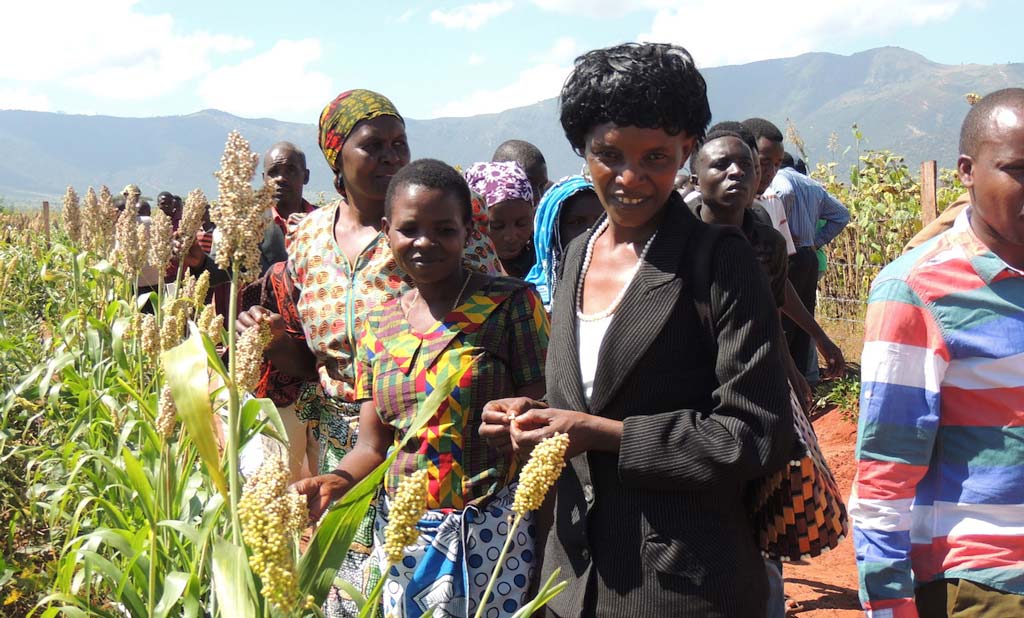
Farmers looking at the improved sorghum varieties intercropped with cowpea at their demonstration site.
Demonstrating and communicating CSA practices
“Climate change has brought many challenges to our farmers. In one season, they are grappling with too much rain and in another with too little rain. This project, which creates awareness on appropriate CSA practices among farmers, including suitable varieties to grow, will help them to adapt and cope with these challenges,” says Ms Shakwaanande Natai, Head of Environment Management Unit at the Ministry of Agriculture. In the project, IITA has been tasked to build the capacity of the government to demonstrate appropriate CSA practices for the major agroecological zones as outlined in the country’s National CSA Guideline and to create awareness among the different stakeholders from farmers to policymakers on CSA. The Government of Tanzania officially launched the national CSA Guideline in 2017 and its aim is to guide the agriculture sector and stakeholders in identifying practices and technologies that are specific to each agro-climatic zone to support crop, livestock, and fisheries production to cope with climate change.Feedback from farmers
The project has organized farmers’ field days in the two sites, inviting farmers to the demonstration plots to expose them to the technologies and practices and to get their views on which technologies they would readily adopt. The farmers are happy with the project and technologies, acknowledging that climate change was indeed one of their major challenges. [su_quote]“Farming is our main source of livelihood and our soils are fragile. We need to use these CSA technologies to increase our yield and in turn our incomes. If we follow these technologies, for sure our lives will get better,” says Sina Mde, Head of Nghumbi village.[/su_quote] His village is one of the sites in Dodoma region in which IITA is demonstrating CSA practices suitable for semi-arid areas in partnership with Hombolo Agricultural Research Institute. Forty-one-year old Martha Paulo, also from Nghumbi village, is among farmers who are already applying some of these CSA practices, having learned from the demonstration plots. [su_quote]“When we were making these chololo pits and tie ridges in this (demonstration) farm, I found the technologies labor intensive. However, I still went ahead and tried them on my farm. Now I am very happy with the results. The crops are doing very well and weed management was very easy. First the weeds were few. All I did was pluck them out,” she said.[/su_quote] As part of the project, IITA will also work with the trainers in the country’s agriculture tertiary institutions to develop material on CSA for inclusion in the country’s agriculture training programs. FAO and TMA will disseminate easy- to-use weather information using appropriate technologies including mobile phones while ICRAF will quantify the trade-offs and benefits of these CSA practices for decision making.Contributed by
Recent stories
No items found