
NEWS

IITA joins national exhibitions to celebrate International Women’s Day in Tanzania
March 14, 2025

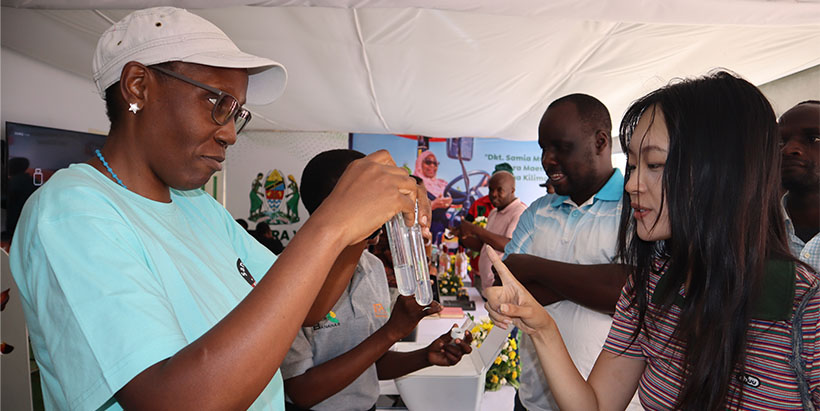
IITA researcher, Nakato, Valentine showcasing tissue culture technology in banana to visitor. (Photo: Hadi-IITA)

Following a week-long exhibition from 1 to 8 March, IITACGIAR participated in the national celebration of International Women’s Day (IWD) held on 8 March 2025 in Arusha, Tanzania. This year’s national theme, “Wanawake na wasichana 2025: Tuimarishe haki, usawa na uwezeshaji,” translates to “Women and girls 2025: Strengthening justice, equality, and empowerment.”

The exhibitions were organized by the Ministry of Community Development, Gender, and Children in collaboration with the Regional Commissioner’s Office in Arusha, providing a platform for women from different sectors to showcase their impactful contributions.

On the invitation of the Tanzania Ministry of Agriculture, IITA showcased agricultural technologies researched and co-developed by women and men scientists. The technologies showcased include banana breeding, Aflasafe, the PlantVillage Nuru digital tool and controlling and managing the banana bunchy top disease, all contribute to transforming Tanzania’s food systems.
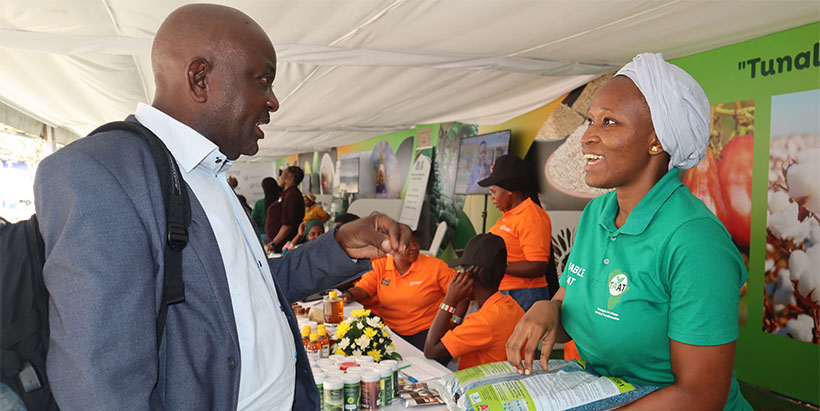
IITA researcher, Fatma Mussa showcasing Aflasafe product to visitor. (Photo: Hadi-IITA)

During the celebration, Her Excellency Dr Samia Suluhu Hassan, the president of Tanzania, expressed her gratitude to government institutions and non-governmental organizations for their commitment and contributions to women and girls’ development across sectors, echoing the global theme “For all women and girls: Rights, equality, empowerment.”

“Coming together is important in driving the necessary changes the government strives for. Today, I want to highlight that significant policy and legal measures have been, and continue to be, implemented to eliminate oppressive traditions and discrimination against women and girls.”

Dr Suluhu noted that gender equality has progressed significantly, with positive changes occurring. Reflecting on previous years, she noted an increase in women’s participation in both government and private institutions, with a substantial increase in leadership positions such as members of parliament, ministers, and even councilors – far more than in the past. “The private sector has also played a key role in promoting and supporting women to reach higher positions,” she added.

The young women researchers at the event engaged with visitors and shared research-driven solutions, many of which are ready to be scaled and adopted by farming communities. This impressed the visitors with the good work IITA is doing in the country.
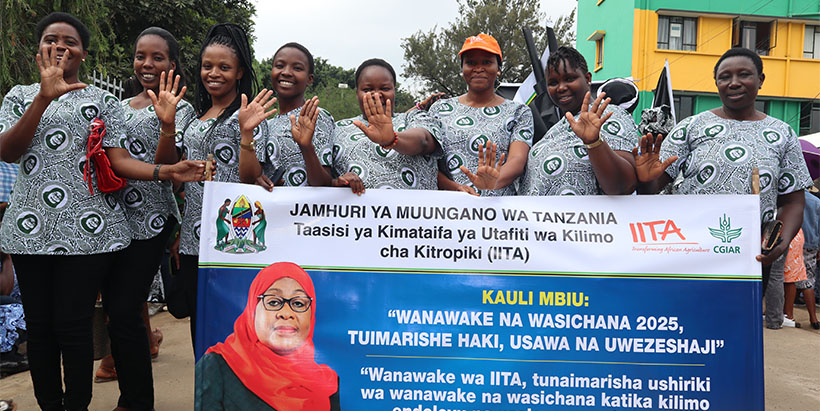
 IITA team in group photo during celebration of IWD. (Photo: Hadi-IITA)
IITA team in group photo during celebration of IWD. (Photo: Hadi-IITA)

“Women’s Day has been a remarkable learning opportunity for us. After visiting the IITA booth, we gained valuable insights into the scientific methods of banana production. We learned that banana plants have seeds, something we never knew before as students,”  Devotha Kalakinandosi, a student at Kisonga Foundation College in Moshi, expressed.

“Additionally, we learned about aflatoxin and using Aflasafe to improve maize productivity. This knowledge is crucial for ensuring food security. I pledge to use what I have learned to raise awareness in my community about Aflasafe and its role in reducing the health risks and food waste,” she said.

Moreover, Emma Edward, a resident of Moriet, expressed her excitement about visiting the IITA booth, where she learned about banana diseases and breeding processes, including the role of tissue culture technology in improving banana plants to enhance food security.

“I thank the Ministry of Agriculture for facilitating IITA’s participation at the event; the team is providing valuable agricultural knowledge to help farmers improve their productivity,” Edward said.

As the year’s women’s global campaign is advocating for action in promoting gender equality, fostering empowerment and advancing women’s and girls’ rights, IITA continues to commit to engaging women and youth in agricultural development by increasing decent jobs in targeted services and markets,  fostering their entrepreneurial competence and agribusiness skills in ways that generate opportunities that grow with time through its strategic objective in the new IITA 2024-2030 Strategy.

Contributed by Hadi Rashid


Contributed by

Recent stories

No items found

Leave a Reply

Your email address will not be published. Required fields are marked *

Scroll to Top
Olaosebikan, Olamide

Olamide Deborah Nwanze is a Senior Research Associate specializing in gender mainstreaming research to inform participatory and inclusive breeding, variety development, and seed systems policies regarding root, tuber, and banana (RTB) crops in the International Institute of Tropical Agriculture Headquarters, Ibadan, Nigeria. She is a PhD candidate at the University of Ibadan and holds an MSc and B. Agric in Agricultural Extension and Rural Development. Olamide is a fellow of the African Women in Agricultural Research and Development – Gender Responsive Agricultural Systems Policy (AWARD-GRASP) and the Gender Responsive Researchers Equipped for Agricultural Transformation (GREAT). She seeks to apply her gender-mainstreaming learnings, gender-responsive research, and policy development, and review expertise to facilitate women, youth, children, and vulnerable social group’s access to and adoption of agricultural Innovations that guarantee food, nutrition, income, and livelihood security in Africa. Her current roles include mentoring research fellows, development of guides and training manuals, implementation and adaptation of gender frameworks and tools, value chain actors’ engagement as citizen science partners, policy review and redesign, data management, and analysis. Her current research explores mixed methods and participatory and interdisciplinary approaches to capture and highlight gender dynamics, needs, preferences, and challenges stakeholders face within the agricultural livelihood value chain to prioritize gender-inclusive strategies in breeding programs, policy design, and implementation.

At IITA, she contributes to the implementation of the CGIAR Accelerated Breeding Initiative and Genetic Innovation Programs; participatory and gender research within the NextGen CassavaHarvestPlusRTBFoods, and Tricot-ClimMob 1000Farms Projects; and gender knowledge communication via the G-LENS webinar series, video documentary, policy briefspublications, and blogs.


Recent publications

de Sousa, K., van Etten, J., Manners, R. Bello, A., Teeken, B., Olaosebikan, O., et al. 2024. The tricot approach: an agile framework for decentralized on-farm testing supported by citizen science. A retrospective. Agron. Sustain. Dev. 44, 8. https://doi.org/10.1007/s13593-023-00937-1

Madu, T., Onwuka, S., Nwafor, S., Onyemauwa, N., Ejechi, M., Ofoeze, M., Ukeje, B., Eluagu, C., Olaosebikan, O., Okoye, B., 2024. Gender-Inclusive Consumer Studies Improve Cassava Breeding in Nigeria in: Frontiers in Sociology, volume 9, number: 1224504, doi: 10.3389/fsoc.2024.1224504

Olaosebikan, O.; Bello, A.; Utoblo, O.; Okoye, B.; Olutegbe, N.; Garner, E.; Teeken, B.; Bryan, E.; Forsythe, L.; Cole, S.; Madu, T. 2023.  Stressors and Resilience within the Cassava Value Chain in Nigeria: Preferred Cassava Variety Traits and Response Strategies of Men and Women to Inform Breeding. Sustainability 15, 7837. https://doi.org/10.3390/su15107837

Okoye, B., Ofoeze, M., Ejechi, M., Onwuka, S., Nwafor, S., Onyemauwa, N., Ukeje, B., Eluagu, C., Obidiegwu, J.*, Olaosebikan, O., Madu, T.* 2023. Prioritizing preferred traits in the yam value chain in Nigeria: a gender situation analysis in: Frontiers in Sociology, volume 8, number: 1232626, pages 1 – 9, ISSN 2297-7775, 2023. https://www.frontiersin.org/articles/10.3389/fsoc.2023.1232626/full

Olaosebikan, O., Bello, A. A., de Sousa, K., Ndjouenkeu, R., Adesokan, M., Alamu, E. O., Agbona, A., van Etten, J., Kegah, F. N.*, Dufour, D., Bouniol, A., Teeken, B. 2023. Consumer acceptability of cassava gari-eba food products across cultural and environmental settings using the triadic comparison of technologies approach (tricot) in: Journal of the Science of Food and Agriculture,

Teeken, B., Olaosebikan, O., Bello, A. A., Madu, T.*, Cole, S. M. 2023. Qualitative assessment on the positionality and preferences of dyads in relation to cassava-related activities: working with tricot trial citizen scientists https://hdl.handle.net/10568/138326 Type: Manual

Bouniol, A., Ceballos, H., Bello, A. A., Teeken, B., Olaosebikan, O., Owoade, D., Agbona, A., Fotso Kuate, A., Madu, T.*, Okoye, B.*, Ofoeze, M.*, Nwafor, S.*, Onyemauwa, N.*, Adinsi, L.*, Forsythe, L., Dufour, D. 2023. Varietal impact on women’s labour, workload and related drudgery in processing root, tuber and banana crops: focus on cassava in sub-Saharan Africa in: Journal of the Science of Food and Agriculture, pages 1 – 25, ISSN 0022-5142,

Bello, A. A., Agbona, A., Olaosebikan, O., Edughaen, G., Dufour, D., Bouniol, A., Iluebbey, P., Ndjouenkeu, R.*, Rabbi, I. Y., Teeken, B. 2023. Genetic and environmental effects on processing productivity and food product yield: drudgery of women’s work in: Journal of the Science of Food and Agriculture, pages 1 – 32, ISSN 0022-5142, 5

Cavicchioli, M., Zimbiti, T., Teeken, B., Nwanze, D.O., Liani, M., Parkes, E. & Bello, A. 2023. IITA-Gender Responsive Breeding Training Report. Genetic Resources Center, IITA-HQ, Ibadan, 21-23 September, 2022. Ibadan, Nigeria: IITA, (34 p.).https://hdl.handle.net/10568/131368

Agbona, A. Peteti P., Teeken B., Olaosebikan O. Bello, A. A., Parkes, E., Rabbi, I. Y., Mueller, L., Egesi, C., Kulakow, P. 2022. Data Management in Multi-disciplinary African RTB Crop Breeding Programs. In: Williamson, H.F., Leonelli, S. (eds) Towards Responsible Plant Data Linkage: Data Challenges for Agricultural Research and Development. Springer, Cham. https://doi.org/10.1007/978-3-031-13276-6_5

Lora Forsythe, Pricilla Marimo, Sarah Mayanja, Olamide D. Olaosebikan, Esme Stuart, Bela Teeken, Benjamin Okoye, Tessy Madu, (2021). Cross-product Gender Analysis of RTBfoods Step 2 Gendered Food Mapping on RTB Products. Understanding the Drivers of Trait Preferences and the Development of Multi-user RTB Product Profiles, WP1. London, UK: RTBfoods Field Scientific Report, 30 p.

Teeken, B., Garner, E., Agbona, A., Balogun, I., Olaosebikan, O., Bello, A., Madu, T., Okoye, B., Egesi, C., Kulakow, P. and Tufan, H.A. 2021. Beyond “Women’s Traits”: Exploring How Gender, Social Difference, and Household Characteristics Influence Trait Preferences. Frontiers Sustainable Food Systems 5:740926. https://doi.org/10.3389/fsufs.2021.740926

Teeken, B., Agbona, A., Bello, A., Olaosebikan, O., Alamu, E., Adesokan, M., Awoyale, W., Madu, T., Okoye, B., Chijioke, U., Owoade, D., Okoro, M., Bouniol, A., Dufour, D., Hershey, C., Rabbi, I., Maziya‐Dixon, B., Egesi, C., Tufan, H. and Kulakow, P. (020. Understanding cassava varietal preferences through pairwise ranking of gari‐eba and fufu prepared by local farmer–processors. Int J Food Sci Technol. https://doi.org/10.1111/ijfs.14862

Bela Teeken, Olamide Olaosebikan, Ireti Balogun, Benjamin Okoye, Tessy Madu, Steven Cole, Abolore Bello, Elizabeth Parkes. (2020). Piloting the G+ customer and product profile tools for gender-responsive cassava breeding in Nigeria. Nigeria: International Institute of Tropical Agriculture (IITA). https://hdl.handle.net/20.500.11766/13000