

In Nigeria and across Africa, cassava is more than just a staple crop, it is a powerhouse of potential, silently yet profoundly driving food security, alleviating poverty, fostering sustainable livelihoods, and fueling an emerging entrepreneurial and industrial revolution. This ‘white gold’ is key to unlocking immense economic opportunities and building a resilient future for millions.
Recognizing this immense significance, World Cassava Day is celebrated annually on 28 June. This year, the observance marked a significant milestone in the journey of cassava transformation in Nigeria, with a series of engaging and insightful maiden events. These included a physical conference, an X (formerly Twitter) Space session, and a targeted radio campaign, collectively emphasizing the critical role of cassava in driving food security, ensuring inclusion, and creating sustainable development within the agricultural sector.
The maiden conference held on 4 July 2025, in Abuja, was the cornerstone of the World Cassava Day celebrations. The theme; “Farm to global markets: Driving industrialization, food security, and exports”, perfectly encapsulated the ambition to transform cassava from a subsistence crop into a major contributor to national wealth and international trade, emphasizing the entire value chain from cultivation to industrial application and export. Policy stakeholders, researchers, private sector players, entrepreneurs, and farmers gathered to chart a course for the future of cassava.
Dignitaries, including Vice President Kashim Shettima, highlighted the government’s commitment to repositioning cassava as a key driver of industrial development and import substitution. He passionately declared, “Cassava, which for long symbolized food security for the vulnerable, can also signify prosperity for the ambitious. Our commitment is unwavering in repositioning cassava not just as a staple crop but as a key driver of industrial development, import substitution, and ultimately, economic diversification.”
Central to the discussions was the remarkable progress in innovative breeding techniques and the strengthening of seed systems. Experts from IITA, National Root Crops Research Institute (NRCRI), and partners highlighted how these advancements are leading to the development and dissemination of high-yielding, resilient cassava varieties tailored to end-users’ requirements.
Prof. Chiedozie Egesi, Executive Director, NRCRI, emphasized, “Our focus is on creating cassava varieties that increase yields for farmers and meet the quality demands of processors and industries. This holistic approach is crucial for sustainable transformation.” He highlighted the strategic shift from supply-driven research to demand-led breeding.
The importance of collaboration between national and private institutions was another key takeaway. Partnerships are instrumental in scaling up the adoption of improved varieties and developing efficient value chains. Dr Mercy Diebiru-Ojo, IITA Seed System Specialist, shared her perspective: “For cassava to transform our economy, we need seamless collaboration across the entire value chain – from research institutions developing innovative varieties to private sector players creating market opportunities and government propelling action plans and inclusive policies. This synergy ensures that advancements at the research level translate into tangible benefits for farmers, processors, and agribusinesses.”
The impact of improved cassava varieties on the productivity of farmers, processors, and industries across Nigeria and Africa was a central theme, demonstrating cassava’s potential to transform rural livelihoods and ensure national food and energy security. An accompanying exhibition showcased the latest advancements in cassava cultivation, processing, and value addition, offering a glimpse into the future of this versatile crop.
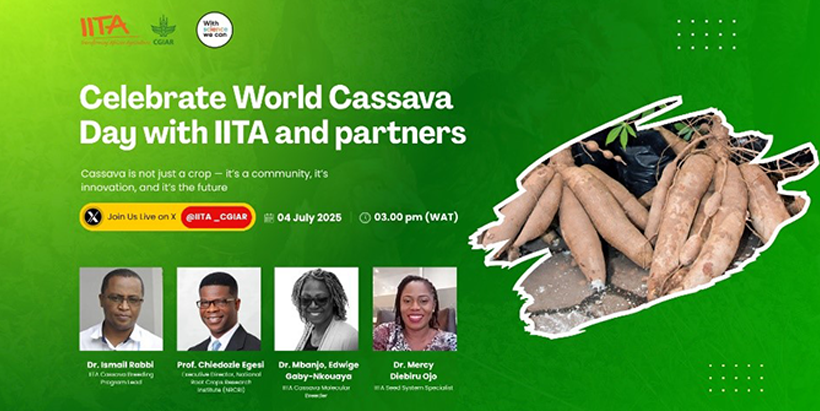
Beyond the partnership for delivery and policy-focused conference, World Cassava Day extended its reach to a broader audience of stakeholders through a virtual platform. The IITA communication team, in collaboration with the cassava breeding program, hosted an engaging X (formerly Twitter) Space session.
This live conversation brought together a diverse group of cassava stakeholders and experts, including Dr Ismail Rabbi, IITA Cassava Breeding Program lead), Prof. Chiedozie Egesi, Executive Director, National Root Crops Research Institute (NRCRI), Dr Mercy Diebiru-Ojo, IITA Seed System Specialist, and Dr Gaby Mbanjo, IITA Molecular Cassava Breeder). They shared valuable insights and experiences on accelerating cassava transformation.
During the insightful session, Prof. Egesi, passionately articulated the paradigm shift in cassava research: “We started by moving away from supply-driven research to demand-led breeding, focusing on improving yields, pest and disease resistance, and more importantly, consumer-preferred attributes. Cassava can drive away rural poverty and bring about development.”
Building on this vision of transformative impact, Dr Mbanjo, detailed the technological strides enabling this progress, explaining: “In the cassava breeding program, we have taken advantage of advancements in technology, combining DNA information (genomics) with advanced phenotyping tools, and implementing quantitative genetics principles to reduce the breeding cycle and increase selection accuracy. Techniques to promote synchronized flowering and accelerate the rate of cassava multiplication are being adopted to speed up breeding. The breeding program is fully digitalized. A central data management platform (CassavaBase) houses all the data. The procedure of analyzing breeding data has been made simpler by the development of an analytical platform.”
Dr Diebiru-Ojo explained further, “through strong collaboration between international and national partners like IITA GoSeed and Umudike Seed, we have established the first early generation seed companies. Utilizing transformative technologies such as semi-autotrophic hydroponics, we aim to flood the country with healthy, quality-certified planting materials of improved varieties, ensuring farmers receive value for their investment.”
Participants raised questions about farming risks, chemical use in cassava processing, and the verification of cassava varieties. Dr Rabbi moderated the questions and feedback session to questions and feedback. He emphasized the need for stakeholder collaboration to improve cassava productivity and impact in Nigeria, aiming to transition cassava from a subsistence crop to an industrial crop. He concluded with a call for continued engagement and feedback from the community to drive innovation in the cassava sector.
Complementing these events and recognizing the crucial role of smallholder farmers in cassava transformation, Radio IITA’s “Olaju Agbe” program played a vital role in disseminating information at the grassroots level. The bilingual (Yoruba and English) program, broadcast on 25 June, featured Bello Abolore and Racheal Abioye, among other experts, who enlightened farmers on the “great importance of cassava value addition to the livelihood of smallholder farmers and national productivity,” aligning perfectly with the overarching goals of World Cassava Day.
These events collectively showcased that cassava is a strategic asset for economic diversification, rural empowerment, and global competitiveness. The commitment from various stakeholders, from government officials to private sector players, underscores a shared vision for a future where agriculture, particularly cassava, is at the heart of shared prosperity, becoming a “white gold” in Nigeria.
Contributed by Mercy Diebiru-Ojo and Olamide Nwaze
Contributed by
Recent stories