
IITA NEWS

IITA and Rotary International explore new frontiers in partnership for community development
February 23, 2026

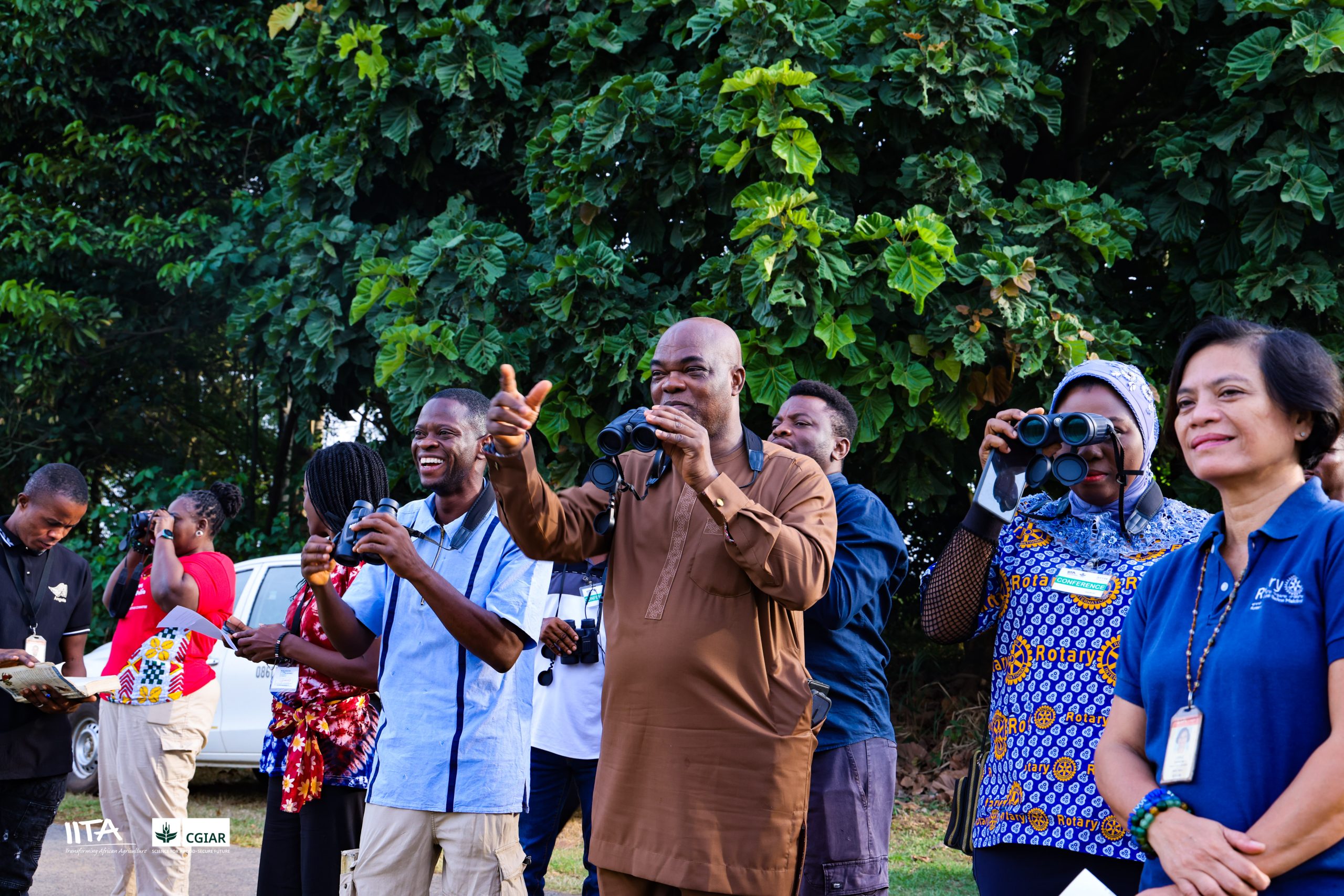
Rotary International President Elect (RIPE), Olayinka Babalola sights the pied kingfisher with his binoculars during the birdwatching exercise, guided by the Head of IITA Forest Center, Adewale Awoyemi, in the company of other Rotarians, the Head of Communication, Kathy Lopez and IITA staff.

Two presidents, IITACGIAR Director General, IITA scientists, and Nigerian Rotarians met on 15 February at IITA to discuss areas of mutual interest and opportunities for future collaboration in community development and peace building.

Earlier in the week, on 11 and 12 February, the Rotary International President Elect (RIPE), Olayinka Babalola, explored the grounds of the IITA campus, taking time out for an early-morning birdwatching session led by the Head of the IITA Forest Center, Adewale Awoyemi. He shared that his interest in birdwatching began during the COVID-19 lockdown, eventually leading him to join the fellowship of Rotarian birdwatchers, with IITA as his preferred base whenever he is in Ibadan.
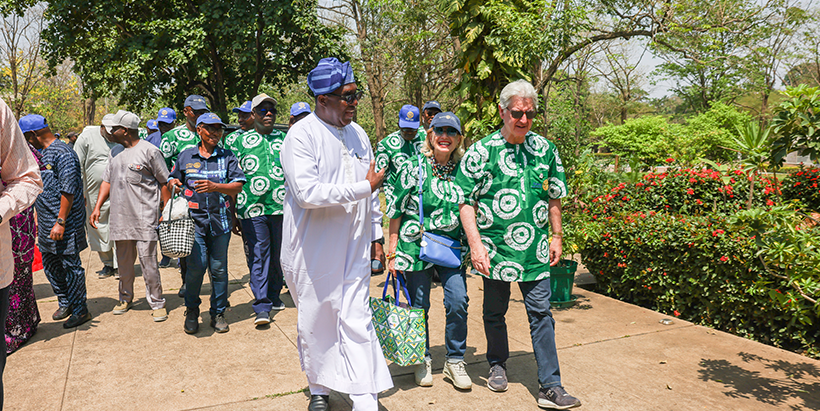
IITA Director General, Simeon Ehui, welcoming the Rotary International President, Francesco Arezzo, his wife, and other Rotarian delegates to IITA.

He was delighted to spot species such as the cormorant, African jacana (popularly called the “jesus bird” for its extraordinarily long toes that enable it to walk on floating vegetation), pied kingfisher, hadada ibis, and the common sandpiper, among others. The experience underscored IITA–CGIAR’s role not only as a hub for agricultural science but also as a center for biodiversity conservation and environmental stewardship.

Babalola later met with IITA–CGIAR Director General, Simeon Ehui, himself once a Rotarian, who expressed appreciation for Rotary International’s progress in polio eradication and other global humanitarian efforts. In his remarks, Dr Ehui provided a brief history of IITA and addressed key FAQs about the Institute. He emphasized the urgent need for food security that led to its founding by the Ford and Rockefeller Foundations. He reiterated IITA’s commitment to delivering cutting-edge science and research innovations that support economic development and food security across Africa and beyond. “Science, partnership, and impact—and accelerating transformative change in people’s lives—are key for us at IITA,” he stated.
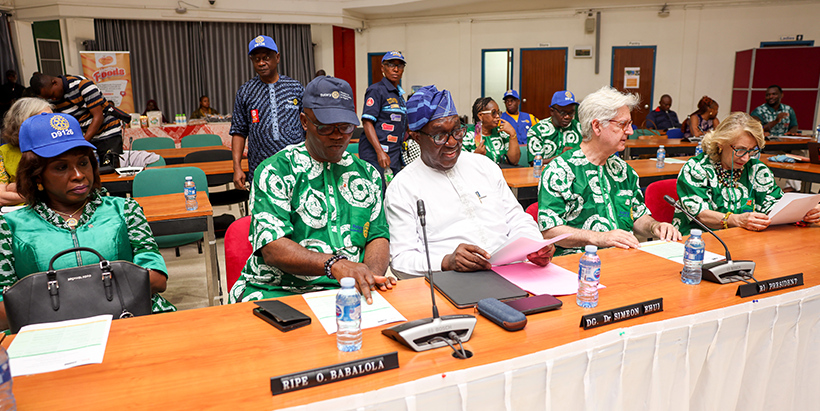
IITA DG, Simeon Ehui, with the Rotarian Incoming President Elect, Olayinka Babalola (L), and the outgoing President of Rotary International, Francesco Arezzo (R), during the partnership engagement meeting, at IITA headquarters, Ibadan.
IITA DG, Simeon Ehui, with the the Rotary International President Elect, Olayinka Babalola (L), and the outgoing President of Rotary International, Francesco Arezzo (R), during the partnership engagement meeting, at IITA headquarters, Ibadan.

Further insights on IITA’s research, innovations, and technologies were presented by Bernard Vanlauwe, Deputy Director General, Research for Development (DDGR4D); Tahirou Abdoulaye, Deputy Director General, Partnerships for Delivery (DDGP4D); and the DG’s Chief of Staff, Ibnou Dieng. They discussed IITA’s innovations and technologies, scaling approaches, and the Institute’s broader strategic impact pathways.

The outgoing President of Rotary International, Francesco Arezzo, expressed his pleasure at witnessing such a promising partnership opportunity between IITA-CGIAR and Rotary International. He highlighted areas of alignment for future collaboration, including youth empowerment, economic development, and environmental sustainability.

Tola Ademosun spoke about IITA-CGIAR’s youth-focused initiatives, that are transforming young people into agripreneurs through climate-smart practices, digital tools, and mechanization. These efforts, supported by partners such as the African Development Bank (AfDB) and the Mastercard Foundation, are tackling unemployment, promoting the dissemination of technology, and creating viable income streams in agribusiness. She expressed optimism about collaborating with Rotary International to further strengthen community development and youth economic empowerment.

RIPE Olayinka Babalola, while highlighting Rotary’s seven areas of focus, identified three to four potential areas of collaboration with IITA, including sustainable livelihoods, youth agribusiness ventures, environmental conservation, and water and sanitation initiatives. These are aimed at fostering peace and preventing conflict. He affirmed that his presidential theme for 2026, “to create lasting impact,” aligns seamlessly with IITA-CGIAR’s commitment to delivering agricultural innovations that positively transform lives.

The meeting concluded with proposals to establish Corporate Rotary Clubs to address shared concerns within corporate spaces—signaling a forward-looking partnership anchored on science, service, and sustainable impact.

Contributed by Folake Oduntan


Contributed by

Related news

No items found

Leave a Reply

Your email address will not be published. Required fields are marked *

Scroll to Top
Olaosebikan, Olamide

Olamide Deborah Nwanze is a Senior Research Associate specializing in gender mainstreaming research to inform participatory and inclusive breeding, variety development, and seed systems policies regarding root, tuber, and banana (RTB) crops in the International Institute of Tropical Agriculture Headquarters, Ibadan, Nigeria. She is a PhD candidate at the University of Ibadan and holds an MSc and B. Agric in Agricultural Extension and Rural Development. Olamide is a fellow of the African Women in Agricultural Research and Development – Gender Responsive Agricultural Systems Policy (AWARD-GRASP) and the Gender Responsive Researchers Equipped for Agricultural Transformation (GREAT). She seeks to apply her gender-mainstreaming learnings, gender-responsive research, and policy development, and review expertise to facilitate women, youth, children, and vulnerable social group’s access to and adoption of agricultural Innovations that guarantee food, nutrition, income, and livelihood security in Africa. Her current roles include mentoring research fellows, development of guides and training manuals, implementation and adaptation of gender frameworks and tools, value chain actors’ engagement as citizen science partners, policy review and redesign, data management, and analysis. Her current research explores mixed methods and participatory and interdisciplinary approaches to capture and highlight gender dynamics, needs, preferences, and challenges stakeholders face within the agricultural livelihood value chain to prioritize gender-inclusive strategies in breeding programs, policy design, and implementation.

At IITA, she contributes to the implementation of the CGIAR Accelerated Breeding Initiative and Genetic Innovation Programs; participatory and gender research within the NextGen CassavaHarvestPlusRTBFoods, and Tricot-ClimMob 1000Farms Projects; and gender knowledge communication via the G-LENS webinar series, video documentary, policy briefspublications, and blogs.


Recent publications

de Sousa, K., van Etten, J., Manners, R. Bello, A., Teeken, B., Olaosebikan, O., et al. 2024. The tricot approach: an agile framework for decentralized on-farm testing supported by citizen science. A retrospective. Agron. Sustain. Dev. 44, 8. https://doi.org/10.1007/s13593-023-00937-1

Madu, T., Onwuka, S., Nwafor, S., Onyemauwa, N., Ejechi, M., Ofoeze, M., Ukeje, B., Eluagu, C., Olaosebikan, O., Okoye, B., 2024. Gender-Inclusive Consumer Studies Improve Cassava Breeding in Nigeria in: Frontiers in Sociology, volume 9, number: 1224504, doi: 10.3389/fsoc.2024.1224504

Olaosebikan, O.; Bello, A.; Utoblo, O.; Okoye, B.; Olutegbe, N.; Garner, E.; Teeken, B.; Bryan, E.; Forsythe, L.; Cole, S.; Madu, T. 2023.  Stressors and Resilience within the Cassava Value Chain in Nigeria: Preferred Cassava Variety Traits and Response Strategies of Men and Women to Inform Breeding. Sustainability 15, 7837. https://doi.org/10.3390/su15107837

Okoye, B., Ofoeze, M., Ejechi, M., Onwuka, S., Nwafor, S., Onyemauwa, N., Ukeje, B., Eluagu, C., Obidiegwu, J.*, Olaosebikan, O., Madu, T.* 2023. Prioritizing preferred traits in the yam value chain in Nigeria: a gender situation analysis in: Frontiers in Sociology, volume 8, number: 1232626, pages 1 – 9, ISSN 2297-7775, 2023. https://www.frontiersin.org/articles/10.3389/fsoc.2023.1232626/full

Olaosebikan, O., Bello, A. A., de Sousa, K., Ndjouenkeu, R., Adesokan, M., Alamu, E. O., Agbona, A., van Etten, J., Kegah, F. N.*, Dufour, D., Bouniol, A., Teeken, B. 2023. Consumer acceptability of cassava gari-eba food products across cultural and environmental settings using the triadic comparison of technologies approach (tricot) in: Journal of the Science of Food and Agriculture,

Teeken, B., Olaosebikan, O., Bello, A. A., Madu, T.*, Cole, S. M. 2023. Qualitative assessment on the positionality and preferences of dyads in relation to cassava-related activities: working with tricot trial citizen scientists https://hdl.handle.net/10568/138326 Type: Manual

Bouniol, A., Ceballos, H., Bello, A. A., Teeken, B., Olaosebikan, O., Owoade, D., Agbona, A., Fotso Kuate, A., Madu, T.*, Okoye, B.*, Ofoeze, M.*, Nwafor, S.*, Onyemauwa, N.*, Adinsi, L.*, Forsythe, L., Dufour, D. 2023. Varietal impact on women’s labour, workload and related drudgery in processing root, tuber and banana crops: focus on cassava in sub-Saharan Africa in: Journal of the Science of Food and Agriculture, pages 1 – 25, ISSN 0022-5142,

Bello, A. A., Agbona, A., Olaosebikan, O., Edughaen, G., Dufour, D., Bouniol, A., Iluebbey, P., Ndjouenkeu, R.*, Rabbi, I. Y., Teeken, B. 2023. Genetic and environmental effects on processing productivity and food product yield: drudgery of women’s work in: Journal of the Science of Food and Agriculture, pages 1 – 32, ISSN 0022-5142, 5

Cavicchioli, M., Zimbiti, T., Teeken, B., Nwanze, D.O., Liani, M., Parkes, E. & Bello, A. 2023. IITA-Gender Responsive Breeding Training Report. Genetic Resources Center, IITA-HQ, Ibadan, 21-23 September, 2022. Ibadan, Nigeria: IITA, (34 p.).https://hdl.handle.net/10568/131368

Agbona, A. Peteti P., Teeken B., Olaosebikan O. Bello, A. A., Parkes, E., Rabbi, I. Y., Mueller, L., Egesi, C., Kulakow, P. 2022. Data Management in Multi-disciplinary African RTB Crop Breeding Programs. In: Williamson, H.F., Leonelli, S. (eds) Towards Responsible Plant Data Linkage: Data Challenges for Agricultural Research and Development. Springer, Cham. https://doi.org/10.1007/978-3-031-13276-6_5

Lora Forsythe, Pricilla Marimo, Sarah Mayanja, Olamide D. Olaosebikan, Esme Stuart, Bela Teeken, Benjamin Okoye, Tessy Madu, (2021). Cross-product Gender Analysis of RTBfoods Step 2 Gendered Food Mapping on RTB Products. Understanding the Drivers of Trait Preferences and the Development of Multi-user RTB Product Profiles, WP1. London, UK: RTBfoods Field Scientific Report, 30 p.

Teeken, B., Garner, E., Agbona, A., Balogun, I., Olaosebikan, O., Bello, A., Madu, T., Okoye, B., Egesi, C., Kulakow, P. and Tufan, H.A. 2021. Beyond “Women’s Traits”: Exploring How Gender, Social Difference, and Household Characteristics Influence Trait Preferences. Frontiers Sustainable Food Systems 5:740926. https://doi.org/10.3389/fsufs.2021.740926

Teeken, B., Agbona, A., Bello, A., Olaosebikan, O., Alamu, E., Adesokan, M., Awoyale, W., Madu, T., Okoye, B., Chijioke, U., Owoade, D., Okoro, M., Bouniol, A., Dufour, D., Hershey, C., Rabbi, I., Maziya‐Dixon, B., Egesi, C., Tufan, H. and Kulakow, P. (020. Understanding cassava varietal preferences through pairwise ranking of gari‐eba and fufu prepared by local farmer–processors. Int J Food Sci Technol. https://doi.org/10.1111/ijfs.14862

Bela Teeken, Olamide Olaosebikan, Ireti Balogun, Benjamin Okoye, Tessy Madu, Steven Cole, Abolore Bello, Elizabeth Parkes. (2020). Piloting the G+ customer and product profile tools for gender-responsive cassava breeding in Nigeria. Nigeria: International Institute of Tropical Agriculture (IITA). https://hdl.handle.net/20.500.11766/13000