
IITA NEWS

Clemson University delegation visits IITA to advance banana research and expand collaboration
June 2, 2026

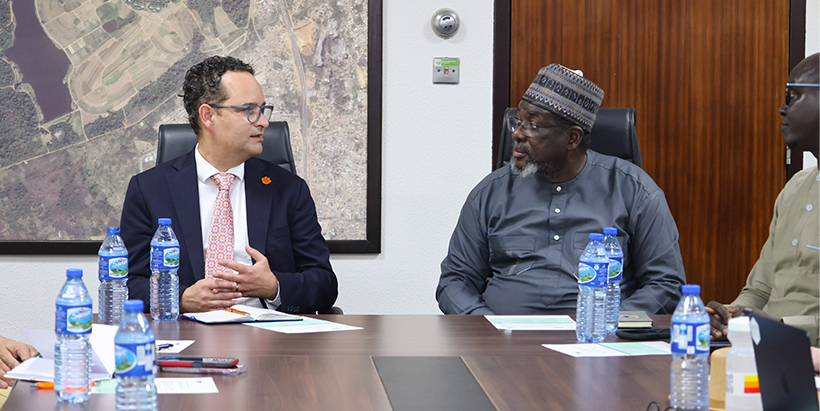
The Clemson Delegates in a meeting with the IITA management team

A delegation from Clemson University visited IITA headquarters from May 11 to 15 for a series of strategic engagements aimed at strengthening research collaboration in banana production and seed systems. The week-long visit marked the inception phase of the Gates Foundation-funded research project, “Post-tissue culture multiplication of banana for efficient scaling (Banana Vegetative Starts),” an initiative focused on strengthening banana propagation systems for enhanced productivity and impact across Africa. 

The visit brought together researchers and experts from both institutions to explore innovative approaches to seed propagation technologies, and modern breeding solutions designed to improve agricultural productivity. During the visit, the delegation toured several facilities across the IITA campus, gaining insights into the Institute’s research activities, innovations, and infrastructure while identifying exciting opportunities for partnership, knowledge exchange, and scientific advancement. 

A mini symposium held during the visit further highlighted the shared commitment of both institutions to agricultural research and development. Head of IITA Genetic Resources Center and Director of the West Africa Hub, Professor Michael Abberton, welcomed the participants and emphasized the importance of the collaboration between IITA and Clemson University. The hybrid session featured presentations on IITA’s value proposition and Clemson University’s contributions to global agricultural research and development. 
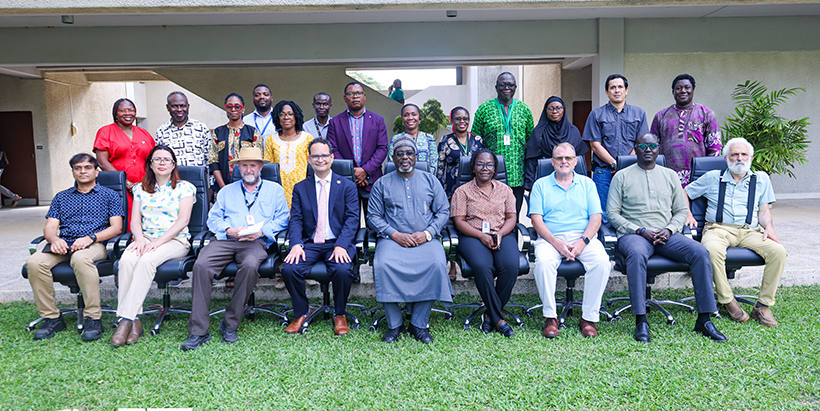
The Clemson Delegates in group photo with the management team

Speaking at the symposium, PROSSIVA (Program for Seed System Innovation for Vegetatively Propagated Crops in Africa) Coordinator and IITA Principal Investigator for the Banana Vegetative Starts project, Delphine Amah, introduced the PROSSIVA project and its objectives, stressing the challenges farmers face in crop cultivation and access to quality planting materials. She also pointed out the gap this new project will address: Current banana seed systems lack efficient and affordable multiplication approaches capable of rapidly scaling clean planting material from tissue culture. “This 3-year project is developing nursery-based hydroponics systems to help bridge that critical delivery gap for seed enterprises and farmers,” she said. 

Representing Clemson University, Professor Jagger Harvey, Director of Global Research Initiatives, shared broader perspectives on how Clemson University’s College of Agriculture, Forestry and Life Sciences (CALFS) is collaboratively addressing major agricultural challenges affecting farmers globally. 

“I have been impressed and inspired by IITA scientists since I began working with them at the Biosciences eastern and central Africa-International Livestock Research Institute Hub in Nairobi in 2009. South Carolina and sub-Saharan Africa share a wide range of agroecologies, crops, livestock, agricultural challenges and cultural roots that our partnership will leverage to accelerate the pace of innovation for both sides. Our visit unearthed a treasure trove of mutually beneficial potential collaborations” emphasizes Harvey. 

Professor of Horticulture at Clemson University, Jeffrey Adelberg, presented on integrating tissue culture and hydroponics into crop production systems. He demonstrated how advances in these technologies have simplified the movement and propagation of plant materials in laboratory systems, using turmeric as an example of a successful micropropagation/greenhouse nursery integration.  Adelberg commented, “Banana has a different growth habit than cassava or yam, but we are delighted to see successful micropropagation/greenhouse integrations IITA collaborators have made with those vegetative seed crop systems.” 

Further discussions on innovative production systems were led by Lance Beecher, Associate Extension Specialist for Food Systems and Safety, Clemson Cooperative Extension Service. He discussed the applications of aquaponics and hydroponics, noting that aquaponics relies on beneficial bacteria to convert ammonia into nitrates necessary for plant growth, while also highlighting challenges related to nutrient management and fish health within the system.  

The symposium concluded with a presentation by IITA Cassava Breeding Program Lead, Ismail Rabbi, on IITA’s modern breeding program. He highlighted the Institute’s adoption of digital technologies (including from Clemson) in breeding operations, which has significantly reduced dependence on paper-based data collection while improving data synchronization and field data management for researchers and breeding teams. 

At the close of the visit, the delegates expressed optimism about the collaboration’s potential to contribute to food security in both Africa and South Carolina. Professor Harvey described IITA as a key partner in the project, stating, “Our partnership with IITA positions Clemson to help drive positive impact across sub-Saharan Africa, enhancing food and nutritional security, stabilizing communities and nations, and driving economic development for future peace and prosperity.” 

Additional areas of potential collaboration identified during the visit included cowpea (black-eyed pea) research—given IITA’s globally recognized germplasm collection—and Aflasafe technology, particularly as aflatoxin contamination remains a challenge for maize and peanut farmers in South Carolina. 

One of the delegates, Gaudy Mayela Ortiz Rivera, a Clemson PhD student and tissue culture scientist from the National Institute for Innovation and Transfer in Agricultural Technology (INTA), Costa Rica, expressed strong interest in IITA’s banana/plantain breeding program and the opportunity to assess some of the Institute’s breeding materials. 

Beyond the official project launch, the engagement also served as a platform for fostering deeper collaboration with the wider IITA research community. Facilities toured during the visit include the Germplasm Health unit, Banana Breeding fields and propagation facilities, Aflasafe laboratories, Cassava and Yam Breeding, PROSSIVA screen houses, IITA GoSeed, Genetic Resources Center, Bioscience Center, and the Tissue Culture Laboratory.  

Contributed by Tolulope Akinola and Christabel Ediri 


Contributed by

Related news

No items found

Leave a Reply

Your email address will not be published. Required fields are marked *

Scroll to Top
Olaosebikan, Olamide

Olamide Deborah Nwanze is a Senior Research Associate specializing in gender mainstreaming research to inform participatory and inclusive breeding, variety development, and seed systems policies regarding root, tuber, and banana (RTB) crops in the International Institute of Tropical Agriculture Headquarters, Ibadan, Nigeria. She is a PhD candidate at the University of Ibadan and holds an MSc and B. Agric in Agricultural Extension and Rural Development. Olamide is a fellow of the African Women in Agricultural Research and Development – Gender Responsive Agricultural Systems Policy (AWARD-GRASP) and the Gender Responsive Researchers Equipped for Agricultural Transformation (GREAT). She seeks to apply her gender-mainstreaming learnings, gender-responsive research, and policy development, and review expertise to facilitate women, youth, children, and vulnerable social group’s access to and adoption of agricultural Innovations that guarantee food, nutrition, income, and livelihood security in Africa. Her current roles include mentoring research fellows, development of guides and training manuals, implementation and adaptation of gender frameworks and tools, value chain actors’ engagement as citizen science partners, policy review and redesign, data management, and analysis. Her current research explores mixed methods and participatory and interdisciplinary approaches to capture and highlight gender dynamics, needs, preferences, and challenges stakeholders face within the agricultural livelihood value chain to prioritize gender-inclusive strategies in breeding programs, policy design, and implementation.

At IITA, she contributes to the implementation of the CGIAR Accelerated Breeding Initiative and Genetic Innovation Programs; participatory and gender research within the NextGen CassavaHarvestPlusRTBFoods, and Tricot-ClimMob 1000Farms Projects; and gender knowledge communication via the G-LENS webinar series, video documentary, policy briefspublications, and blogs.


Recent publications

de Sousa, K., van Etten, J., Manners, R. Bello, A., Teeken, B., Olaosebikan, O., et al. 2024. The tricot approach: an agile framework for decentralized on-farm testing supported by citizen science. A retrospective. Agron. Sustain. Dev. 44, 8. https://doi.org/10.1007/s13593-023-00937-1

Madu, T., Onwuka, S., Nwafor, S., Onyemauwa, N., Ejechi, M., Ofoeze, M., Ukeje, B., Eluagu, C., Olaosebikan, O., Okoye, B., 2024. Gender-Inclusive Consumer Studies Improve Cassava Breeding in Nigeria in: Frontiers in Sociology, volume 9, number: 1224504, doi: 10.3389/fsoc.2024.1224504

Olaosebikan, O.; Bello, A.; Utoblo, O.; Okoye, B.; Olutegbe, N.; Garner, E.; Teeken, B.; Bryan, E.; Forsythe, L.; Cole, S.; Madu, T. 2023.  Stressors and Resilience within the Cassava Value Chain in Nigeria: Preferred Cassava Variety Traits and Response Strategies of Men and Women to Inform Breeding. Sustainability 15, 7837. https://doi.org/10.3390/su15107837

Okoye, B., Ofoeze, M., Ejechi, M., Onwuka, S., Nwafor, S., Onyemauwa, N., Ukeje, B., Eluagu, C., Obidiegwu, J.*, Olaosebikan, O., Madu, T.* 2023. Prioritizing preferred traits in the yam value chain in Nigeria: a gender situation analysis in: Frontiers in Sociology, volume 8, number: 1232626, pages 1 – 9, ISSN 2297-7775, 2023. https://www.frontiersin.org/articles/10.3389/fsoc.2023.1232626/full

Olaosebikan, O., Bello, A. A., de Sousa, K., Ndjouenkeu, R., Adesokan, M., Alamu, E. O., Agbona, A., van Etten, J., Kegah, F. N.*, Dufour, D., Bouniol, A., Teeken, B. 2023. Consumer acceptability of cassava gari-eba food products across cultural and environmental settings using the triadic comparison of technologies approach (tricot) in: Journal of the Science of Food and Agriculture,

Teeken, B., Olaosebikan, O., Bello, A. A., Madu, T.*, Cole, S. M. 2023. Qualitative assessment on the positionality and preferences of dyads in relation to cassava-related activities: working with tricot trial citizen scientists https://hdl.handle.net/10568/138326 Type: Manual

Bouniol, A., Ceballos, H., Bello, A. A., Teeken, B., Olaosebikan, O., Owoade, D., Agbona, A., Fotso Kuate, A., Madu, T.*, Okoye, B.*, Ofoeze, M.*, Nwafor, S.*, Onyemauwa, N.*, Adinsi, L.*, Forsythe, L., Dufour, D. 2023. Varietal impact on women’s labour, workload and related drudgery in processing root, tuber and banana crops: focus on cassava in sub-Saharan Africa in: Journal of the Science of Food and Agriculture, pages 1 – 25, ISSN 0022-5142,

Bello, A. A., Agbona, A., Olaosebikan, O., Edughaen, G., Dufour, D., Bouniol, A., Iluebbey, P., Ndjouenkeu, R.*, Rabbi, I. Y., Teeken, B. 2023. Genetic and environmental effects on processing productivity and food product yield: drudgery of women’s work in: Journal of the Science of Food and Agriculture, pages 1 – 32, ISSN 0022-5142, 5

Cavicchioli, M., Zimbiti, T., Teeken, B., Nwanze, D.O., Liani, M., Parkes, E. & Bello, A. 2023. IITA-Gender Responsive Breeding Training Report. Genetic Resources Center, IITA-HQ, Ibadan, 21-23 September, 2022. Ibadan, Nigeria: IITA, (34 p.).https://hdl.handle.net/10568/131368

Agbona, A. Peteti P., Teeken B., Olaosebikan O. Bello, A. A., Parkes, E., Rabbi, I. Y., Mueller, L., Egesi, C., Kulakow, P. 2022. Data Management in Multi-disciplinary African RTB Crop Breeding Programs. In: Williamson, H.F., Leonelli, S. (eds) Towards Responsible Plant Data Linkage: Data Challenges for Agricultural Research and Development. Springer, Cham. https://doi.org/10.1007/978-3-031-13276-6_5

Lora Forsythe, Pricilla Marimo, Sarah Mayanja, Olamide D. Olaosebikan, Esme Stuart, Bela Teeken, Benjamin Okoye, Tessy Madu, (2021). Cross-product Gender Analysis of RTBfoods Step 2 Gendered Food Mapping on RTB Products. Understanding the Drivers of Trait Preferences and the Development of Multi-user RTB Product Profiles, WP1. London, UK: RTBfoods Field Scientific Report, 30 p.

Teeken, B., Garner, E., Agbona, A., Balogun, I., Olaosebikan, O., Bello, A., Madu, T., Okoye, B., Egesi, C., Kulakow, P. and Tufan, H.A. 2021. Beyond “Women’s Traits”: Exploring How Gender, Social Difference, and Household Characteristics Influence Trait Preferences. Frontiers Sustainable Food Systems 5:740926. https://doi.org/10.3389/fsufs.2021.740926

Teeken, B., Agbona, A., Bello, A., Olaosebikan, O., Alamu, E., Adesokan, M., Awoyale, W., Madu, T., Okoye, B., Chijioke, U., Owoade, D., Okoro, M., Bouniol, A., Dufour, D., Hershey, C., Rabbi, I., Maziya‐Dixon, B., Egesi, C., Tufan, H. and Kulakow, P. (020. Understanding cassava varietal preferences through pairwise ranking of gari‐eba and fufu prepared by local farmer–processors. Int J Food Sci Technol. https://doi.org/10.1111/ijfs.14862

Bela Teeken, Olamide Olaosebikan, Ireti Balogun, Benjamin Okoye, Tessy Madu, Steven Cole, Abolore Bello, Elizabeth Parkes. (2020). Piloting the G+ customer and product profile tools for gender-responsive cassava breeding in Nigeria. Nigeria: International Institute of Tropical Agriculture (IITA). https://hdl.handle.net/20.500.11766/13000