
IITA NEWS

IITA’s innovations are attracting growing interest in the Democratic Republic of the Congo
August 13, 2026
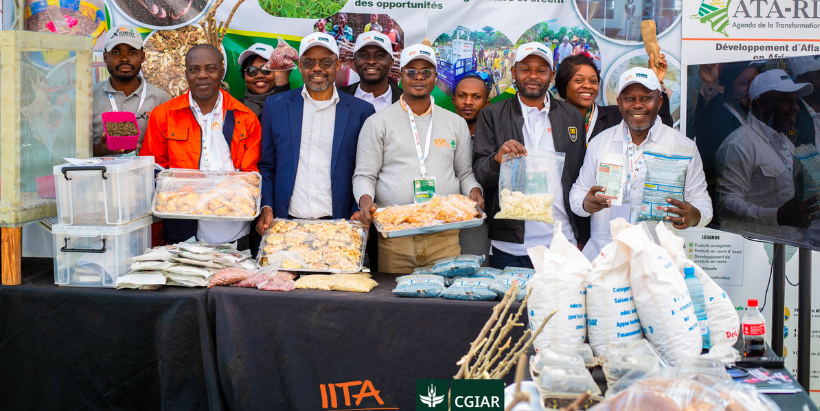
IITA Stand at the GSAD 2026, Lualaba, Kolwezi-DRC.

IITACGIAR‘s innovations continue to generate growing interest in the Democratic Republic of the Congo (DRC). Requests for partnerships, technical support, and scaling of its technologies are multiplying around its innovative solutions, which contribute to the sustainable transformation of agrifood systems and food security in the DRC.

Based on this development, from July 16 to 18, 2026, in Kolwezi, in the province of Lualaba, IITA took part in the 5th edition of the Grand Salon of Agribusiness and Digital in Africa, a major event bringing together public decision-makers, private sector, technical and financial partners, researchers, and entrepreneurs around the agricultural transformation of the DRC. Held under the theme “Agriculture, Mines and Technologies (AgriTech)”, this event highlighted synergies among these sectors to promote innovation, stimulate job creation, enhance local resources, and contribute to a sustainable future in the Democratic Republic of Congo.

IITA’s participation is fully in line with its mission to promote sustainable food systems, accelerate the adoption of agricultural innovations, and strengthen strategic partnerships to support agricultural transformation.
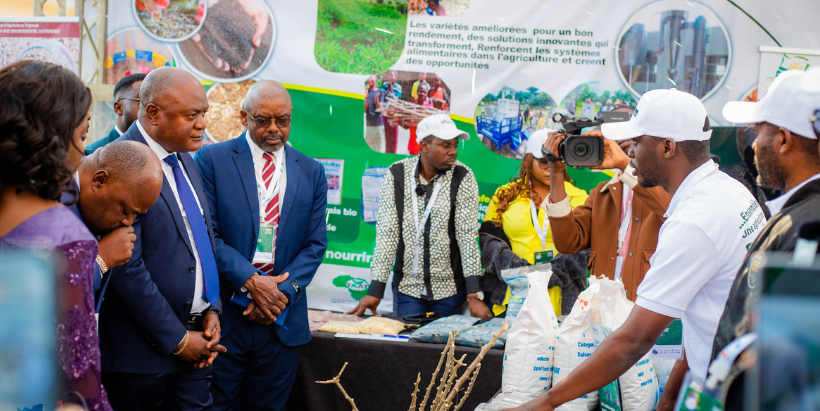
GSAD participants visiting the IITA stand.

Through its stand, IITA showcased a wide range of innovative technologies and solutions to address challenges in food security, agricultural productivity, agrifood processing, and job creation.

Visitors discovered, among other things, Aflasafe™, a biological technology for combating aflatoxins in maize, peanuts, and sorghum; NoduMax®, a biofertilizer that promotes soil fertility and biological nitrogen fixation in soybeans; improved seeds and high-quality seed systems; and improved cassava varieties and quality planting materials.

IITA also showcased the Black Soldier Fly technology, which transforms organic waste into larvae, a locally produced, sustainable, and protein-rich source of animal feed, while also producing an organic fertilizer (frass) from the residual organic matter processed by the larvae, thereby contributing to the sustainable improvement of soil fertility.

The booth also showcased innovations developed within the framework of the Cassava Value Chain Development (CVCD), including semi-autotrophic hydroponic (SAH) technology, several improved, high-yielding, disease- and pest-resistant cassava varieties (Obama, Ilona, Lumono, and Liyayi), as well as high-quality cassava flour (HQCF) and its derivative products including bread made from 10% HQCF and 90% wheat flour, waffles and doughnuts made from 50% HQCF, and starch flakes made from 100% cassava starch, illustrating the numerous opportunities for adding value to this crop.
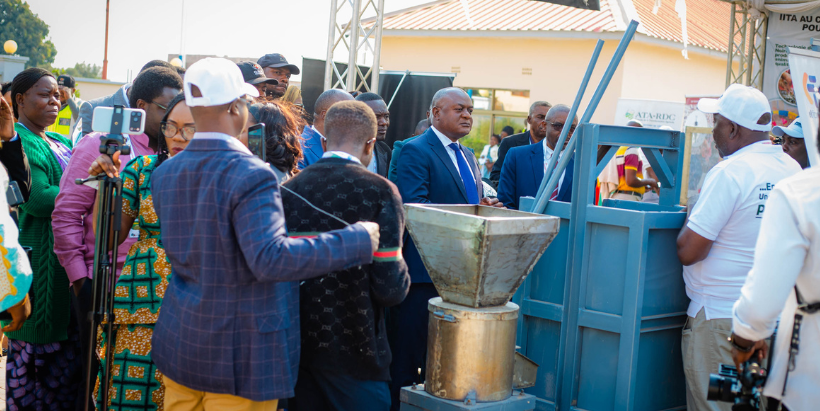
Showcase of cassava processing equipment.

Equipment for good agricultural practices and cassava processing, including a weeder, a grater, a press, and a hammer mill, was also on display. Finally, digital agriculture, traceability, and decision-support solutions, such as SeedTracker, were presented.

Over the three days of the trade fair, the IITA booth welcomed several hundred visitors, including national and provincial authorities, representatives of mining companies, technical and financial partners, universities, farmers’ organizations, and numerous young entrepreneurs. Several opportunities for collaboration were identified in seed systems, mechanization, cassava processing, digital agriculture, and bio-inputs.

During the high-level panels, IITA experts highlighted the Institute’s contributions to the sustainable transformation of agriculture in the DRC. Dr Joseph Atehnkeng presented IITA’s experience in developing agricultural value chains, seed systems, agrifood processing, and public-private partnerships; Dr Christopher Suh outlined IITA’s innovative solutions, including biofertilizers and sustainable soil management technologies to reduce dependence on imported inputs; while Dr Adebowale Abdul-Rasaq and Ir. Simon Lukombo presented IITA’s innovations in the cassava value chain, processing technologies, and business models that promote youth entrepreneurship and inclusive development.

Through these interventions, IITA experts demonstrated how agricultural research, technological innovation, and public-private partnerships can contribute to the industrialization of value chains, the development of local solutions to global challenges, and the creation of sustainable jobs.
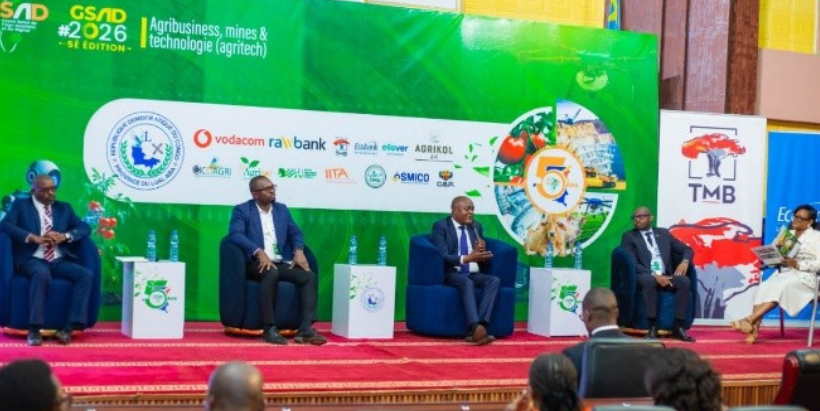
IITA experts participating in the panel discussion.

Alongside the conferences and the exhibition, the IITA team held several bilateral meetings with the authorities of the Lualaba Provincial Government, the technical services of the Ministry of Agriculture, financial institutions, universities, farmers’ organizations, and development partners to explore new opportunities for collaboration.

Through its participation in GSAD 2026, IITA reaffirms its commitment to supporting the Democratic Republic of Congo in modernizing its agriculture through research, innovation, and strategic partnerships. By bringing together producers, investors, public authorities, and the private sector around proven solutions, the Institute helps build more resilient, competitive, and job-creating food systems for the benefit of rural communities.


Contributed by

Ritha Bumwe and Nazareth Ambua

Scroll to Top
Olaosebikan, Olamide

Olamide Deborah Nwanze is a Senior Research Associate specializing in gender mainstreaming research to inform participatory and inclusive breeding, variety development, and seed systems policies regarding root, tuber, and banana (RTB) crops in the International Institute of Tropical Agriculture Headquarters, Ibadan, Nigeria. She is a PhD candidate at the University of Ibadan and holds an MSc and B. Agric in Agricultural Extension and Rural Development. Olamide is a fellow of the African Women in Agricultural Research and Development – Gender Responsive Agricultural Systems Policy (AWARD-GRASP) and the Gender Responsive Researchers Equipped for Agricultural Transformation (GREAT). She seeks to apply her gender-mainstreaming learnings, gender-responsive research, and policy development, and review expertise to facilitate women, youth, children, and vulnerable social group’s access to and adoption of agricultural Innovations that guarantee food, nutrition, income, and livelihood security in Africa. Her current roles include mentoring research fellows, development of guides and training manuals, implementation and adaptation of gender frameworks and tools, value chain actors’ engagement as citizen science partners, policy review and redesign, data management, and analysis. Her current research explores mixed methods and participatory and interdisciplinary approaches to capture and highlight gender dynamics, needs, preferences, and challenges stakeholders face within the agricultural livelihood value chain to prioritize gender-inclusive strategies in breeding programs, policy design, and implementation.

At IITA, she contributes to the implementation of the CGIAR Accelerated Breeding Initiative and Genetic Innovation Programs; participatory and gender research within the NextGen CassavaHarvestPlusRTBFoods, and Tricot-ClimMob 1000Farms Projects; and gender knowledge communication via the G-LENS webinar series, video documentary, policy briefspublications, and blogs.


Recent publications

de Sousa, K., van Etten, J., Manners, R. Bello, A., Teeken, B., Olaosebikan, O., et al. 2024. The tricot approach: an agile framework for decentralized on-farm testing supported by citizen science. A retrospective. Agron. Sustain. Dev. 44, 8. https://doi.org/10.1007/s13593-023-00937-1

Madu, T., Onwuka, S., Nwafor, S., Onyemauwa, N., Ejechi, M., Ofoeze, M., Ukeje, B., Eluagu, C., Olaosebikan, O., Okoye, B., 2024. Gender-Inclusive Consumer Studies Improve Cassava Breeding in Nigeria in: Frontiers in Sociology, volume 9, number: 1224504, doi: 10.3389/fsoc.2024.1224504

Olaosebikan, O.; Bello, A.; Utoblo, O.; Okoye, B.; Olutegbe, N.; Garner, E.; Teeken, B.; Bryan, E.; Forsythe, L.; Cole, S.; Madu, T. 2023.  Stressors and Resilience within the Cassava Value Chain in Nigeria: Preferred Cassava Variety Traits and Response Strategies of Men and Women to Inform Breeding. Sustainability 15, 7837. https://doi.org/10.3390/su15107837

Okoye, B., Ofoeze, M., Ejechi, M., Onwuka, S., Nwafor, S., Onyemauwa, N., Ukeje, B., Eluagu, C., Obidiegwu, J.*, Olaosebikan, O., Madu, T.* 2023. Prioritizing preferred traits in the yam value chain in Nigeria: a gender situation analysis in: Frontiers in Sociology, volume 8, number: 1232626, pages 1 – 9, ISSN 2297-7775, 2023. https://www.frontiersin.org/articles/10.3389/fsoc.2023.1232626/full

Olaosebikan, O., Bello, A. A., de Sousa, K., Ndjouenkeu, R., Adesokan, M., Alamu, E. O., Agbona, A., van Etten, J., Kegah, F. N.*, Dufour, D., Bouniol, A., Teeken, B. 2023. Consumer acceptability of cassava gari-eba food products across cultural and environmental settings using the triadic comparison of technologies approach (tricot) in: Journal of the Science of Food and Agriculture,

Teeken, B., Olaosebikan, O., Bello, A. A., Madu, T.*, Cole, S. M. 2023. Qualitative assessment on the positionality and preferences of dyads in relation to cassava-related activities: working with tricot trial citizen scientists https://hdl.handle.net/10568/138326 Type: Manual

Bouniol, A., Ceballos, H., Bello, A. A., Teeken, B., Olaosebikan, O., Owoade, D., Agbona, A., Fotso Kuate, A., Madu, T.*, Okoye, B.*, Ofoeze, M.*, Nwafor, S.*, Onyemauwa, N.*, Adinsi, L.*, Forsythe, L., Dufour, D. 2023. Varietal impact on women’s labour, workload and related drudgery in processing root, tuber and banana crops: focus on cassava in sub-Saharan Africa in: Journal of the Science of Food and Agriculture, pages 1 – 25, ISSN 0022-5142,

Bello, A. A., Agbona, A., Olaosebikan, O., Edughaen, G., Dufour, D., Bouniol, A., Iluebbey, P., Ndjouenkeu, R.*, Rabbi, I. Y., Teeken, B. 2023. Genetic and environmental effects on processing productivity and food product yield: drudgery of women’s work in: Journal of the Science of Food and Agriculture, pages 1 – 32, ISSN 0022-5142, 5

Cavicchioli, M., Zimbiti, T., Teeken, B., Nwanze, D.O., Liani, M., Parkes, E. & Bello, A. 2023. IITA-Gender Responsive Breeding Training Report. Genetic Resources Center, IITA-HQ, Ibadan, 21-23 September, 2022. Ibadan, Nigeria: IITA, (34 p.).https://hdl.handle.net/10568/131368

Agbona, A. Peteti P., Teeken B., Olaosebikan O. Bello, A. A., Parkes, E., Rabbi, I. Y., Mueller, L., Egesi, C., Kulakow, P. 2022. Data Management in Multi-disciplinary African RTB Crop Breeding Programs. In: Williamson, H.F., Leonelli, S. (eds) Towards Responsible Plant Data Linkage: Data Challenges for Agricultural Research and Development. Springer, Cham. https://doi.org/10.1007/978-3-031-13276-6_5

Lora Forsythe, Pricilla Marimo, Sarah Mayanja, Olamide D. Olaosebikan, Esme Stuart, Bela Teeken, Benjamin Okoye, Tessy Madu, (2021). Cross-product Gender Analysis of RTBfoods Step 2 Gendered Food Mapping on RTB Products. Understanding the Drivers of Trait Preferences and the Development of Multi-user RTB Product Profiles, WP1. London, UK: RTBfoods Field Scientific Report, 30 p.

Teeken, B., Garner, E., Agbona, A., Balogun, I., Olaosebikan, O., Bello, A., Madu, T., Okoye, B., Egesi, C., Kulakow, P. and Tufan, H.A. 2021. Beyond “Women’s Traits”: Exploring How Gender, Social Difference, and Household Characteristics Influence Trait Preferences. Frontiers Sustainable Food Systems 5:740926. https://doi.org/10.3389/fsufs.2021.740926

Teeken, B., Agbona, A., Bello, A., Olaosebikan, O., Alamu, E., Adesokan, M., Awoyale, W., Madu, T., Okoye, B., Chijioke, U., Owoade, D., Okoro, M., Bouniol, A., Dufour, D., Hershey, C., Rabbi, I., Maziya‐Dixon, B., Egesi, C., Tufan, H. and Kulakow, P. (020. Understanding cassava varietal preferences through pairwise ranking of gari‐eba and fufu prepared by local farmer–processors. Int J Food Sci Technol. https://doi.org/10.1111/ijfs.14862

Bela Teeken, Olamide Olaosebikan, Ireti Balogun, Benjamin Okoye, Tessy Madu, Steven Cole, Abolore Bello, Elizabeth Parkes. (2020). Piloting the G+ customer and product profile tools for gender-responsive cassava breeding in Nigeria. Nigeria: International Institute of Tropical Agriculture (IITA). https://hdl.handle.net/20.500.11766/13000