NEWS

Beyond the Boardroom: Inside IITA’s science and impact
October 23, 2026
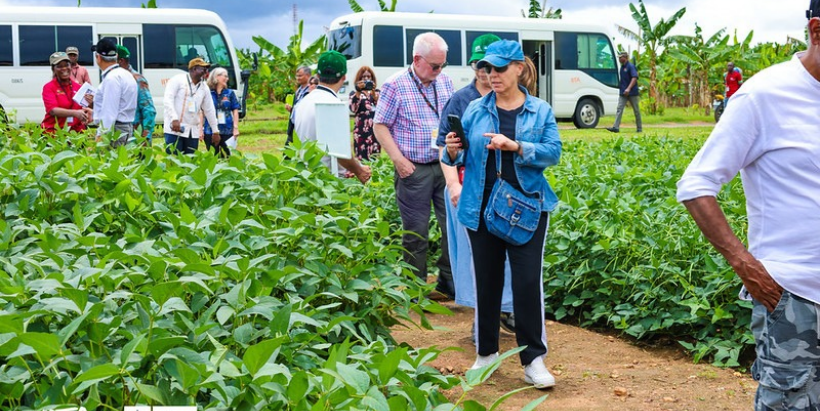
CGIAR Board members arriving at IITA's research fields in Ibadan.
CGIAR Board members arriving at IITA’s research fields in Ibadan.

Some stories are best understood not from a boardroom, but from the field.

And walking through research fields, seeing firsthand where discoveries take shape in laboratories, and standing beneath the towering canopy of the IITA Forest offered a different perspective entirely for the CGIAR Board members and senior leaders on the sidelines of the Board meeting, Futures Workshop and Global Leadership Team (GLT) held at IITA headquarters in Ibadan from 23-29 September.  

Their tour took them through research fields where innovations are tested, laboratories where research breakthroughs begin, the internationally recognized IITA Forest that protects biodiversity in southwestern Nigeria, and facilities that support one of Africa’s leading agricultural research institutions.

The tour highlighted not only what IITA is accomplishing today, but the legacy of science, partnership, and people working together to transform lives for six decades.

Reflecting on the Institute’s remarkable journey, Sylvia Oyinlola, CGIAR Global Head of the System Council Secretariat said, “IITA has done a lot of amazing and impactful work over 50 years,” adding that scaling even more of those innovations will help “show the world what they can do.”

Her observation speaks to a defining feature of IITA’s work. The Institute has long recognized that research achieves its greatest value when it moves beyond scientific publications to reach farmers, communities, policymakers, and markets.

From improved cassava and maize varieties to healthier bananas and plantains, resilient soybeans, breeding in cowpea, and yam research, IITA’s work continues to demonstrate how science can address real-world challenges.

Professor Ramesh Chand, a CGIAR Board member, speaking on how Africa’s agricultural future can be driven by African-led science said, “IITA is on the path of helping Africa drive its own Green Revolution like India, and it is commendable.”

His comparison points to something larger than the innovations IITA has developed over the years. It reflects growing confidence that investments in African research institutions, locally adapted innovations, and strong partnerships can help unlock sustainable agricultural growth tailored to the continent’s own realities.
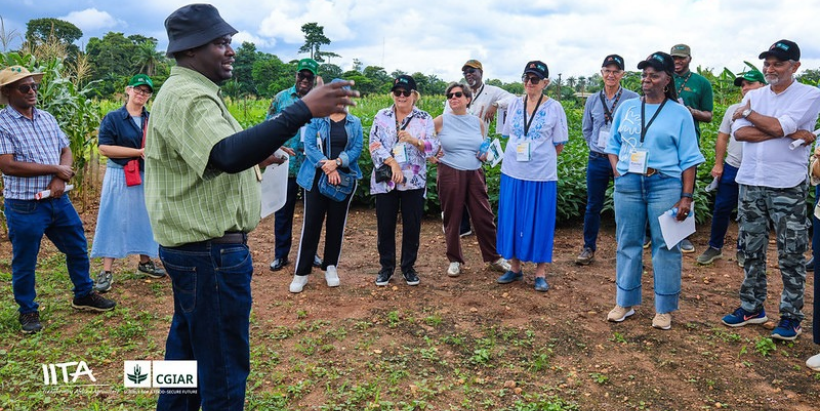
Dean Muungani, IITA Product Manager presenting research trial results to the Board members during the tour.

Inside IITA’s laboratories and on the field, the visitors saw where the research is being carried out, before it continues the journey through field trials, partnerships, and scaling efforts across over 25 countries.

For Dr Stanford Blade, Deputy Director General for Research at International Crops Research Institute for the Semi-Arid Tropics (ICRISAT), the significance of IITA’s work is already visible across these countries.

“IITA’s research impact seen across sub-Saharan Africa is laudable.”

That impact spans crop improvement, plant health, sustainable farming practices, digital agriculture, biological solutions, and efforts to strengthen food systems in the face of climate change and emerging threats.

The people behind the science

One message that surfaced repeatedly throughout the meetings and visit: great people build great institutions.

Estelle Carino, Ethics and Compliance Officer at International Maize and Wheat Improvement Center (CIMMYT), believes IITA’s greatest strength extends beyond its scientific achievements. “With the great science IITA is deploying, the best thing IITA has is its people.”

She described IITA’s teams as a powerful example of collaboration in action, “They are a great example of teamwork,” she added.

That spirit of collaboration is visible across the campus, where scientists, technical staff, students, field teams, and research support staff work together across disciplines and countries to tackle some of agriculture’s biggest challenges.
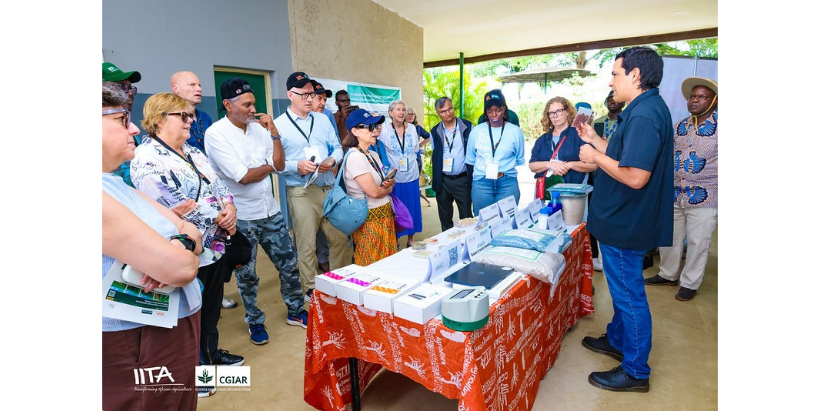
Alejandro Ortega-Beltran, Head of Pathology and Mycotoxin/Aflasafe Unit, IITA speaking on the impact of Aflasafe.

Offering the visitors a reminder that agricultural research is also about protecting the ecosystems that sustain food production, the IITA Forest, one of Nigeria’s most important remaining forest reserves, showcased the Institute’s commitment to biodiversity conservation alongside agricultural innovation.

The forest stands as an example that agriculture and conservation can reinforce one another in building more resilient food systems.

Vanessa Riveros, from Global People and Culture at the Alliance of Bioversity International and CIAT, found that balance particularly inspiring, “I think it is amazing the biodiversity work that IITA is doing, protecting the environment and biodiversity in Nigeria.”

The tour captured something more insightful than research excellence for Ndidi Okonkwo Nwuneli, Executive Chair of Sahel Consulting, “IITA has the amazing power of science to change lives.”

She also recognized the people who make that mission possible.

“The hardworking, innovative team members show the beauty of collaboration, hard work, and commitment.”

Her reflection captures the essence of what the delegation encountered throughout the week: innovation is rarely the work of individuals alone. It grows through partnerships, shared purpose, and a commitment to creating solutions that impact millions of lives.

More than a tour

By walking through research fields where tomorrow’s crops are being tested, visiting laboratories where discoveries are taking shape, exploring a forest that safeguards biodiversity, and meeting the people behind the work, CGIAR Board members experienced the full breadth of IITA’s mission.

Their reflections point to an institution whose influence extends far beyond its headquarters in Ibadan—one whose research is helping shape agricultural transformation across Africa while demonstrating how research excellence, environmental stewardship, and human collaboration can work together to build more resilient food systems.

As IITA looks toward the future, the message from the CGIAR Board was clear: the Institute’s greatest strength lies not only in what it has achieved in close to 60 years, but in its capacity to scale innovation, strengthen partnerships, and continue using science to improve lives across the continent.


Contributed by

Timilehin Osunde

Scroll to Top
Olaosebikan, Olamide

Olamide Deborah Nwanze is a Senior Research Associate specializing in gender mainstreaming research to inform participatory and inclusive breeding, variety development, and seed systems policies regarding root, tuber, and banana (RTB) crops in the International Institute of Tropical Agriculture Headquarters, Ibadan, Nigeria. She is a PhD candidate at the University of Ibadan and holds an MSc and B. Agric in Agricultural Extension and Rural Development. Olamide is a fellow of the African Women in Agricultural Research and Development – Gender Responsive Agricultural Systems Policy (AWARD-GRASP) and the Gender Responsive Researchers Equipped for Agricultural Transformation (GREAT). She seeks to apply her gender-mainstreaming learnings, gender-responsive research, and policy development, and review expertise to facilitate women, youth, children, and vulnerable social group’s access to and adoption of agricultural Innovations that guarantee food, nutrition, income, and livelihood security in Africa. Her current roles include mentoring research fellows, development of guides and training manuals, implementation and adaptation of gender frameworks and tools, value chain actors’ engagement as citizen science partners, policy review and redesign, data management, and analysis. Her current research explores mixed methods and participatory and interdisciplinary approaches to capture and highlight gender dynamics, needs, preferences, and challenges stakeholders face within the agricultural livelihood value chain to prioritize gender-inclusive strategies in breeding programs, policy design, and implementation.

At IITA, she contributes to the implementation of the CGIAR Accelerated Breeding Initiative and Genetic Innovation Programs; participatory and gender research within the NextGen Cassava, HarvestPlus, RTBFoods, and Tricot-ClimMob 1000Farms Projects; and gender knowledge communication via the G-LENS webinar series, video documentary, policy briefs, publications, and blogs.


Recent publications

de Sousa, K., van Etten, J., Manners, R. Bello, A., Teeken, B., Olaosebikan, O., et al. 2024. The tricot approach: an agile framework for decentralized on-farm testing supported by citizen science. A retrospective. Agron. Sustain. Dev. 44, 8. https://doi.org/10.1007/s13593-023-00937-1

Madu, T., Onwuka, S., Nwafor, S., Onyemauwa, N., Ejechi, M., Ofoeze, M., Ukeje, B., Eluagu, C., Olaosebikan, O., Okoye, B., 2024. Gender-Inclusive Consumer Studies Improve Cassava Breeding in Nigeria in: Frontiers in Sociology, volume 9, number: 1224504, doi: 10.3389/fsoc.2024.1224504

Olaosebikan, O.; Bello, A.; Utoblo, O.; Okoye, B.; Olutegbe, N.; Garner, E.; Teeken, B.; Bryan, E.; Forsythe, L.; Cole, S.; Madu, T. 2023.  Stressors and Resilience within the Cassava Value Chain in Nigeria: Preferred Cassava Variety Traits and Response Strategies of Men and Women to Inform Breeding. Sustainability 15, 7837. https://doi.org/10.3390/su15107837

Okoye, B., Ofoeze, M., Ejechi, M., Onwuka, S., Nwafor, S., Onyemauwa, N., Ukeje, B., Eluagu, C., Obidiegwu, J.*, Olaosebikan, O., Madu, T.* 2023. Prioritizing preferred traits in the yam value chain in Nigeria: a gender situation analysis in: Frontiers in Sociology, volume 8, number: 1232626, pages 1 – 9, ISSN 2297-7775, 2023. https://www.frontiersin.org/articles/10.3389/fsoc.2023.1232626/full

Olaosebikan, O., Bello, A. A., de Sousa, K., Ndjouenkeu, R., Adesokan, M., Alamu, E. O., Agbona, A., van Etten, J., Kegah, F. N.*, Dufour, D., Bouniol, A., Teeken, B. 2023. Consumer acceptability of cassava gari-eba food products across cultural and environmental settings using the triadic comparison of technologies approach (tricot) in: Journal of the Science of Food and Agriculture,

Teeken, B., Olaosebikan, O., Bello, A. A., Madu, T.*, Cole, S. M. 2023. Qualitative assessment on the positionality and preferences of dyads in relation to cassava-related activities: working with tricot trial citizen scientists https://hdl.handle.net/10568/138326 Type: Manual

Bouniol, A., Ceballos, H., Bello, A. A., Teeken, B., Olaosebikan, O., Owoade, D., Agbona, A., Fotso Kuate, A., Madu, T.*, Okoye, B.*, Ofoeze, M.*, Nwafor, S.*, Onyemauwa, N.*, Adinsi, L.*, Forsythe, L., Dufour, D. 2023. Varietal impact on women’s labour, workload and related drudgery in processing root, tuber and banana crops: focus on cassava in sub-Saharan Africa in: Journal of the Science of Food and Agriculture, pages 1 – 25, ISSN 0022-5142,

Bello, A. A., Agbona, A., Olaosebikan, O., Edughaen, G., Dufour, D., Bouniol, A., Iluebbey, P., Ndjouenkeu, R.*, Rabbi, I. Y., Teeken, B. 2023. Genetic and environmental effects on processing productivity and food product yield: drudgery of women’s work in: Journal of the Science of Food and Agriculture, pages 1 – 32, ISSN 0022-5142, 5

Cavicchioli, M., Zimbiti, T., Teeken, B., Nwanze, D.O., Liani, M., Parkes, E. & Bello, A. 2023. IITA-Gender Responsive Breeding Training Report. Genetic Resources Center, IITA-HQ, Ibadan, 21-23 September, 2022. Ibadan, Nigeria: IITA, (34 p.).https://hdl.handle.net/10568/131368

Agbona, A. Peteti P., Teeken B., Olaosebikan O. Bello, A. A., Parkes, E., Rabbi, I. Y., Mueller, L., Egesi, C., Kulakow, P. 2022. Data Management in Multi-disciplinary African RTB Crop Breeding Programs. In: Williamson, H.F., Leonelli, S. (eds) Towards Responsible Plant Data Linkage: Data Challenges for Agricultural Research and Development. Springer, Cham. https://doi.org/10.1007/978-3-031-13276-6_5

Lora Forsythe, Pricilla Marimo, Sarah Mayanja, Olamide D. Olaosebikan, Esme Stuart, Bela Teeken, Benjamin Okoye, Tessy Madu, (2021). Cross-product Gender Analysis of RTBfoods Step 2 Gendered Food Mapping on RTB Products. Understanding the Drivers of Trait Preferences and the Development of Multi-user RTB Product Profiles, WP1. London, UK: RTBfoods Field Scientific Report, 30 p.

Teeken, B., Garner, E., Agbona, A., Balogun, I., Olaosebikan, O., Bello, A., Madu, T., Okoye, B., Egesi, C., Kulakow, P. and Tufan, H.A. 2021. Beyond “Women’s Traits”: Exploring How Gender, Social Difference, and Household Characteristics Influence Trait Preferences. Frontiers Sustainable Food Systems 5:740926. https://doi.org/10.3389/fsufs.2021.740926

Teeken, B., Agbona, A., Bello, A., Olaosebikan, O., Alamu, E., Adesokan, M., Awoyale, W., Madu, T., Okoye, B., Chijioke, U., Owoade, D., Okoro, M., Bouniol, A., Dufour, D., Hershey, C., Rabbi, I., Maziya‐Dixon, B., Egesi, C., Tufan, H. and Kulakow, P. (020. Understanding cassava varietal preferences through pairwise ranking of gari‐eba and fufu prepared by local farmer–processors. Int J Food Sci Technol. https://doi.org/10.1111/ijfs.14862

Bela Teeken, Olamide Olaosebikan, Ireti Balogun, Benjamin Okoye, Tessy Madu, Steven Cole, Abolore Bello, Elizabeth Parkes. (2020). Piloting the G+ customer and product profile tools for gender-responsive cassava breeding in Nigeria. Nigeria: International Institute of Tropical Agriculture (IITA). https://hdl.handle.net/20.500.11766/13000