
Agricultural challenge: where ICT play a role
January 15, 2016
The use of information and communication technology (ICT) in agriculture has been identified as one of the best ways to enhance access to finance for smallholder farmers and transform unproductive farming activities in Africa into sustainable means of livelihood.
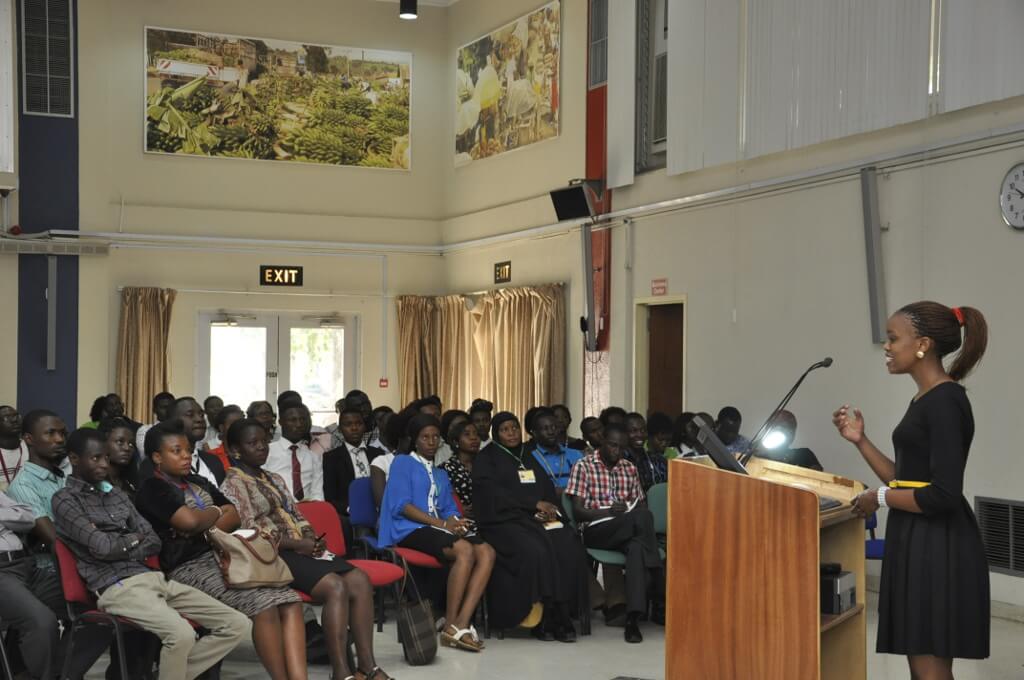 Rita Kimani, the co-founder of FarmDrive, said this on 12 January during a seminar organized by the IITA Youth Agripreneurs (IYA) on ICT and Agriculture at the IITA headquarters in Ibadan, Nigeria.
FarmDrive is a Kenya-based ICT company which helps smallholder farmers access loans through a technology platform used in collecting data on farmers. The data is used to link farmers with sources of credit, increasing their income by 300% in the process. Speaking at the seminar titled “ICT meets Agriculture,” Rita stressed that some of the challenges faced by smallholder farmers in Africa include access to finance, a huge information gap between the farmers and lenders, and operational risks involved in agriculture. She added that the use of the latest technology and data is the only means of helping the smallholder farmers address these challenges.
Highlighting the importance of the use of ICT in this regard, Rita added that ICT can be used by smallholder farmers in carrying out soil tests on their farm before planting. She stated that through the use of mobile phone applications, ICT can help farmers share knowledge with extension services, consult with experts, have access to inputs, enhance marketing skills especially in the areas of determining market prices, understand market demand, and establish a trading platform between the smallholder farmers and the consumers.
Sharing her experiences on the use of ICT in helping smallholder farmers in Kenya, Rita said that FarmDrive, which is currently working with over a thousand farmers in the country, uses a platform to collect self-reported farm-level data from farmers, value chain players, and satellite data for smallholder farmers.
IYA panelists at the seminar—Tomiwa Adesanya, Bunmi Ajilore, Damola Adewole, and Rita—all agreed that the use of ICT can help change the perception on agriculture and emphasize its new role as a transformative driver of the economy.
Speaking at the end of the seminar, IITA Director General Nteranya Sanginga urged the youth to take the issue of ICT in agriculture seriously as it provides numerous opportunities for youth involvement.
He emphasized that with the government move to embrace agriculture in generating income for the country, the youth will play a major role in reviving the economy through agriculture. He said that the only way to make the agricultural practice distinct from the way it was being practiced is to treat it as a business and introduce attractive technologies.
Rita Kimani, the co-founder of FarmDrive, said this on 12 January during a seminar organized by the IITA Youth Agripreneurs (IYA) on ICT and Agriculture at the IITA headquarters in Ibadan, Nigeria.
FarmDrive is a Kenya-based ICT company which helps smallholder farmers access loans through a technology platform used in collecting data on farmers. The data is used to link farmers with sources of credit, increasing their income by 300% in the process. Speaking at the seminar titled “ICT meets Agriculture,” Rita stressed that some of the challenges faced by smallholder farmers in Africa include access to finance, a huge information gap between the farmers and lenders, and operational risks involved in agriculture. She added that the use of the latest technology and data is the only means of helping the smallholder farmers address these challenges.
Highlighting the importance of the use of ICT in this regard, Rita added that ICT can be used by smallholder farmers in carrying out soil tests on their farm before planting. She stated that through the use of mobile phone applications, ICT can help farmers share knowledge with extension services, consult with experts, have access to inputs, enhance marketing skills especially in the areas of determining market prices, understand market demand, and establish a trading platform between the smallholder farmers and the consumers.
Sharing her experiences on the use of ICT in helping smallholder farmers in Kenya, Rita said that FarmDrive, which is currently working with over a thousand farmers in the country, uses a platform to collect self-reported farm-level data from farmers, value chain players, and satellite data for smallholder farmers.
IYA panelists at the seminar—Tomiwa Adesanya, Bunmi Ajilore, Damola Adewole, and Rita—all agreed that the use of ICT can help change the perception on agriculture and emphasize its new role as a transformative driver of the economy.
Speaking at the end of the seminar, IITA Director General Nteranya Sanginga urged the youth to take the issue of ICT in agriculture seriously as it provides numerous opportunities for youth involvement.
He emphasized that with the government move to embrace agriculture in generating income for the country, the youth will play a major role in reviving the economy through agriculture. He said that the only way to make the agricultural practice distinct from the way it was being practiced is to treat it as a business and introduce attractive technologies.
Rita addressing participants during the seminar
Contributed by
Recent stories
No items found