
IFAD/ IITA/HQCF value chain project organizes farmers’ field day
January 15, 2016
The IFAD/IITA HQCF Value chain project organized a field day at Ijoga-Orile on 8 December 2015, bringing together HQCF master bakers, extension agents, farmers, financial institutions, input suppliers, local machine fabricators, marketers, nutritionists, processors, researchers, transporters, youth, and students. The event was hosted by project partner Open Door International Ltd.
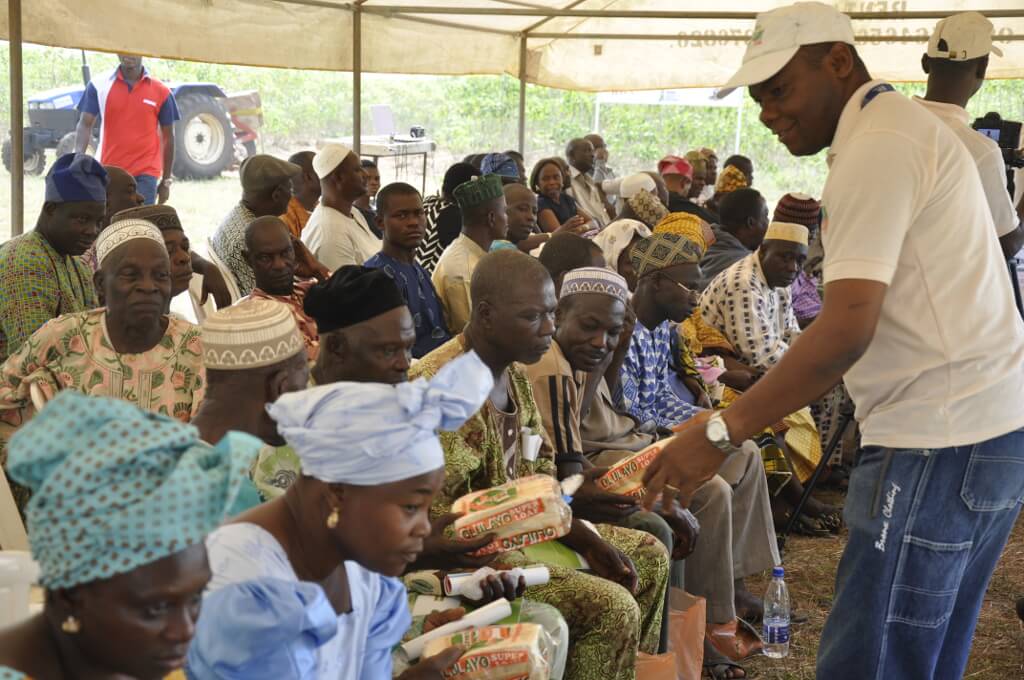 More than 120 project and non-project farmers participated in the field day. The field day aimed to allow project farmers and non-project farmers to participate and witness the harvesting of the demo farm planted at Ijoga-Orile; bring together all actors in the value chain at Ijoga-Orile and foster a business-oriented sustainable platform; and finally say thank you to the community for welcoming the project and Open Door to Ijoga-Orile.
“The result of profitable cassava production is what we are witnessing today,” said Alhaji Aderemi Mohammed, CEO and Director of Open Door International, who encouraged other farmers within the environs of Ijoga-Orile to work with the project and his processing factory. He said he is ready to procure all cassava roots that the farmers produce.
Various farm inputs were on display, such as herbicides and improved cassava stems; also 10% HQCF/wheat bread was given to participants.
During the feedback session, community representatives called for more field days and expressed thanks to IITA for introducing a cassava variety that was able to withstand the dry season conditions and produce a bumper harvest, which they witnessed. One of the youth and a project beneficiary, who spoke on behalf of the other youths, appreciated the effort of the Project for the training they acquired on mechanical planting, farm management, and weed control.
Kehinde Adegbola, a non-project farmer, expressed his surprise at the cassava varieties the project introduced and the bountiful yield. He said he wondered if cassava can be easily harvested irrespective of the dry season. “I can say categorically that the cassava business has been made easy and is now more profitable than before.”
The IFAD/IITA/HQCF Value Chain Project Coordinator, Alenkhe Bamidele, in his closing remarks thanked the community for their warm acceptance of the project and advised all participants to take advantage of all the useful products that the project had introduced within the 12 months of working in Ijoga-Orile. He also urged all actors along the value chain to work together, exploiting existing business opportunities that can be generated within the platform as members of the Ijoga-Orile innovation platform.
More than 120 project and non-project farmers participated in the field day. The field day aimed to allow project farmers and non-project farmers to participate and witness the harvesting of the demo farm planted at Ijoga-Orile; bring together all actors in the value chain at Ijoga-Orile and foster a business-oriented sustainable platform; and finally say thank you to the community for welcoming the project and Open Door to Ijoga-Orile.
“The result of profitable cassava production is what we are witnessing today,” said Alhaji Aderemi Mohammed, CEO and Director of Open Door International, who encouraged other farmers within the environs of Ijoga-Orile to work with the project and his processing factory. He said he is ready to procure all cassava roots that the farmers produce.
Various farm inputs were on display, such as herbicides and improved cassava stems; also 10% HQCF/wheat bread was given to participants.
During the feedback session, community representatives called for more field days and expressed thanks to IITA for introducing a cassava variety that was able to withstand the dry season conditions and produce a bumper harvest, which they witnessed. One of the youth and a project beneficiary, who spoke on behalf of the other youths, appreciated the effort of the Project for the training they acquired on mechanical planting, farm management, and weed control.
Kehinde Adegbola, a non-project farmer, expressed his surprise at the cassava varieties the project introduced and the bountiful yield. He said he wondered if cassava can be easily harvested irrespective of the dry season. “I can say categorically that the cassava business has been made easy and is now more profitable than before.”
The IFAD/IITA/HQCF Value Chain Project Coordinator, Alenkhe Bamidele, in his closing remarks thanked the community for their warm acceptance of the project and advised all participants to take advantage of all the useful products that the project had introduced within the 12 months of working in Ijoga-Orile. He also urged all actors along the value chain to work together, exploiting existing business opportunities that can be generated within the platform as members of the Ijoga-Orile innovation platform.
Gregory Nwaoliwe, HQCF Project staff, gives 10% HQCF-Wheat bread to participants during the field day.
Contributed by
Recent stories
No items found