
IITA NEWS

Alliance reviews pilot control strategies for banana bunchy top disease in Africa
March 21, 2015

Members of the Alliance for Banana Bunchy Top Disease (BBTD) Control in Africa met at IITA, Ibadan, Nigeria, 9-14 March, to share progress made during the first year of pilot site implementation in eight countries in sub-Saharan Africa and to develop follow-up action.
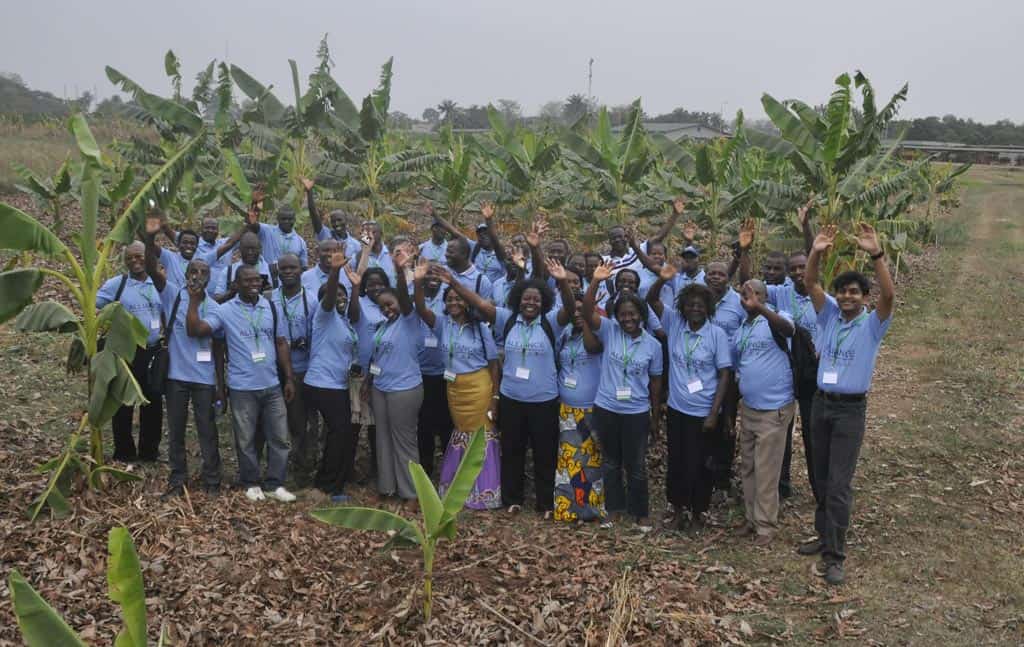
Picture of Alliance members during a tour of IITA banana fields in Ibadan, Nigeria, led by Lava Kumar (extreme right).
Alliance members during a tour of IITA banana fields in Ibadan, Nigeria, led by Lava Kumar (extreme right).

The meeting was attended by about 50 implementing partners from 11 countries. It provided a platform for refining the protocols for studying the BBTD epidemiology; mapping household and community social practices; ensuring clean seed production and supply; and developing a plan that consolidated and improved shared learning for implementation in 2015.

BBTD, caused by the Banana bunchy top virus (BBTV), is the most devastating disease of banana for which no sources of resistance are available. The disease is spread through infected planting material and also by an insect vector—the banana aphid.

Banana is one of the key staple crops supporting the livelihoods of an estimated 100 million people, most of who live in sub-Saharan Africa. Over 50% of the world’s production of banana ( and plantain) is grown in the region.

Bunchy top was first reported from Africa in 1901 and has spread extensively into new production areas during the last two decades. It recently invaded Bénin and Nigeria in West Africa and had a limited spread within the Kivu provinces of DR Congo, neighbor to Ug anda, the largest banana-producing country in Africa. Currently, BBTD occurrence has been confirmed in 13 countries in sub-Saharan Africa.

In February 2013, experts under the umbrella of the CGIAR Research Program on Roots, Tubers and Bananas (RTB) formed an alliance to implement medium and long-term strategies to control BBTD in sub-Saharan Africa. The ongoing initiative under this framework, Banana bunchy top disease containment and recovery in sub-Saharan Africa: Building capacity and piloting field recovery approaches through a learning alliance is led by IITA, Bioversity International, CIRAD, together with national partners in Bénin, Burundi, Cameroon, Congo Brazzaville, DR Congo, Ghana, Malawi, and Nigeria.

The alliance is focused on field-scale approaches to the recovery of BBTD-infested areas. This includes (i) Eradication of infected plants, (ii) Design of a supply flow for BBTV-free planting material, (iii) Establishment of clean fields in the banana-free zone with virus-free planting material; and (iv) Development of capacity for disease diagnosis and control, including training farmers in producing clean planting material.

“All sites have partnered with new communities to establish banana-free fallows and a supply chain for BBTV-free planting material and these partnerships are working well” said Charles Staver of Bioversity International. He also emphasized that the success of the alliance lay in the strength of the partnerships. The project is building on previous work to assess the extent of BBTV spread in the target countries. It evaluates banana and plantain l andraces and synthetic hybrids in endemic sites to assess their performance against BBTD and the banana aphid. “This work has shown some Musa cultivars with a high degree of tolerance to BBTD that can be used in endemic areas,” said Rachid Hanna, Entomologist, IITA-Cameroon.

“Training in developing diagnostic skills is one of the focus areas of the project. Pilot sites have started to adopt diagnostic protocols for virus indexing following the training course held in July 2014 in Montpellier,” said Marie-Line Caruana, Virologist, CIRAD.

The project has also focused on building research capacity through three PhD and five MSc students on aspects of the cropping system, epidemiology and ecology of BBTD, varietal reaction to disease, and socioeconomic studies. The project has partnered with the gender and socioeconomic group of RTB to identify the household and community dimensions to mobilizing recovery areas from BBTD.

“The pilot sites are proving to be effective platforms for testing new strategies and technologies, learning and forming excellent in-situ avenues for training and capacity strengthening. The pilot zone concept can be scaled up and scaled out in the eight target countries and exp anded to five other BBTD-affected countries (Angola, Central African Republic, Equatorial Guinea, Rw anda, and Zambia) in the next phase,” said Lava Kumar, Virologist and workshop organizer, IITA-Nigeria.

A session on ‘innovations’ was organized as part of this workshop and dealt with the latest initiatives to tackle BBTD through underst anding virus-host-vector interactions, disease impact on planting material degeneration, transgenic approaches to develop resistance to BBTV and the banana aphid, underst anding vector dynamics in relation to climate change, new propagation technologies using tissue culture and bioreactors, and the potential for youth agripreneurs in banana seed production. Experiences and lessons from BBTD management efforts in Australia were shared by John Thomas, Virologist from the University of Queensl and, Brisbane, who attended as an external expert and appreciated the efforts of the alliance to control BBTD.

Participants were exposed to the phytosanitary and indexing procedures used to generate healthy planting material, the in-vitro conservation of Musa in the IITA gene bank, and the breeder’s reference collection in the field.

As part of the program, participants visited BBTD-affected areas in Idologun, Ogun State, which is also the base for the Nigerian pilot site and interacted with farmers and community leaders about the action being taken to mitigate BBTD. Sunday Akinyemi (NIHORT) and Charles Onyeani (NAQS) outlined the scheme being used to recover banana production in the pilot site. Dr Claude Mvila from Congo Republic appreciated the involvement of the entire community, from leaders to laborers, in this initiative.

For more information, please contact:

Lava Kumar, Head of the Germplasm Health Unit, and Virology and Molecular Diagnostics Unit l.kumar@cgiar.org

Andrea Gros, Head of Communication, International Institute of Tropical Agriculture a.gros@cgiar.org

About IITA, www.iita.org

IITA is one of the world’s leading research partners in finding solutions for hunger, malnutrition, and poverty. Its award-winning research for development (R4D) approach addresses the development needs of tropical countries. IITA works with partners to enhance crop quality and productivity, reduce producer and consumer risks, and generate wealth from agriculture. IITA is a nonprofit organization founded in 1967 and governed by a Board of Trustees. IITA works on the following crops: cowpea, soybean, banana/plantain, yam, cassava, and maize. IITA is a member of CGIAR, a global agriculture research partnership for a food secure future.


Contributed by

Related news

No items found

Leave a Reply

Your email address will not be published. Required fields are marked *

Scroll to Top
Olaosebikan, Olamide

Olamide Deborah Nwanze is a Senior Research Associate specializing in gender mainstreaming research to inform participatory and inclusive breeding, variety development, and seed systems policies regarding root, tuber, and banana (RTB) crops in the International Institute of Tropical Agriculture Headquarters, Ibadan, Nigeria. She is a PhD candidate at the University of Ibadan and holds an MSc and B. Agric in Agricultural Extension and Rural Development. Olamide is a fellow of the African Women in Agricultural Research and Development – Gender Responsive Agricultural Systems Policy (AWARD-GRASP) and the Gender Responsive Researchers Equipped for Agricultural Transformation (GREAT). She seeks to apply her gender-mainstreaming learnings, gender-responsive research, and policy development, and review expertise to facilitate women, youth, children, and vulnerable social group’s access to and adoption of agricultural Innovations that guarantee food, nutrition, income, and livelihood security in Africa. Her current roles include mentoring research fellows, development of guides and training manuals, implementation and adaptation of gender frameworks and tools, value chain actors’ engagement as citizen science partners, policy review and redesign, data management, and analysis. Her current research explores mixed methods and participatory and interdisciplinary approaches to capture and highlight gender dynamics, needs, preferences, and challenges stakeholders face within the agricultural livelihood value chain to prioritize gender-inclusive strategies in breeding programs, policy design, and implementation.

At IITA, she contributes to the implementation of the CGIAR Accelerated Breeding Initiative and Genetic Innovation Programs; participatory and gender research within the NextGen CassavaHarvestPlusRTBFoods, and Tricot-ClimMob 1000Farms Projects; and gender knowledge communication via the G-LENS webinar series, video documentary, policy briefspublications, and blogs.


Recent publications

de Sousa, K., van Etten, J., Manners, R. Bello, A., Teeken, B., Olaosebikan, O., et al. 2024. The tricot approach: an agile framework for decentralized on-farm testing supported by citizen science. A retrospective. Agron. Sustain. Dev. 44, 8. https://doi.org/10.1007/s13593-023-00937-1

Madu, T., Onwuka, S., Nwafor, S., Onyemauwa, N., Ejechi, M., Ofoeze, M., Ukeje, B., Eluagu, C., Olaosebikan, O., Okoye, B., 2024. Gender-Inclusive Consumer Studies Improve Cassava Breeding in Nigeria in: Frontiers in Sociology, volume 9, number: 1224504, doi: 10.3389/fsoc.2024.1224504

Olaosebikan, O.; Bello, A.; Utoblo, O.; Okoye, B.; Olutegbe, N.; Garner, E.; Teeken, B.; Bryan, E.; Forsythe, L.; Cole, S.; Madu, T. 2023.  Stressors and Resilience within the Cassava Value Chain in Nigeria: Preferred Cassava Variety Traits and Response Strategies of Men and Women to Inform Breeding. Sustainability 15, 7837. https://doi.org/10.3390/su15107837

Okoye, B., Ofoeze, M., Ejechi, M., Onwuka, S., Nwafor, S., Onyemauwa, N., Ukeje, B., Eluagu, C., Obidiegwu, J.*, Olaosebikan, O., Madu, T.* 2023. Prioritizing preferred traits in the yam value chain in Nigeria: a gender situation analysis in: Frontiers in Sociology, volume 8, number: 1232626, pages 1 – 9, ISSN 2297-7775, 2023. https://www.frontiersin.org/articles/10.3389/fsoc.2023.1232626/full

Olaosebikan, O., Bello, A. A., de Sousa, K., Ndjouenkeu, R., Adesokan, M., Alamu, E. O., Agbona, A., van Etten, J., Kegah, F. N.*, Dufour, D., Bouniol, A., Teeken, B. 2023. Consumer acceptability of cassava gari-eba food products across cultural and environmental settings using the triadic comparison of technologies approach (tricot) in: Journal of the Science of Food and Agriculture,

Teeken, B., Olaosebikan, O., Bello, A. A., Madu, T.*, Cole, S. M. 2023. Qualitative assessment on the positionality and preferences of dyads in relation to cassava-related activities: working with tricot trial citizen scientists https://hdl.handle.net/10568/138326 Type: Manual

Bouniol, A., Ceballos, H., Bello, A. A., Teeken, B., Olaosebikan, O., Owoade, D., Agbona, A., Fotso Kuate, A., Madu, T.*, Okoye, B.*, Ofoeze, M.*, Nwafor, S.*, Onyemauwa, N.*, Adinsi, L.*, Forsythe, L., Dufour, D. 2023. Varietal impact on women’s labour, workload and related drudgery in processing root, tuber and banana crops: focus on cassava in sub-Saharan Africa in: Journal of the Science of Food and Agriculture, pages 1 – 25, ISSN 0022-5142,

Bello, A. A., Agbona, A., Olaosebikan, O., Edughaen, G., Dufour, D., Bouniol, A., Iluebbey, P., Ndjouenkeu, R.*, Rabbi, I. Y., Teeken, B. 2023. Genetic and environmental effects on processing productivity and food product yield: drudgery of women’s work in: Journal of the Science of Food and Agriculture, pages 1 – 32, ISSN 0022-5142, 5

Cavicchioli, M., Zimbiti, T., Teeken, B., Nwanze, D.O., Liani, M., Parkes, E. & Bello, A. 2023. IITA-Gender Responsive Breeding Training Report. Genetic Resources Center, IITA-HQ, Ibadan, 21-23 September, 2022. Ibadan, Nigeria: IITA, (34 p.).https://hdl.handle.net/10568/131368

Agbona, A. Peteti P., Teeken B., Olaosebikan O. Bello, A. A., Parkes, E., Rabbi, I. Y., Mueller, L., Egesi, C., Kulakow, P. 2022. Data Management in Multi-disciplinary African RTB Crop Breeding Programs. In: Williamson, H.F., Leonelli, S. (eds) Towards Responsible Plant Data Linkage: Data Challenges for Agricultural Research and Development. Springer, Cham. https://doi.org/10.1007/978-3-031-13276-6_5

Lora Forsythe, Pricilla Marimo, Sarah Mayanja, Olamide D. Olaosebikan, Esme Stuart, Bela Teeken, Benjamin Okoye, Tessy Madu, (2021). Cross-product Gender Analysis of RTBfoods Step 2 Gendered Food Mapping on RTB Products. Understanding the Drivers of Trait Preferences and the Development of Multi-user RTB Product Profiles, WP1. London, UK: RTBfoods Field Scientific Report, 30 p.

Teeken, B., Garner, E., Agbona, A., Balogun, I., Olaosebikan, O., Bello, A., Madu, T., Okoye, B., Egesi, C., Kulakow, P. and Tufan, H.A. 2021. Beyond “Women’s Traits”: Exploring How Gender, Social Difference, and Household Characteristics Influence Trait Preferences. Frontiers Sustainable Food Systems 5:740926. https://doi.org/10.3389/fsufs.2021.740926

Teeken, B., Agbona, A., Bello, A., Olaosebikan, O., Alamu, E., Adesokan, M., Awoyale, W., Madu, T., Okoye, B., Chijioke, U., Owoade, D., Okoro, M., Bouniol, A., Dufour, D., Hershey, C., Rabbi, I., Maziya‐Dixon, B., Egesi, C., Tufan, H. and Kulakow, P. (020. Understanding cassava varietal preferences through pairwise ranking of gari‐eba and fufu prepared by local farmer–processors. Int J Food Sci Technol. https://doi.org/10.1111/ijfs.14862

Bela Teeken, Olamide Olaosebikan, Ireti Balogun, Benjamin Okoye, Tessy Madu, Steven Cole, Abolore Bello, Elizabeth Parkes. (2020). Piloting the G+ customer and product profile tools for gender-responsive cassava breeding in Nigeria. Nigeria: International Institute of Tropical Agriculture (IITA). https://hdl.handle.net/20.500.11766/13000