
Biodiversity focus: IITA Forest Center monitors bird populations with mist nets
October 1, 2019
The IITA Forest Reserve is one of 27 sites designated as Important Bird and Biodiversity Areas (IBAs) in Nigeria. The 350-ha forest qualifies as an IBA because it holds 67 bird species that are restricted to the Guinea-Congo Forest Biome, and the entire IITA-Ibadan Campus, which consists of other habitat types, is a haven for birds as over 270 different species have so far been documented in the area. Apart from the ecosystem services these birds render, they also enhance ecotourism in the area—the campus remains one of the hotspots for bird watching in Nigeria.
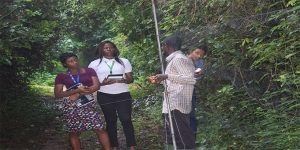 With funding support from the A.G. Leventis Foundation and the Nigerian Conservation Foundation, the IITA Forest Center uses different census techniques, including line transect, point count, and mist-netting, to monitor these birds quarterly. The aim is to understand their populations and other life history parameters. Although each of these techniques is unique, mist-netting is exceptionally interesting, especially for nonprofessionals, as they would have the opportunity of holding the birds in their hands for better appreciation of their beautiful feathers. The third mist-netting session for 2019 took place 10-12 September between 6 am and 11 am, during which 41 birds, distributed across 10 species, were mist-netted.
Mainly conducted by experts, mist-netting is a technique used to capture wild birds for ringing or banding. The mist-nets, made of nylon or polyester mesh, are suspended between light-weight poles. When properly set up, the nets are virtually invisible to birds. As the birds are familiar with these routes, they enter the nets unknowingly and get trapped in the baggy pockets until they are carefully removed by an expert.
Explaining the process, Ornithologist and IITA Forest Center Manager Adewale Awoyemi said, “The safety of these birds is very important. We want to extract the birds from the nets, collect data, and release them back into the wild as healthy as possible. Therefore, if a bird starts struggling, we let it go.” Ideally, birds are checked for removal from the nets at 30-minute intervals. The nets are in various sizes, length, height, and mesh, depending on the specific bird species targeted for the survey.
With funding support from the A.G. Leventis Foundation and the Nigerian Conservation Foundation, the IITA Forest Center uses different census techniques, including line transect, point count, and mist-netting, to monitor these birds quarterly. The aim is to understand their populations and other life history parameters. Although each of these techniques is unique, mist-netting is exceptionally interesting, especially for nonprofessionals, as they would have the opportunity of holding the birds in their hands for better appreciation of their beautiful feathers. The third mist-netting session for 2019 took place 10-12 September between 6 am and 11 am, during which 41 birds, distributed across 10 species, were mist-netted.
Mainly conducted by experts, mist-netting is a technique used to capture wild birds for ringing or banding. The mist-nets, made of nylon or polyester mesh, are suspended between light-weight poles. When properly set up, the nets are virtually invisible to birds. As the birds are familiar with these routes, they enter the nets unknowingly and get trapped in the baggy pockets until they are carefully removed by an expert.
Explaining the process, Ornithologist and IITA Forest Center Manager Adewale Awoyemi said, “The safety of these birds is very important. We want to extract the birds from the nets, collect data, and release them back into the wild as healthy as possible. Therefore, if a bird starts struggling, we let it go.” Ideally, birds are checked for removal from the nets at 30-minute intervals. The nets are in various sizes, length, height, and mesh, depending on the specific bird species targeted for the survey.
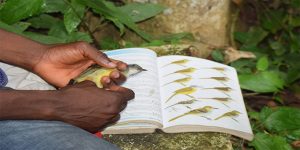 After extraction from the nets, they take the birds to the ringing station for identification, ringing, and data collection. With the help of field guides, the birds are identified to species level, after which a metal ring, containing coded identification numbers, is gently fitted on the tarsus with the aid of a special plier. The rings are in different sizes and are used, based on the size of the bird trapped.
Other morphometric data, such as wing, bill, head, and tarsus length, mass, breeding evidence (brood patch), age, moulting, and samples (blood, feather, and cloacal swabs), are also collected. This information, if collected systematically over a long period of time, can be used to unravel some aspects of bird ecology, physiology, behavior, and population structure.
After extraction from the nets, they take the birds to the ringing station for identification, ringing, and data collection. With the help of field guides, the birds are identified to species level, after which a metal ring, containing coded identification numbers, is gently fitted on the tarsus with the aid of a special plier. The rings are in different sizes and are used, based on the size of the bird trapped.
Other morphometric data, such as wing, bill, head, and tarsus length, mass, breeding evidence (brood patch), age, moulting, and samples (blood, feather, and cloacal swabs), are also collected. This information, if collected systematically over a long period of time, can be used to unravel some aspects of bird ecology, physiology, behavior, and population structure.
Mist-nets are normally set up along existing trails to minimize disturbance.
Field guides aid bird identification during ringing. Photo by A. Ajayi, IITA.
Contributed by
Recent stories
No items found