
British government strengthens partnership with IITA while planning for more areas of collaboration
May 28, 2021
On 21 May, His Excellency, Ben Llewellyn-Jones, the new British Deputy High Commissioner, visited IITA headquarters, accompanied by his Political Adviser, Wale Adebajo. His visit aimed to explore and understand the activities and technologies of IITA contributing to climate-smart agriculture (CSA), combating climate change, increasing yield, and supporting food security on the continent.
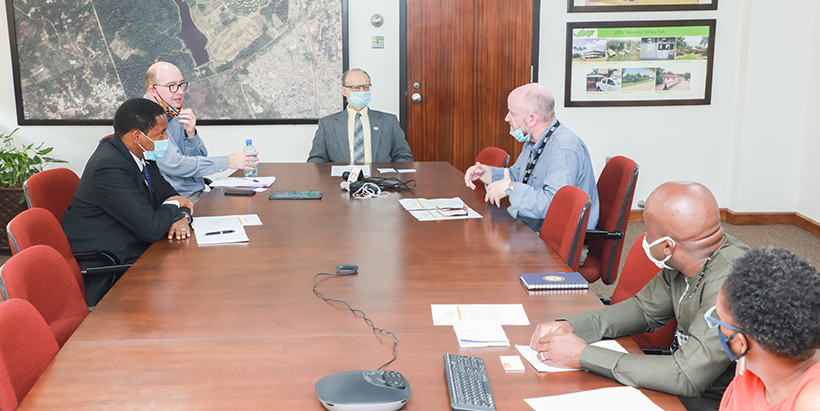 During the introductory meeting, Kenton Dashiell, Deputy Director General, Partnerships for Delivery, mentioned the long-standing partnership between IITA and the British High Commission. “IITA would like to help with whatever can be done to strengthen the partnership, even with British private sector companies such as agricultural companies,” he said.
Llewellyn-Jones affirmed that there is much that the British Government and IITA are doing together already. However, it was necessary to strengthen the already existing partnerships and identify future areas of collaboration. He mentioned that his responsibility is Economic Development, which includes climate change, supporting British businesses, representing the UK, and the South West of Nigeria. He sought to understand IITA’s perspective on reforestation in Nigeria while looking into the impact of deforestation on climate change, as well as how CSA can increase production yield for farmers.
During the introductory meeting, Kenton Dashiell, Deputy Director General, Partnerships for Delivery, mentioned the long-standing partnership between IITA and the British High Commission. “IITA would like to help with whatever can be done to strengthen the partnership, even with British private sector companies such as agricultural companies,” he said.
Llewellyn-Jones affirmed that there is much that the British Government and IITA are doing together already. However, it was necessary to strengthen the already existing partnerships and identify future areas of collaboration. He mentioned that his responsibility is Economic Development, which includes climate change, supporting British businesses, representing the UK, and the South West of Nigeria. He sought to understand IITA’s perspective on reforestation in Nigeria while looking into the impact of deforestation on climate change, as well as how CSA can increase production yield for farmers.
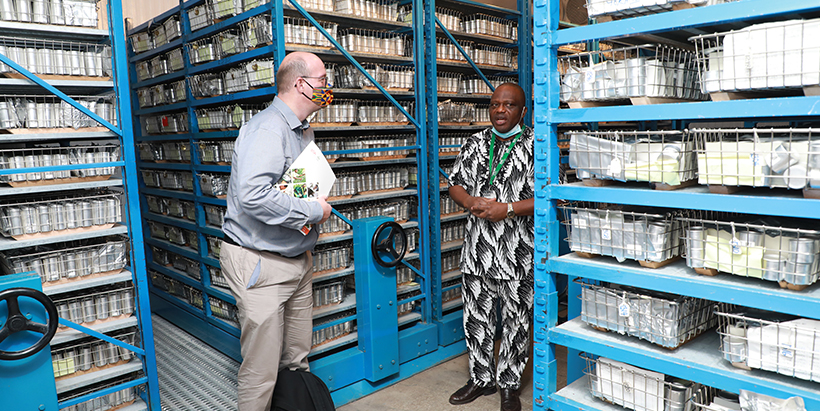 Michael Abberton, Director of Research for Development in IITA-West Africa, shared ongoing activities and projects in the various IITA stations in West Africa, especially at the headquarters. He stated that IITA is working with partners and donors to upgrade facilities at the institute. “IITA is interested in helping farmers know how research knowledge and products translate to increased yield on the farm. We are also working to increase employment opportunities in Africa,” he added.
Kayode Awobajo, Head of Project Development and Administration Unit, mentioned how IITA has received tremendous support from the UK government since 2004 and has collaborated with some UK organizations in accessing funds. “We are open to a further collaborative partnership with your team and hope this visit results in specific areas that we could work on together,” he said.
Michael Abberton, Director of Research for Development in IITA-West Africa, shared ongoing activities and projects in the various IITA stations in West Africa, especially at the headquarters. He stated that IITA is working with partners and donors to upgrade facilities at the institute. “IITA is interested in helping farmers know how research knowledge and products translate to increased yield on the farm. We are also working to increase employment opportunities in Africa,” he added.
Kayode Awobajo, Head of Project Development and Administration Unit, mentioned how IITA has received tremendous support from the UK government since 2004 and has collaborated with some UK organizations in accessing funds. “We are open to a further collaborative partnership with your team and hope this visit results in specific areas that we could work on together,” he said.
 Dashiell added that IITA is addressing climate change through CSA. While highlighting other challenges linked with climate change, he also stated that youth unemployment is another issue that interacts with climate change, and contributes to terrorism. “A key factor that can help reduce terrorism in Africa is providing massive employment opportunities through agriculture. Climate-smart technologies not only increase productivity but also give opportunities to youth,” he explained.
Dashiell explained that IITA has forged and maintained a good relationship with the federal and state governments and other private organizations. “In every state with an IITA station, we have a good rapport with the state government. IITA is proactive at taking opportunities to partner with the government on projects before commencement, which has helped its relationship with the government.”
To affirm this, Abberton gave an example of IITA’s response to COVID-19, helping farmers access planting materials despite the massive interruption to the agriculture process caused by COVID. Aside from agriculture, IITA works in partnership with the government and private organizations in providing technical expertise, he said.
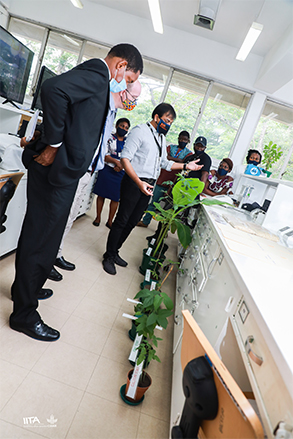
Following the meeting, His Excellency, Llewellyn-Jones was taken on a tour of the Virology Laboratory, Food Science and Nutrition Laboratory, and the Genetic Resources Center.
Dashiell added that IITA is addressing climate change through CSA. While highlighting other challenges linked with climate change, he also stated that youth unemployment is another issue that interacts with climate change, and contributes to terrorism. “A key factor that can help reduce terrorism in Africa is providing massive employment opportunities through agriculture. Climate-smart technologies not only increase productivity but also give opportunities to youth,” he explained.
Dashiell explained that IITA has forged and maintained a good relationship with the federal and state governments and other private organizations. “In every state with an IITA station, we have a good rapport with the state government. IITA is proactive at taking opportunities to partner with the government on projects before commencement, which has helped its relationship with the government.”
To affirm this, Abberton gave an example of IITA’s response to COVID-19, helping farmers access planting materials despite the massive interruption to the agriculture process caused by COVID. Aside from agriculture, IITA works in partnership with the government and private organizations in providing technical expertise, he said.
Following the meeting, His Excellency, Llewellyn-Jones was taken on a tour of the Virology Laboratory, Food Science and Nutrition Laboratory, and the Genetic Resources Center.
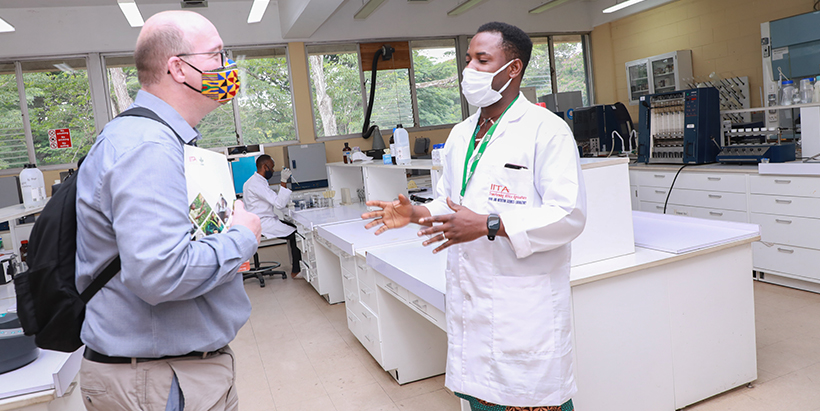 During an interview, Llewellyn-Jones said that his visit to IITA was to meet the most professional scientific researchers working in the space, including female researchers. “It has been a fascinating visit and I am very impressed by the professionalism, reach, and planning that has been going into more partnership for the future,” he said.
His Excellency, Ben Llewellyn-Jones, the new British Deputy High Commissioner, meeting with the IITA Management Team. Photo: IITA
The Deputy High Commissioner touring the gene bank at the Genetic Resources Center. Photo: IITA
Llewellyn-Jones visiting the Virology Laboratory. Photo: IITA
Llewellyn-Jones at the Food Science and Nutrition Laboratory. Photo: IITA
Contributed by
Recent stories
No items found