Enhancing soil health in Rwanda: What’s lime got to do with it?
July 8, 2024
Rwanda’s farmers have long struggled to obtain quality lime to improve their soil for better crop productivity. The most common lime available was unprocessed, requiring large quantities—between 2.5 and 4 metric tons (mt) per hectare—and had to be applied at least two months before planting. Additionally, distribution networks were inadequate, making it difficult for farmers to access the lime on time. The lack of awareness further compromised adoption.
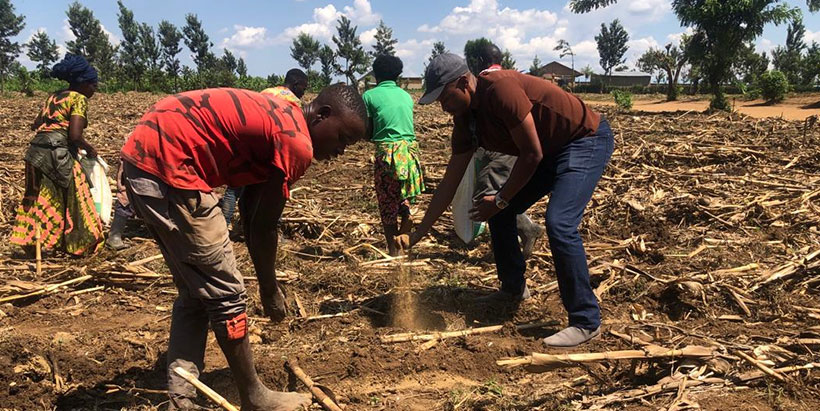
On a field day in Gatsibo District, Eastern Province, Pascal Twizere (r), the Managing Director of MULIMECO, showing a farmer (l) the best practice for applying grade one lime to the soil.
The introduction of machinery for processing lime, supported by the Alliance for a Green Revolution in Africa (AGRA), has revolutionized the lime value chain in Rwanda. This technology produces ‘lime grade one’, which is higher quality and easier to apply than the previously used ungraded lime. The application rate of lime grade one is significantly reduced, requiring between 750 to 1500 kilos per hectare, depending on soil type and quality. This advancement has simplified the application process, making it more cost-effective and profitable for farmers.
For this reason, the Great Lakes Accelerated Innovation Delivery Initiative Rapid Delivery Hub (AID-I GLR) partnered with AGRA, leveraging AGRA’s previous investments in lime processing to address soil acidity and visibly transform agriculture in Rwanda.
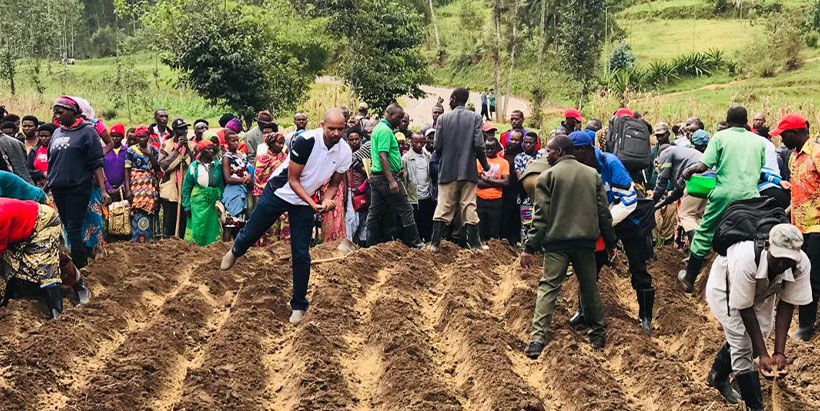
June 2024: Farmers in Gatsibo District learning the lime grade one application methods and good agronomic practices.
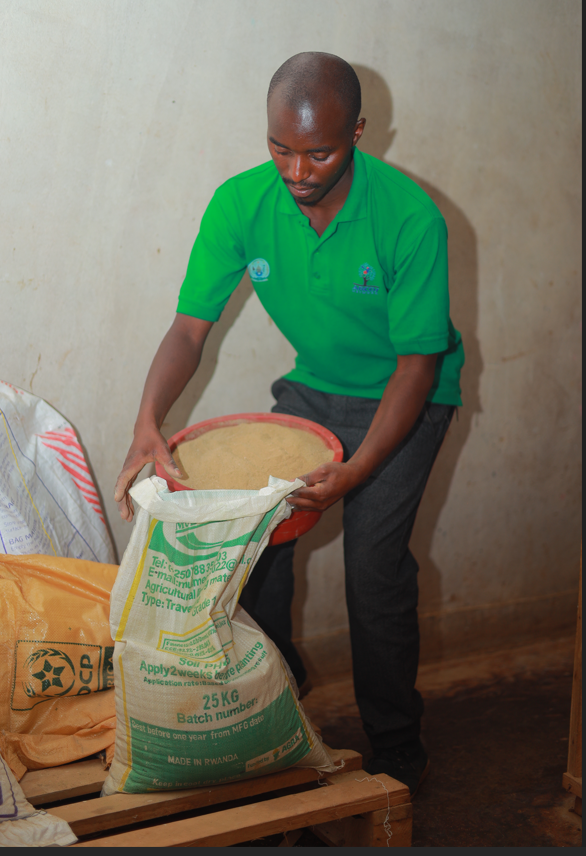
One of AGRA’s significant investments was supporting MULIMECO, a lime grade one processing company in Musanze District, Northern Province. With AGRA’s financial support, MULIMECO acquired a lime-processing unit to produce lime grade one, ensuring a higher quality and effectiveness. This lime was then distributed through a newly established channel involving local agro-dealers.
“For Rwanda’s acidic soils, this partnership with AGRA has been a game-changer in improving and promoting the integrated use of quality lime and nutrient-blended fertilizers for sustainable agricultural productivity, soil health, food security, and income of smallholder farmers,” revealed MULIMECO’s Managing Director, Pascal Twizere.
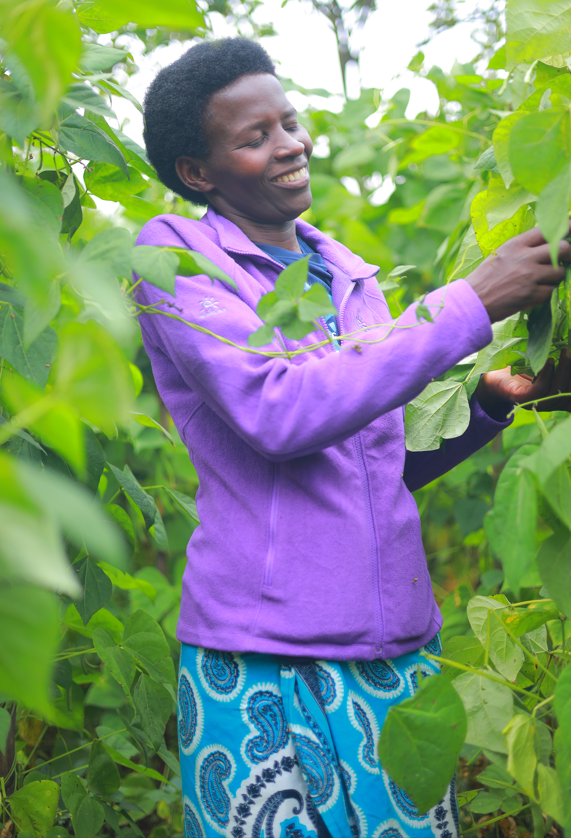
Valentine Dusengimana, a farmer in Rulindo District, admiring the improved condition beans after using lime grade one.
MULIMECO’s efforts to promote awareness and farmers’ adoption of lime grade one include setting up demonstration plots in acidic soil zones. Farmer Promoters (a volunteer extension agents’ group at the village level) lead these demo plots, where they showcase the benefits of using high-quality lime. MULIMECO also organized farmer field days to educate farmers on the advantages of using lime grade one, providing small packs of seeds and lime for testing in their plots. The live demos spurred requests for lime grade one, thereby igniting business relations between MULIMECO and the agro-dealers, which improved access and availability of lime grade one.
Valentine Dusengimana of Rulindo District, Northern
Valentine Dusengimana, a farmer in Rulindo District, admiring the improved condition beans after using lime grade one.
Province, experimented with lime grade one on her Irish potatoes and beans plot. She observed significant improvements: “For my Irish potatoes, the harvest increased from 350 kilos in season 2023 C to 1 metric ton in season 2024 A. This encouraged me to buy more lime to grow Irish potatoes in season 2024 B. Beans are also benefiting from the effect of lime applied last season. We were advised to apply lime every two seasons. It has helped the beans, and it is looking good in the field, even though the sun had come earlier than usual. Many of the crops that the lime grade one had not been applied to, especially the beans on my colleagues’ farms, who did not apply the lime grade one and the good agronomic practices, are not performing well; they have started to dry up. However, I expect a good yield because I used lime grade one and other good agronomic practices,”
she explained.
Valentine’s experience is echoed by many other farmers who attended the field days and tried the lime on their plots. Encouraged by the positive results, farmers have returned to agro-dealers to purchase more lime for larger plots. One agro-dealer reported an increase in demand, from 300 farmers in season 2024 A to 1,200 farmers in season 2024 B, with numerous farmers returning for more lime grade one after seeing its benefits.
“The demand for lime grade one has grown. Previously, I would bring 5 Tons of lime to sell in my shop per season. Now, I can sell up to 20 Tons in one agricultural season,” reported Jean Claude Nshimiyimana, an agro-dealer in Rulindo District.
The success of this initiative is a testament to the power of high-quality agricultural inputs and community-driven awareness programs, as evidenced by returning customers driven by good product performance.
By ensuring the availability of lime grade one through local agro-dealers, MULIMECO has improved individual farmers’ yields and enhanced the sustainability of the lime value chain in Rwanda. Most importantly, in the long run, the initiative will contribute to restoring the health, wealth, and well-being of Rwandan soil.
Olamide Deborah Nwanze is a Senior Research Associate specializing in gender mainstreaming research to inform participatory and inclusive breeding, variety development, and seed systems policies regarding root, tuber, and banana (RTB) crops in the International Institute of Tropical Agriculture Headquarters, Ibadan, Nigeria. She is a PhD candidate at the University of Ibadan and holds an MSc and B. Agric in Agricultural Extension and Rural Development. Olamide is a fellow of the African Women in Agricultural Research and Development – Gender Responsive Agricultural Systems Policy (AWARD-GRASP) and the Gender Responsive Researchers Equipped for Agricultural Transformation (GREAT). She seeks to apply her gender-mainstreaming learnings, gender-responsive research, and policy development, and review expertise to facilitate women, youth, children, and vulnerable social group’s access to and adoption of agricultural Innovations that guarantee food, nutrition, income, and livelihood security in Africa. Her current roles include mentoring research fellows, development of guides and training manuals, implementation and adaptation of gender frameworks and tools, value chain actors’ engagement as citizen science partners, policy review and redesign, data management, and analysis. Her current research explores mixed methods and participatory and interdisciplinary approaches to capture and highlight gender dynamics, needs, preferences, and challenges stakeholders face within the agricultural livelihood value chain to prioritize gender-inclusive strategies in breeding programs, policy design, and implementation.
de Sousa, K., van Etten, J., Manners, R. Bello, A., Teeken, B., Olaosebikan, O., et al. 2024. The tricot approach: an agile framework for decentralized on-farm testing supported by citizen science. A retrospective. Agron. Sustain. Dev. 44, 8. https://doi.org/10.1007/s13593-023-00937-1
Madu, T., Onwuka, S., Nwafor, S., Onyemauwa, N., Ejechi, M., Ofoeze, M., Ukeje, B., Eluagu, C., Olaosebikan, O., Okoye, B., 2024. Gender-Inclusive Consumer Studies Improve Cassava Breeding in Nigeria in: Frontiers in Sociology, volume 9, number: 1224504, doi: 10.3389/fsoc.2024.1224504
Olaosebikan, O.; Bello, A.; Utoblo, O.; Okoye, B.; Olutegbe, N.; Garner, E.; Teeken, B.; Bryan, E.; Forsythe, L.; Cole, S.; Madu, T. 2023. Stressors and Resilience within the Cassava Value Chain in Nigeria: Preferred Cassava Variety Traits and Response Strategies of Men and Women to Inform Breeding. Sustainability 15, 7837. https://doi.org/10.3390/su15107837
Okoye, B., Ofoeze, M., Ejechi, M., Onwuka, S., Nwafor, S., Onyemauwa, N., Ukeje, B., Eluagu, C., Obidiegwu, J.*, Olaosebikan, O., Madu, T.* 2023. Prioritizing preferred traits in the yam value chain in Nigeria: a gender situation analysis in: Frontiers in Sociology, volume 8, number: 1232626, pages 1 – 9, ISSN 2297-7775, 2023. https://www.frontiersin.org/articles/10.3389/fsoc.2023.1232626/full
Olaosebikan, O., Bello, A. A., de Sousa, K., Ndjouenkeu, R., Adesokan, M., Alamu, E. O., Agbona, A., van Etten, J., Kegah, F. N.*, Dufour, D., Bouniol, A., Teeken, B. 2023. Consumer acceptability of cassava gari-eba food products across cultural and environmental settings using the triadic comparison of technologies approach (tricot) in: Journal of the Science of Food and Agriculture,
Teeken, B., Olaosebikan, O., Bello, A. A., Madu, T.*, Cole, S. M. 2023. Qualitative assessment on the positionality and preferences of dyads in relation to cassava-related activities: working with tricot trial citizen scientists https://hdl.handle.net/10568/138326 Type: Manual
Bouniol, A., Ceballos, H., Bello, A. A., Teeken, B., Olaosebikan, O., Owoade, D., Agbona, A., Fotso Kuate, A., Madu, T.*, Okoye, B.*, Ofoeze, M.*, Nwafor, S.*, Onyemauwa, N.*, Adinsi, L.*, Forsythe, L., Dufour, D. 2023. Varietal impact on women’s labour, workload and related drudgery in processing root, tuber and banana crops: focus on cassava in sub-Saharan Africa in: Journal of the Science of Food and Agriculture, pages 1 – 25, ISSN 0022-5142,
Bello, A. A., Agbona, A., Olaosebikan, O., Edughaen, G., Dufour, D., Bouniol, A., Iluebbey, P., Ndjouenkeu, R.*, Rabbi, I. Y., Teeken, B. 2023. Genetic and environmental effects on processing productivity and food product yield: drudgery of women’s work in: Journal of the Science of Food and Agriculture, pages 1 – 32, ISSN 0022-5142, 5
Cavicchioli, M., Zimbiti, T., Teeken, B., Nwanze, D.O., Liani, M., Parkes, E. & Bello, A. 2023. IITA-Gender Responsive Breeding Training Report. Genetic Resources Center, IITA-HQ, Ibadan, 21-23 September, 2022. Ibadan, Nigeria: IITA, (34 p.).https://hdl.handle.net/10568/131368
Agbona, A. Peteti P., Teeken B., Olaosebikan O. Bello, A. A., Parkes, E., Rabbi, I. Y., Mueller, L., Egesi, C., Kulakow, P. 2022. Data Management in Multi-disciplinary African RTB Crop Breeding Programs. In: Williamson, H.F., Leonelli, S. (eds) Towards Responsible Plant Data Linkage: Data Challenges for Agricultural Research and Development. Springer, Cham. https://doi.org/10.1007/978-3-031-13276-6_5
Lora Forsythe, Pricilla Marimo, Sarah Mayanja, Olamide D. Olaosebikan, Esme Stuart, Bela Teeken, Benjamin Okoye, Tessy Madu, (2021). Cross-product Gender Analysis of RTBfoods Step 2 Gendered Food Mapping on RTB Products. Understanding the Drivers of Trait Preferences and the Development of Multi-user RTB Product Profiles, WP1. London, UK: RTBfoods Field Scientific Report, 30 p.
Teeken, B., Garner, E., Agbona, A., Balogun, I., Olaosebikan, O., Bello, A., Madu, T., Okoye, B., Egesi, C., Kulakow, P. and Tufan, H.A. 2021. Beyond “Women’s Traits”: Exploring How Gender, Social Difference, and Household Characteristics Influence Trait Preferences. Frontiers Sustainable Food Systems 5:740926. https://doi.org/10.3389/fsufs.2021.740926
Teeken, B., Agbona, A., Bello, A., Olaosebikan, O., Alamu, E., Adesokan, M., Awoyale, W., Madu, T., Okoye, B., Chijioke, U., Owoade, D., Okoro, M., Bouniol, A., Dufour, D., Hershey, C., Rabbi, I., Maziya‐Dixon, B., Egesi, C., Tufan, H. and Kulakow, P. (020. Understanding cassava varietal preferences through pairwise ranking of gari‐eba and fufu prepared by local farmer–processors. Int J Food Sci Technol.https://doi.org/10.1111/ijfs.14862
Bela Teeken, Olamide Olaosebikan, Ireti Balogun, Benjamin Okoye, Tessy Madu, Steven Cole, Abolore Bello, Elizabeth Parkes. (2020). Piloting the G+ customer and product profile tools for gender-responsive cassava breeding in Nigeria. Nigeria: International Institute of Tropical Agriculture (IITA). https://hdl.handle.net/20.500.11766/13000