Farmers and traders’ insights on enhancing the cowpea value chains for improved health and wealth in Nigeria
Cowpea is an important grain legume crop widely grown for human food, livestock fodder, and feeds. It is widely recognized as a staple dietary protein source, rich in micronutrients such as iron and zinc, especially in Africa and Asia, where they are predominantly consumed. The amino acid profiles of grain legumes are complementary to those of cereals, such that consuming them together improves the nutritional effectiveness of cereal-dominated diets of low-income earners. Cowpea food is also low in glycemic index; consuming it reduces the risk of obesity and diabetes. One major way of utilizing this legume crop is through food processing, “converting the raw materials into semi-finished and finished products that can be consumed or stored”. The food can be processed at different levels, including home-based food processing and at the industrial level (Plate 1). Industrial food processing could be at the cottage level or on a large scale.
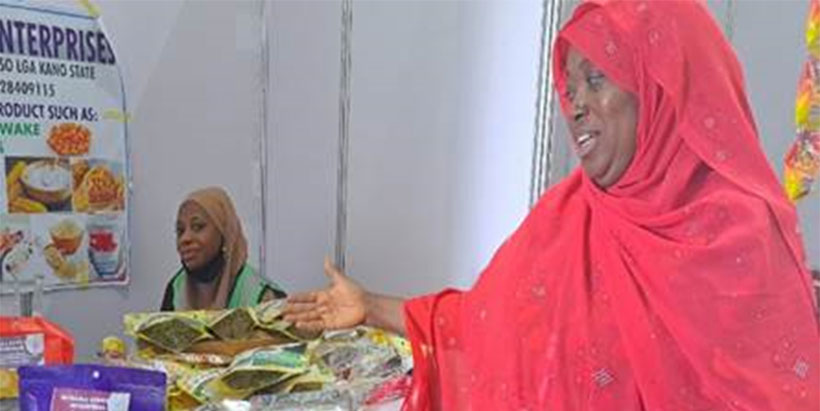
Plate 1. A woman food processor showcasing her nutrient-dense food products.
There has been a growing interest in interventions in agriculture to become more nutrition-sensitive. Nutrition is a critical part of health, and poor health reduces work performance, income, and productivity in agricultural communities. Various entry points have been identified to design nutrition-sensitive agriculture (Jaenicke and Virchow, 2013). One of the strong openings is to boost the production of nutritious foods and maintain food quality. This can be achieved by expanding the production of nutrient-dense crops such as cowpea and reducing grain contamination from pesticide residue by limiting the use of hazardous chemicals for grain storage.
Women’s participation in legume seed systems is rapidly changing in northern Nigeria in response to various factors, including enhanced access to technologies, increased urbanization, the shift in diets, improvements in farmers’ education and health, institutional and policy reforms, and investments in rural infrastructure. Consequently, gender integration of the smallholder legume seed system is changing food markets and helping to create new income opportunities and a more dynamic environment in which new technologies and agricultural practices can contribute to helping smallholder farmers respond to climate change, which are critical challenges facing the food industry. Climate-sensitive health risks disproportionately impact women. Therefore, solutions should address gender disparities in access to food, health care, education, and economic well-being. Engaging more women in legume seed systems will ensure gender equality and inclusion.
Agriculture, climate change, health and wealth
Climate change can disrupt food availability, reduce access to food, and affect food quality. The adverse effect of climate change will put people’s food supplies at risk, particularly in developing nations, which can drive down crop yields, destroy livestock, and interfere with food transport. This will eventually affect human health and development progress and jeopardize future generations’ health, well-being, and livelihoods, with a remarkable impact on women.
What does food have to do with climate change?
Let me say here that what we eat and how that food is produced affects our health and the environment. Food must be grown, processed, transported, distributed, prepared, consumed, and sometimes disposed of. Each step creates greenhouse gases that trap the sun’s heat and contribute to climate change. Studies have shown that about a third of all human-caused greenhouse gas emissions are linked to food.
What are the foods that cause the most greenhouse gas emissions?
The climate impact of food is measured in terms of the intensity of greenhouse gas emissions. The emissions intensity is expressed in kilograms of “carbon dioxide equivalents”—which includes not only CO2 but all greenhouse gases—per kilogram of food, per gram of protein or calorie. Animal-based foods, especially red meat, dairy, and farmed shrimp, are generally associated with higher greenhouse gas emissions than plant-based foods.
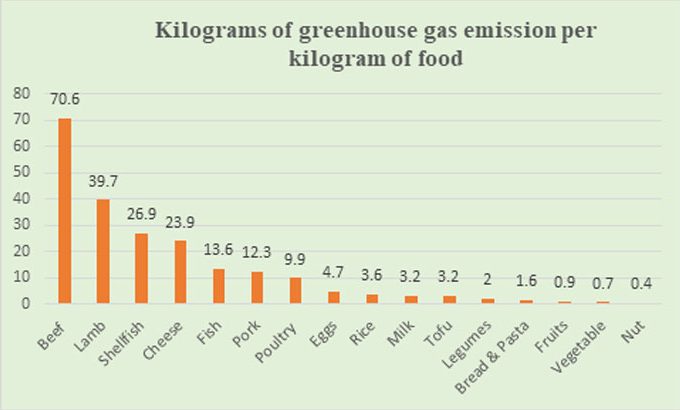
However, plant-based foods such as whole grains (cowpeas and beans) are among the few that have lower greenhouse gas intensities than animal-based foods. Legumes generally use less energy, land, and water. Figure 1 shows the carbon footprint of other food products. Emissions can be compared based on weight (per kilogram of food) or in terms of nutritional units (per 100 grams of protein or 1000 kilocalories)
The chart shows that emissions can be compared based on weight (per kilogram of food) or in terms of nutritional units (per 100 grams of protein or 1000 kilocalories), which shows us how efficiently different foods supply protein or energy (Poor and Nemeck, 2018).
Figure 1. Chart showing the carbon footprint of different food products.
This suggests that greenhouse gas emissions from the food sector can be reduced if we shift food systems toward plant-rich diets with more plant protein (such as cowpea), a reduced amount of animal-based foods (meat and dairy), and less saturated fats (butter, milk, cheese, meat, coconut oil, and palm oil) will reduce greenhouse gas emission and improve health. Cowpea is, therefore, a strategic crop for climate change adaptation and good nutrition.
Globally, women play a vital role in the food industry, particularly in leadership and innovation. Empowering women and facilitating sustainable access to high-value markets will enable smallholder farmers to increase their incomes, effectively reducing poverty and improving livelihoods. Many women have participated in the legume value chains as producers, traders, processors, retailers, and consumers. Women’s inclusion in improving the performance of legume value chains can thus benefit many people—a way of adapting to climate change and improving human health. A testament to this fact is the technical collaboration with diverse partners that led to the creation of a new value chain (processing and utilization of cowpea and soybean food to reduce malnutrition).
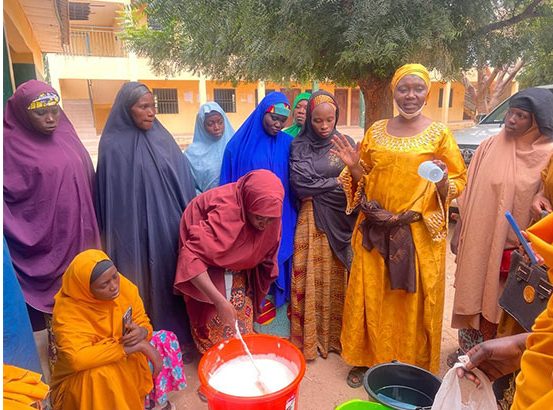
In 2023, IITA collaborated with the Kano State Agro-pastoral Development Project (KSADP) to train women in legume production, food processing for household nutrition, and income generation (Plate 2). IITA also collaborated with HarvestPlus to strengthen the legume food chain and support female-led food businesses to enable female workers and leaders to overcome the constraints they face in achieving full economic participation. The partnership works along the food systems to meet the needs of all people regardless of their socioeconomic status. Empowering women is believed to provide more opportunities to drive social change and maximize their potential contributions to the economy and society.
Plate 1. Training of women in food processing for household nutrition and income generation.
There are clear signs that food industries significantly impact economic development and poverty reduction in urban and rural communities. Changes in and around the agri-food sector can contribute to developing better support services for farmers, such as technology and financial products, and advancing health and nutrition. Evidence has shown that small producers with access to technical support services are more willing to adopt new technologies and invest in exploiting emerging market opportunities. Seed Equal has developed various interventions in legume seed systems and associated markets. These have focused on research for development programs that emphasize increasing food production and productivity, as well as the commercialization and development of inclusive value chains. This approach was initially developed to increase the competitiveness and improve the livelihoods of smallholder legume producers, which has proved helpful in northern Nigeria and other parts of West Africa. The food industry has made progressive changes in recent years, promoting gender equity.
Olamide Deborah Nwanze is a Senior Research Associate specializing in gender mainstreaming research to inform participatory and inclusive breeding, variety development, and seed systems policies regarding root, tuber, and banana (RTB) crops in the International Institute of Tropical Agriculture Headquarters, Ibadan, Nigeria. She is a PhD candidate at the University of Ibadan and holds an MSc and B. Agric in Agricultural Extension and Rural Development. Olamide is a fellow of the African Women in Agricultural Research and Development – Gender Responsive Agricultural Systems Policy (AWARD-GRASP) and the Gender Responsive Researchers Equipped for Agricultural Transformation (GREAT). She seeks to apply her gender-mainstreaming learnings, gender-responsive research, and policy development, and review expertise to facilitate women, youth, children, and vulnerable social group’s access to and adoption of agricultural Innovations that guarantee food, nutrition, income, and livelihood security in Africa. Her current roles include mentoring research fellows, development of guides and training manuals, implementation and adaptation of gender frameworks and tools, value chain actors’ engagement as citizen science partners, policy review and redesign, data management, and analysis. Her current research explores mixed methods and participatory and interdisciplinary approaches to capture and highlight gender dynamics, needs, preferences, and challenges stakeholders face within the agricultural livelihood value chain to prioritize gender-inclusive strategies in breeding programs, policy design, and implementation.
de Sousa, K., van Etten, J., Manners, R. Bello, A., Teeken, B., Olaosebikan, O., et al. 2024. The tricot approach: an agile framework for decentralized on-farm testing supported by citizen science. A retrospective. Agron. Sustain. Dev. 44, 8. https://doi.org/10.1007/s13593-023-00937-1
Madu, T., Onwuka, S., Nwafor, S., Onyemauwa, N., Ejechi, M., Ofoeze, M., Ukeje, B., Eluagu, C., Olaosebikan, O., Okoye, B., 2024. Gender-Inclusive Consumer Studies Improve Cassava Breeding in Nigeria in: Frontiers in Sociology, volume 9, number: 1224504, doi: 10.3389/fsoc.2024.1224504
Olaosebikan, O.; Bello, A.; Utoblo, O.; Okoye, B.; Olutegbe, N.; Garner, E.; Teeken, B.; Bryan, E.; Forsythe, L.; Cole, S.; Madu, T. 2023. Stressors and Resilience within the Cassava Value Chain in Nigeria: Preferred Cassava Variety Traits and Response Strategies of Men and Women to Inform Breeding. Sustainability 15, 7837. https://doi.org/10.3390/su15107837
Okoye, B., Ofoeze, M., Ejechi, M., Onwuka, S., Nwafor, S., Onyemauwa, N., Ukeje, B., Eluagu, C., Obidiegwu, J.*, Olaosebikan, O., Madu, T.* 2023. Prioritizing preferred traits in the yam value chain in Nigeria: a gender situation analysis in: Frontiers in Sociology, volume 8, number: 1232626, pages 1 – 9, ISSN 2297-7775, 2023. https://www.frontiersin.org/articles/10.3389/fsoc.2023.1232626/full
Olaosebikan, O., Bello, A. A., de Sousa, K., Ndjouenkeu, R., Adesokan, M., Alamu, E. O., Agbona, A., van Etten, J., Kegah, F. N.*, Dufour, D., Bouniol, A., Teeken, B. 2023. Consumer acceptability of cassava gari-eba food products across cultural and environmental settings using the triadic comparison of technologies approach (tricot) in: Journal of the Science of Food and Agriculture,
Teeken, B., Olaosebikan, O., Bello, A. A., Madu, T.*, Cole, S. M. 2023. Qualitative assessment on the positionality and preferences of dyads in relation to cassava-related activities: working with tricot trial citizen scientists https://hdl.handle.net/10568/138326 Type: Manual
Bouniol, A., Ceballos, H., Bello, A. A., Teeken, B., Olaosebikan, O., Owoade, D., Agbona, A., Fotso Kuate, A., Madu, T.*, Okoye, B.*, Ofoeze, M.*, Nwafor, S.*, Onyemauwa, N.*, Adinsi, L.*, Forsythe, L., Dufour, D. 2023. Varietal impact on women’s labour, workload and related drudgery in processing root, tuber and banana crops: focus on cassava in sub-Saharan Africa in: Journal of the Science of Food and Agriculture, pages 1 – 25, ISSN 0022-5142,
Bello, A. A., Agbona, A., Olaosebikan, O., Edughaen, G., Dufour, D., Bouniol, A., Iluebbey, P., Ndjouenkeu, R.*, Rabbi, I. Y., Teeken, B. 2023. Genetic and environmental effects on processing productivity and food product yield: drudgery of women’s work in: Journal of the Science of Food and Agriculture, pages 1 – 32, ISSN 0022-5142, 5
Cavicchioli, M., Zimbiti, T., Teeken, B., Nwanze, D.O., Liani, M., Parkes, E. & Bello, A. 2023. IITA-Gender Responsive Breeding Training Report. Genetic Resources Center, IITA-HQ, Ibadan, 21-23 September, 2022. Ibadan, Nigeria: IITA, (34 p.).https://hdl.handle.net/10568/131368
Agbona, A. Peteti P., Teeken B., Olaosebikan O. Bello, A. A., Parkes, E., Rabbi, I. Y., Mueller, L., Egesi, C., Kulakow, P. 2022. Data Management in Multi-disciplinary African RTB Crop Breeding Programs. In: Williamson, H.F., Leonelli, S. (eds) Towards Responsible Plant Data Linkage: Data Challenges for Agricultural Research and Development. Springer, Cham. https://doi.org/10.1007/978-3-031-13276-6_5
Lora Forsythe, Pricilla Marimo, Sarah Mayanja, Olamide D. Olaosebikan, Esme Stuart, Bela Teeken, Benjamin Okoye, Tessy Madu, (2021). Cross-product Gender Analysis of RTBfoods Step 2 Gendered Food Mapping on RTB Products. Understanding the Drivers of Trait Preferences and the Development of Multi-user RTB Product Profiles, WP1. London, UK: RTBfoods Field Scientific Report, 30 p.
Teeken, B., Garner, E., Agbona, A., Balogun, I., Olaosebikan, O., Bello, A., Madu, T., Okoye, B., Egesi, C., Kulakow, P. and Tufan, H.A. 2021. Beyond “Women’s Traits”: Exploring How Gender, Social Difference, and Household Characteristics Influence Trait Preferences. Frontiers Sustainable Food Systems 5:740926. https://doi.org/10.3389/fsufs.2021.740926
Teeken, B., Agbona, A., Bello, A., Olaosebikan, O., Alamu, E., Adesokan, M., Awoyale, W., Madu, T., Okoye, B., Chijioke, U., Owoade, D., Okoro, M., Bouniol, A., Dufour, D., Hershey, C., Rabbi, I., Maziya‐Dixon, B., Egesi, C., Tufan, H. and Kulakow, P. (020. Understanding cassava varietal preferences through pairwise ranking of gari‐eba and fufu prepared by local farmer–processors. Int J Food Sci Technol.https://doi.org/10.1111/ijfs.14862
Bela Teeken, Olamide Olaosebikan, Ireti Balogun, Benjamin Okoye, Tessy Madu, Steven Cole, Abolore Bello, Elizabeth Parkes. (2020). Piloting the G+ customer and product profile tools for gender-responsive cassava breeding in Nigeria. Nigeria: International Institute of Tropical Agriculture (IITA). https://hdl.handle.net/20.500.11766/13000