
IITA NEWS

From research to markets: How IITA is fostering trade and investment through science and innovation
August 12, 2026
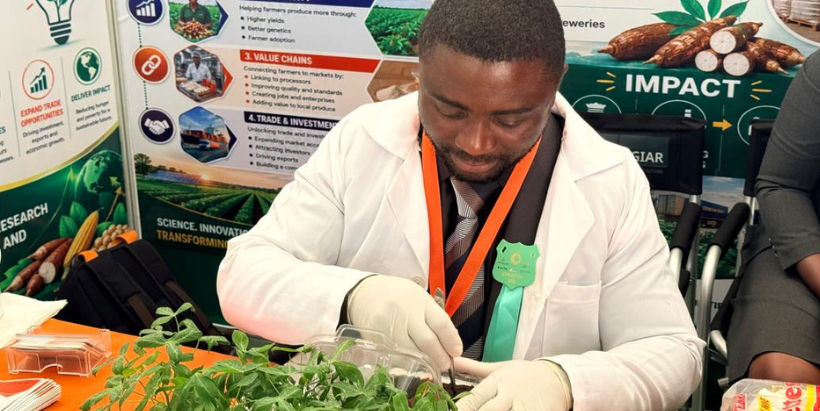
Demonstrating innovative propagation techniques that accelerate the delivery of improved cassava planting materials to farmers.

Zambia hosted its 98th Agricultural and Commercial Show, one of the country’s largest platforms for showcasing agriculture, commerce, and innovation. Held under the theme “Fostering trade and investment,” this year’s show challenged exhibitors to demonstrate how agriculture can contribute to economic growth and national prosperity. The show ran from 29 July to 3 August 2026, in Lusaka.

The Agricultural and Commercial Show Society of Zambia describes the show as Southern Africa’s premier agricultural and commercial exhibition platform. For IITACGIAR, the answer lay not only in the technologies on display, but in the story behind them.

Agricultural trade is often associated with markets, exports, and commercial transactions. Yet long before products reach supermarket shelves or cross international borders, they begin in research laboratories, breeding programs, and experimental fields where scientists develop solutions to improve agricultural productivity.
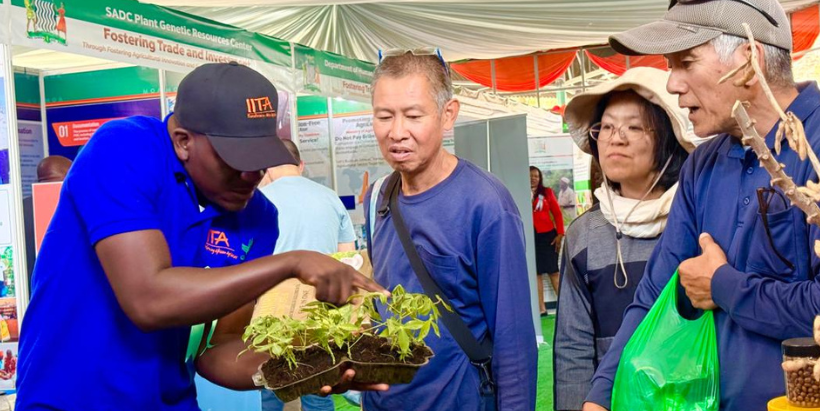
Showcasing IITA's cassava seed multiplication innovation to stand visitors.
Showcasing IITA’s cassava seed multiplication innovation to stand visitors.

It is through this process that research becomes the foundation of competitive agricultural economies.

This year’s exhibition provided IITA with an opportunity to demonstrate how science and innovation are strengthening agricultural value chains, empowering farmers, and creating the conditions necessary for investment, agro-processing, and regional trade.

One of the exhibition’s key highlights was IITA’s soybean breeding program, where visitors learned about the development of rust-resistant soybean lines. Soybean rust remains one of the crop’s most significant production constraints, reducing yields and affecting farmers’ incomes. Through advanced breeding, IITA is developing improved varieties that help farmers produce healthier, more resilient crops while reducing production risks, and the impact extends well beyond the farm.

Higher-yielding, disease-resistant varieties provide industries with a more reliable supply of raw materials for livestock feed, poultry production, aquaculture, edible oil processing, and food manufacturing. Reliable supply creates confidence for processors and agribusinesses to invest, strengthening agricultural markets and expanding trade opportunities.
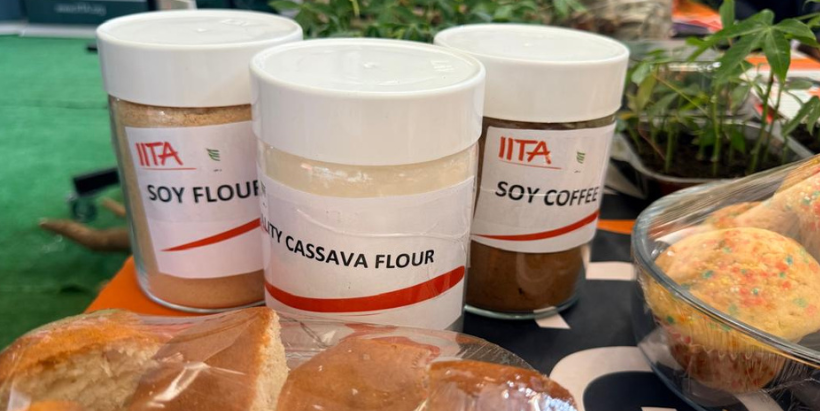
Soybean and cassava transformed into value-added products that create opportunities for industry, investment and trade.

The same principle is evident in cassava.

Through the Semi-Autotrophic Hydroponics (SAH) technology, IITA is transforming cassava seed systems by improving the multiplication of clean and healthy planting materials. Greater access to quality planting material enables farmers to increase production while supporting industries that depend on cassava for flour, starch, animal feed, and other industrial products.

Research, therefore, does more than improve productivity. It strengthens entire value chains.

Recognizing that agricultural transformation also depends on people, IITA showcased its Youth in Agribusiness initiative, which equips young people with practical skills and entrepreneurial opportunities across agricultural value chains. By investing in youth, IITA is helping to develop the next generation of producers, processors, and agribusiness leaders who will continue to drive agricultural innovation and enterprise.
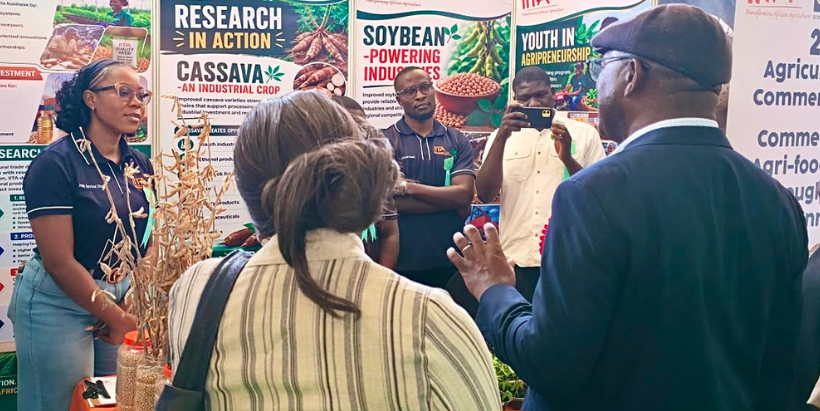
Engaging visitors on how science and innovation create opportunities for investment, value addition and economic growth.

Taken together, the technologies on display demonstrated a simple but powerful principle.

Research leads to innovation.

Innovation improves productivity.

Productivity creates a reliable supply.

Reliable supply supports agro-processing and industry.

Industry attracts investment.

Investment expands trade.

This is how science contributes to economic transformation.

As governments increasingly recognize agriculture as a strategic driver of industrialization and economic growth, research has become more than a scientific endeavor. It has become the foundation upon which competitive industries, resilient value chains, and sustainable economies are built.

The 98th Zambia Agricultural and Commercial Show reminded us that fostering trade and investment begins long before products reach the marketplace. It begins with sustained investment in science, innovation, and partnerships that transform research into opportunities for farmers, businesses, and economies.


Scroll to Top
Olaosebikan, Olamide

Olamide Deborah Nwanze is a Senior Research Associate specializing in gender mainstreaming research to inform participatory and inclusive breeding, variety development, and seed systems policies regarding root, tuber, and banana (RTB) crops in the International Institute of Tropical Agriculture Headquarters, Ibadan, Nigeria. She is a PhD candidate at the University of Ibadan and holds an MSc and B. Agric in Agricultural Extension and Rural Development. Olamide is a fellow of the African Women in Agricultural Research and Development – Gender Responsive Agricultural Systems Policy (AWARD-GRASP) and the Gender Responsive Researchers Equipped for Agricultural Transformation (GREAT). She seeks to apply her gender-mainstreaming learnings, gender-responsive research, and policy development, and review expertise to facilitate women, youth, children, and vulnerable social group’s access to and adoption of agricultural Innovations that guarantee food, nutrition, income, and livelihood security in Africa. Her current roles include mentoring research fellows, development of guides and training manuals, implementation and adaptation of gender frameworks and tools, value chain actors’ engagement as citizen science partners, policy review and redesign, data management, and analysis. Her current research explores mixed methods and participatory and interdisciplinary approaches to capture and highlight gender dynamics, needs, preferences, and challenges stakeholders face within the agricultural livelihood value chain to prioritize gender-inclusive strategies in breeding programs, policy design, and implementation.

At IITA, she contributes to the implementation of the CGIAR Accelerated Breeding Initiative and Genetic Innovation Programs; participatory and gender research within the NextGen CassavaHarvestPlusRTBFoods, and Tricot-ClimMob 1000Farms Projects; and gender knowledge communication via the G-LENS webinar series, video documentary, policy briefspublications, and blogs.


Recent publications

de Sousa, K., van Etten, J., Manners, R. Bello, A., Teeken, B., Olaosebikan, O., et al. 2024. The tricot approach: an agile framework for decentralized on-farm testing supported by citizen science. A retrospective. Agron. Sustain. Dev. 44, 8. https://doi.org/10.1007/s13593-023-00937-1

Madu, T., Onwuka, S., Nwafor, S., Onyemauwa, N., Ejechi, M., Ofoeze, M., Ukeje, B., Eluagu, C., Olaosebikan, O., Okoye, B., 2024. Gender-Inclusive Consumer Studies Improve Cassava Breeding in Nigeria in: Frontiers in Sociology, volume 9, number: 1224504, doi: 10.3389/fsoc.2024.1224504

Olaosebikan, O.; Bello, A.; Utoblo, O.; Okoye, B.; Olutegbe, N.; Garner, E.; Teeken, B.; Bryan, E.; Forsythe, L.; Cole, S.; Madu, T. 2023.  Stressors and Resilience within the Cassava Value Chain in Nigeria: Preferred Cassava Variety Traits and Response Strategies of Men and Women to Inform Breeding. Sustainability 15, 7837. https://doi.org/10.3390/su15107837

Okoye, B., Ofoeze, M., Ejechi, M., Onwuka, S., Nwafor, S., Onyemauwa, N., Ukeje, B., Eluagu, C., Obidiegwu, J.*, Olaosebikan, O., Madu, T.* 2023. Prioritizing preferred traits in the yam value chain in Nigeria: a gender situation analysis in: Frontiers in Sociology, volume 8, number: 1232626, pages 1 – 9, ISSN 2297-7775, 2023. https://www.frontiersin.org/articles/10.3389/fsoc.2023.1232626/full

Olaosebikan, O., Bello, A. A., de Sousa, K., Ndjouenkeu, R., Adesokan, M., Alamu, E. O., Agbona, A., van Etten, J., Kegah, F. N.*, Dufour, D., Bouniol, A., Teeken, B. 2023. Consumer acceptability of cassava gari-eba food products across cultural and environmental settings using the triadic comparison of technologies approach (tricot) in: Journal of the Science of Food and Agriculture,

Teeken, B., Olaosebikan, O., Bello, A. A., Madu, T.*, Cole, S. M. 2023. Qualitative assessment on the positionality and preferences of dyads in relation to cassava-related activities: working with tricot trial citizen scientists https://hdl.handle.net/10568/138326 Type: Manual

Bouniol, A., Ceballos, H., Bello, A. A., Teeken, B., Olaosebikan, O., Owoade, D., Agbona, A., Fotso Kuate, A., Madu, T.*, Okoye, B.*, Ofoeze, M.*, Nwafor, S.*, Onyemauwa, N.*, Adinsi, L.*, Forsythe, L., Dufour, D. 2023. Varietal impact on women’s labour, workload and related drudgery in processing root, tuber and banana crops: focus on cassava in sub-Saharan Africa in: Journal of the Science of Food and Agriculture, pages 1 – 25, ISSN 0022-5142,

Bello, A. A., Agbona, A., Olaosebikan, O., Edughaen, G., Dufour, D., Bouniol, A., Iluebbey, P., Ndjouenkeu, R.*, Rabbi, I. Y., Teeken, B. 2023. Genetic and environmental effects on processing productivity and food product yield: drudgery of women’s work in: Journal of the Science of Food and Agriculture, pages 1 – 32, ISSN 0022-5142, 5

Cavicchioli, M., Zimbiti, T., Teeken, B., Nwanze, D.O., Liani, M., Parkes, E. & Bello, A. 2023. IITA-Gender Responsive Breeding Training Report. Genetic Resources Center, IITA-HQ, Ibadan, 21-23 September, 2022. Ibadan, Nigeria: IITA, (34 p.).https://hdl.handle.net/10568/131368

Agbona, A. Peteti P., Teeken B., Olaosebikan O. Bello, A. A., Parkes, E., Rabbi, I. Y., Mueller, L., Egesi, C., Kulakow, P. 2022. Data Management in Multi-disciplinary African RTB Crop Breeding Programs. In: Williamson, H.F., Leonelli, S. (eds) Towards Responsible Plant Data Linkage: Data Challenges for Agricultural Research and Development. Springer, Cham. https://doi.org/10.1007/978-3-031-13276-6_5

Lora Forsythe, Pricilla Marimo, Sarah Mayanja, Olamide D. Olaosebikan, Esme Stuart, Bela Teeken, Benjamin Okoye, Tessy Madu, (2021). Cross-product Gender Analysis of RTBfoods Step 2 Gendered Food Mapping on RTB Products. Understanding the Drivers of Trait Preferences and the Development of Multi-user RTB Product Profiles, WP1. London, UK: RTBfoods Field Scientific Report, 30 p.

Teeken, B., Garner, E., Agbona, A., Balogun, I., Olaosebikan, O., Bello, A., Madu, T., Okoye, B., Egesi, C., Kulakow, P. and Tufan, H.A. 2021. Beyond “Women’s Traits”: Exploring How Gender, Social Difference, and Household Characteristics Influence Trait Preferences. Frontiers Sustainable Food Systems 5:740926. https://doi.org/10.3389/fsufs.2021.740926

Teeken, B., Agbona, A., Bello, A., Olaosebikan, O., Alamu, E., Adesokan, M., Awoyale, W., Madu, T., Okoye, B., Chijioke, U., Owoade, D., Okoro, M., Bouniol, A., Dufour, D., Hershey, C., Rabbi, I., Maziya‐Dixon, B., Egesi, C., Tufan, H. and Kulakow, P. (020. Understanding cassava varietal preferences through pairwise ranking of gari‐eba and fufu prepared by local farmer–processors. Int J Food Sci Technol. https://doi.org/10.1111/ijfs.14862

Bela Teeken, Olamide Olaosebikan, Ireti Balogun, Benjamin Okoye, Tessy Madu, Steven Cole, Abolore Bello, Elizabeth Parkes. (2020). Piloting the G+ customer and product profile tools for gender-responsive cassava breeding in Nigeria. Nigeria: International Institute of Tropical Agriculture (IITA). https://hdl.handle.net/20.500.11766/13000