
IITA NEWS

FS4A, RADIO IITA collaborate to tackle food safety challenges in Nigeria’s informal sector
March 24, 2025

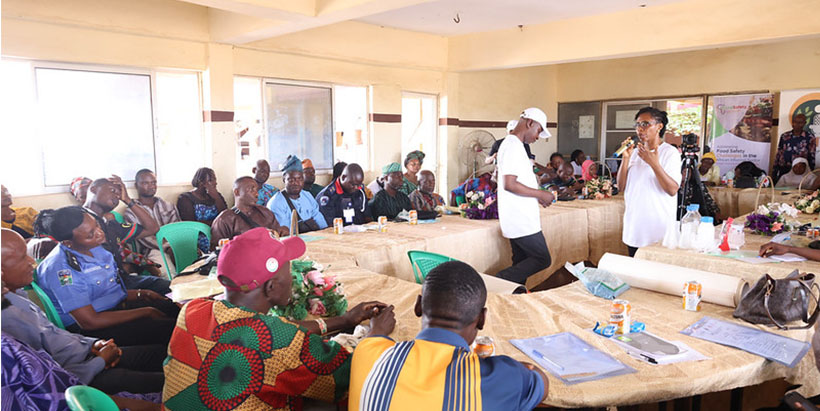
Participants during the training.

The Akinyele Local Government Headquarters in Moniya, Oyo State, recently hosted a critical training session on food safety, drawing over 60 participants from the informal sector. Organized by Food Safety for Africa (FS4A) in collaboration with Radio IITA, the training aimed to equip farmers, traders, food processors, and transporters with essential skills to enhance food quality and safety.

The Chairman of Akinyele Local Government, Honorable Akinwole Akinleye, commended the initiative, stating that the training was timely in addressing food handling and safety concerns. “Ensuring food safety is crucial not just for preventing foodborne diseases but also for strengthening the agricultural economy and consumer confidence,” he said.

Food safety and veterinary health experts led the session, delivering practical insights. The Pathology Scientist and FS4Africa Project Coordinator, Dr Titilayo Falade,  emphasized hygiene in food handling and contamination prevention. She highlighted best practices such as drying crops on clean, covered surfaces to prevent mycotoxin contamination, storing well-dried grains in hermetic containers like Purdue Improved Crop Storage (PICS) bags, and using covered vehicles for transportation. She also warned against applying pesticides directly to produce and encouraged using clean, appropriate shopping bags for carrying food items.
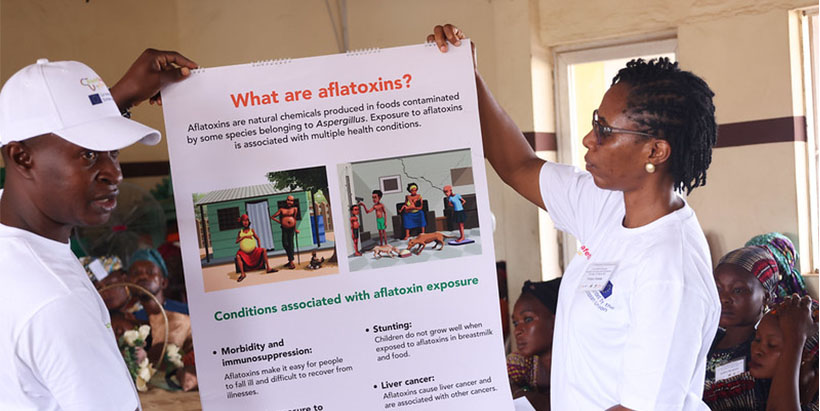
Food safety Expert Dr Titilayo Falade explaining the effect of Aflatoxins in food and human health.

Dr Ibikunle Akanbi, a veterinary doctor at the Oyo State Ministry of Agriculture and Rural Development, addressed livestock health and safe meat production, warning against poor slaughtering practices. “The safety of our food starts with the health of our animals,” he explained. “Regular veterinary check-ups, proper feeding, and safe meat handling ensure that consumers get nutritious and disease-free food.”

Participants actively engaged in discussions, raising concerns about pesticide use, food storage in rural areas with limited refrigeration, and proper meat-handling techniques. The training provided practical solutions, addressing these issues in a locally relevant manner.

The Radio IITA Lead, Dajie Odok Blessing, also spoke about the significance of the collaboration, noting that Radio IITA has been instrumental in disseminating the latest research updates on IITA’s mandate crops. “Beyond advancing agricultural research, Radio IITA is now expanding its outreach to ensure that farmers receive vital food safety tips that can improve public health and market access,” she said.
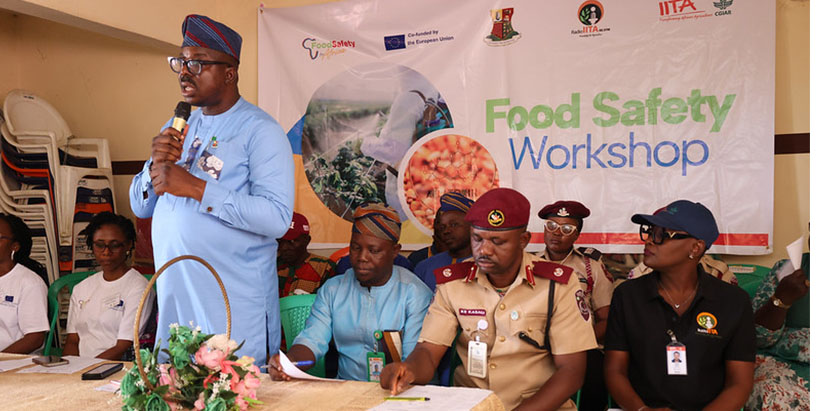
Akinyele Local Government Chairman, Honorable Akinwole Akinyele during his opening remarks.

Several participants shared how the training will impact their businesses. Muritala, a butcher from Moniya, appreciated the knowledge of safe meat handling. “I’ve learned that proper slaughtering practices and hygiene can prevent meat contamination and protect my customers’ health. I’ll henceforth ensure that the meat I sell is handled with the highest safety standards.”

Ajoke Onifade, a food processor, acknowledged that she had been unaware of certain contamination risks. “I used to dry my grains on the bare ground, not realizing that this could introduce harmful toxins. From now on, I will use clean mats and store my grains properly to maintain quality and safety,” she said.

Similarly, Adesola Adesokan, a food transporter, found the session enlightening. “I never knew that using open trucks to transport food items exposed them to dust and contamination. Now, I understand the importance of using covered vehicles and proper storage methods,” he noted.

In addition to enhancing their knowledge, the participants will, in turn, train other grassroots actors, including those involved in production, processing, transportation, trading, and consumption, equipping them with skills and tools to improve food safety across the value chain.

The European Union (EU)-funded project focuses on ensuring food safety by addressing contamination from informal markets and food hazards, setting a new standard in food safety awareness.

As participants left the session, they expressed their commitment to implementing their newfound knowledge and sharing these practices within their communities, ensuring that food safety becomes an integral part of everyday life.

Contributed by Bamise Dada


Contributed by

Related news

No items found

Leave a Reply

Your email address will not be published. Required fields are marked *

Scroll to Top
Olaosebikan, Olamide

Olamide Deborah Nwanze is a Senior Research Associate specializing in gender mainstreaming research to inform participatory and inclusive breeding, variety development, and seed systems policies regarding root, tuber, and banana (RTB) crops in the International Institute of Tropical Agriculture Headquarters, Ibadan, Nigeria. She is a PhD candidate at the University of Ibadan and holds an MSc and B. Agric in Agricultural Extension and Rural Development. Olamide is a fellow of the African Women in Agricultural Research and Development – Gender Responsive Agricultural Systems Policy (AWARD-GRASP) and the Gender Responsive Researchers Equipped for Agricultural Transformation (GREAT). She seeks to apply her gender-mainstreaming learnings, gender-responsive research, and policy development, and review expertise to facilitate women, youth, children, and vulnerable social group’s access to and adoption of agricultural Innovations that guarantee food, nutrition, income, and livelihood security in Africa. Her current roles include mentoring research fellows, development of guides and training manuals, implementation and adaptation of gender frameworks and tools, value chain actors’ engagement as citizen science partners, policy review and redesign, data management, and analysis. Her current research explores mixed methods and participatory and interdisciplinary approaches to capture and highlight gender dynamics, needs, preferences, and challenges stakeholders face within the agricultural livelihood value chain to prioritize gender-inclusive strategies in breeding programs, policy design, and implementation.

At IITA, she contributes to the implementation of the CGIAR Accelerated Breeding Initiative and Genetic Innovation Programs; participatory and gender research within the NextGen CassavaHarvestPlusRTBFoods, and Tricot-ClimMob 1000Farms Projects; and gender knowledge communication via the G-LENS webinar series, video documentary, policy briefspublications, and blogs.


Recent publications

de Sousa, K., van Etten, J., Manners, R. Bello, A., Teeken, B., Olaosebikan, O., et al. 2024. The tricot approach: an agile framework for decentralized on-farm testing supported by citizen science. A retrospective. Agron. Sustain. Dev. 44, 8. https://doi.org/10.1007/s13593-023-00937-1

Madu, T., Onwuka, S., Nwafor, S., Onyemauwa, N., Ejechi, M., Ofoeze, M., Ukeje, B., Eluagu, C., Olaosebikan, O., Okoye, B., 2024. Gender-Inclusive Consumer Studies Improve Cassava Breeding in Nigeria in: Frontiers in Sociology, volume 9, number: 1224504, doi: 10.3389/fsoc.2024.1224504

Olaosebikan, O.; Bello, A.; Utoblo, O.; Okoye, B.; Olutegbe, N.; Garner, E.; Teeken, B.; Bryan, E.; Forsythe, L.; Cole, S.; Madu, T. 2023.  Stressors and Resilience within the Cassava Value Chain in Nigeria: Preferred Cassava Variety Traits and Response Strategies of Men and Women to Inform Breeding. Sustainability 15, 7837. https://doi.org/10.3390/su15107837

Okoye, B., Ofoeze, M., Ejechi, M., Onwuka, S., Nwafor, S., Onyemauwa, N., Ukeje, B., Eluagu, C., Obidiegwu, J.*, Olaosebikan, O., Madu, T.* 2023. Prioritizing preferred traits in the yam value chain in Nigeria: a gender situation analysis in: Frontiers in Sociology, volume 8, number: 1232626, pages 1 – 9, ISSN 2297-7775, 2023. https://www.frontiersin.org/articles/10.3389/fsoc.2023.1232626/full

Olaosebikan, O., Bello, A. A., de Sousa, K., Ndjouenkeu, R., Adesokan, M., Alamu, E. O., Agbona, A., van Etten, J., Kegah, F. N.*, Dufour, D., Bouniol, A., Teeken, B. 2023. Consumer acceptability of cassava gari-eba food products across cultural and environmental settings using the triadic comparison of technologies approach (tricot) in: Journal of the Science of Food and Agriculture,

Teeken, B., Olaosebikan, O., Bello, A. A., Madu, T.*, Cole, S. M. 2023. Qualitative assessment on the positionality and preferences of dyads in relation to cassava-related activities: working with tricot trial citizen scientists https://hdl.handle.net/10568/138326 Type: Manual

Bouniol, A., Ceballos, H., Bello, A. A., Teeken, B., Olaosebikan, O., Owoade, D., Agbona, A., Fotso Kuate, A., Madu, T.*, Okoye, B.*, Ofoeze, M.*, Nwafor, S.*, Onyemauwa, N.*, Adinsi, L.*, Forsythe, L., Dufour, D. 2023. Varietal impact on women’s labour, workload and related drudgery in processing root, tuber and banana crops: focus on cassava in sub-Saharan Africa in: Journal of the Science of Food and Agriculture, pages 1 – 25, ISSN 0022-5142,

Bello, A. A., Agbona, A., Olaosebikan, O., Edughaen, G., Dufour, D., Bouniol, A., Iluebbey, P., Ndjouenkeu, R.*, Rabbi, I. Y., Teeken, B. 2023. Genetic and environmental effects on processing productivity and food product yield: drudgery of women’s work in: Journal of the Science of Food and Agriculture, pages 1 – 32, ISSN 0022-5142, 5

Cavicchioli, M., Zimbiti, T., Teeken, B., Nwanze, D.O., Liani, M., Parkes, E. & Bello, A. 2023. IITA-Gender Responsive Breeding Training Report. Genetic Resources Center, IITA-HQ, Ibadan, 21-23 September, 2022. Ibadan, Nigeria: IITA, (34 p.).https://hdl.handle.net/10568/131368

Agbona, A. Peteti P., Teeken B., Olaosebikan O. Bello, A. A., Parkes, E., Rabbi, I. Y., Mueller, L., Egesi, C., Kulakow, P. 2022. Data Management in Multi-disciplinary African RTB Crop Breeding Programs. In: Williamson, H.F., Leonelli, S. (eds) Towards Responsible Plant Data Linkage: Data Challenges for Agricultural Research and Development. Springer, Cham. https://doi.org/10.1007/978-3-031-13276-6_5

Lora Forsythe, Pricilla Marimo, Sarah Mayanja, Olamide D. Olaosebikan, Esme Stuart, Bela Teeken, Benjamin Okoye, Tessy Madu, (2021). Cross-product Gender Analysis of RTBfoods Step 2 Gendered Food Mapping on RTB Products. Understanding the Drivers of Trait Preferences and the Development of Multi-user RTB Product Profiles, WP1. London, UK: RTBfoods Field Scientific Report, 30 p.

Teeken, B., Garner, E., Agbona, A., Balogun, I., Olaosebikan, O., Bello, A., Madu, T., Okoye, B., Egesi, C., Kulakow, P. and Tufan, H.A. 2021. Beyond “Women’s Traits”: Exploring How Gender, Social Difference, and Household Characteristics Influence Trait Preferences. Frontiers Sustainable Food Systems 5:740926. https://doi.org/10.3389/fsufs.2021.740926

Teeken, B., Agbona, A., Bello, A., Olaosebikan, O., Alamu, E., Adesokan, M., Awoyale, W., Madu, T., Okoye, B., Chijioke, U., Owoade, D., Okoro, M., Bouniol, A., Dufour, D., Hershey, C., Rabbi, I., Maziya‐Dixon, B., Egesi, C., Tufan, H. and Kulakow, P. (020. Understanding cassava varietal preferences through pairwise ranking of gari‐eba and fufu prepared by local farmer–processors. Int J Food Sci Technol. https://doi.org/10.1111/ijfs.14862

Bela Teeken, Olamide Olaosebikan, Ireti Balogun, Benjamin Okoye, Tessy Madu, Steven Cole, Abolore Bello, Elizabeth Parkes. (2020). Piloting the G+ customer and product profile tools for gender-responsive cassava breeding in Nigeria. Nigeria: International Institute of Tropical Agriculture (IITA). https://hdl.handle.net/20.500.11766/13000