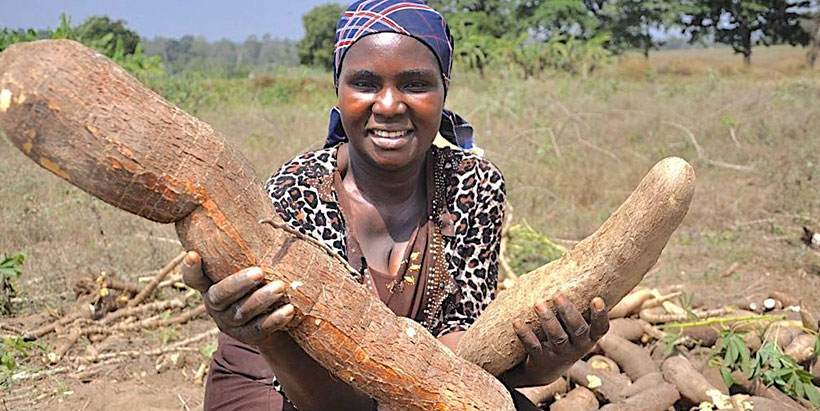
An anonymous gift of $2.65 million to support Cornell and partner research in Tanzania will improve distribution of new and more resistant varieties of cassava while empowering women and marginalized groups in the East African nation.
Cassava is a fundamental staple and basis of food security for 500 million people across Africa and a major source of employment and income for millions of farmers. In Tanzania alone, more than 2 million smallholder farmers – 81% of whom are women – rely on cassava for their income.
The gift will launch a three-year project called Muhogo Bora – a Swahili phrase meaning “better cassava.” The new initiative in Cornell’s Department of Global Development will create a fully integrated cassava seed supply chain and will improve linkages between farmers, seed entrepreneurs and markets among the nearly 3 million people in the country’s Western Zone, Southern Highlands and Central region.
A farmer with an improved cassava variety
Led by researchers Chiedozie Egesi and Hale Ann Tufan in the College of Agriculture and Life Sciences with support from the Tanzania Agricultural Research Institute (TARI) and the International Institute of Tropical Agriculture (IITA), Muhogo Bora will reinforce existing scientific efforts like Cornell’s NextGen Cassava project with the aim of improving livelihoods and quality of life for rural farmers.
“Better quality cassava feeds many more people and provides income generating opportunities for agricultural entrepreneurs, with positive ripple effects on millions of people,” the anonymous donor said in a statement. “Cornell’s demonstrated commitment to scholarship and the improvement of people’s lives for the past 150 years, with the experience to manage complex and multi-year research programs with outstanding international faculty, positions it well to promote transformation in these Tanzanian communities. We are delighted to provide the financial resources to achieve such meaningful objectives.”
Despite women’s important role in cassava production in Tanzania, restrictive gender norms often exclude them from key farm decisions. Muhogo Bora will create an effective and more inclusive cassava seed system working with women cassava farmers.
“By working with women farmers to support them to become successful seed entrepreneurs, we hope to attract young people to farming and build the next generation of cassava farmers in Tanzania,” said Tufan, who leads NextGen’s survey division and is a leading voice on gender issues in agriculture and crop improvement.
“Focusing on women benefits all,” Tufan said. “Fostering greater inclusion and creating more equitable outcomes for women farmers can help close a destructively large economic and empowerment gap between men and women and drive change in the food system.”
Muhogo Bora researchers plan extensive market research in Tanzania to better understand prevailing social structures, farmers’ needs, and opportunities to introduce new and more resistant cassava varieties. That improved understanding will then drive outreach efforts to provide farmers with education about the new varieties, skills development and access to credit and markets. The project will develop and test gender transformative seed system development approaches to ensure a focus on supporting women farmers.
The team’s rapid response approach will focus on three key goals:
increase understanding of the needs of rural Tanzanian farmers, seed producers and consumers;
expand system capacity while empowering women and rural farmers as seed entrepreneurs; and
distribute cost-effective technologies to address hunger and drive prosperity.
Serious obstacles – both longstanding and emerging – threaten the crop’s productivity and profitability. Devastating plant diseases such as cassava brown streak disease, which rots the plant’s edible pulp, ravage Tanzania’s cassava crop and create losses of $51 million each year. Production and seed distribution systems are lagging in Tanzania due to under-developed infrastructure and significant need for outreach and training.
Muhogo Bora will support growers through workshops to build awareness of improved varieties and enhance distribution of cost-effective technologies, including relevant apps and mobile cash payments. These interventions will be underpinned by gender analysis of the barriers women face in participating and benefitting from cassava seed systems, to ensure equitable outcomes. These improved practices, along with the use of newly released NextGen Cassava varieties, are expected to triple the national average yield.
“Cassava breeders are hard at work developing varieties that are responsive to farmers and consumers, but these efforts too often fall short without a functional seed system which integrates detailed knowledge of the needs of the people who grow, process and eat cassava every day,” said Egesi, who leads the NextGen Cassava project. “Muhogo Bora merges social science and plant breeding in ways that will drive real change for the people of Tanzania.”
Matt Hayes is associate director for communications for Global Development in the College of Agriculture and Life Sciences.
Olamide Deborah Nwanze is a Senior Research Associate specializing in gender mainstreaming research to inform participatory and inclusive breeding, variety development, and seed systems policies regarding root, tuber, and banana (RTB) crops in the International Institute of Tropical Agriculture Headquarters, Ibadan, Nigeria. She is a PhD candidate at the University of Ibadan and holds an MSc and B. Agric in Agricultural Extension and Rural Development. Olamide is a fellow of the African Women in Agricultural Research and Development – Gender Responsive Agricultural Systems Policy (AWARD-GRASP) and the Gender Responsive Researchers Equipped for Agricultural Transformation (GREAT). She seeks to apply her gender-mainstreaming learnings, gender-responsive research, and policy development, and review expertise to facilitate women, youth, children, and vulnerable social group’s access to and adoption of agricultural Innovations that guarantee food, nutrition, income, and livelihood security in Africa. Her current roles include mentoring research fellows, development of guides and training manuals, implementation and adaptation of gender frameworks and tools, value chain actors’ engagement as citizen science partners, policy review and redesign, data management, and analysis. Her current research explores mixed methods and participatory and interdisciplinary approaches to capture and highlight gender dynamics, needs, preferences, and challenges stakeholders face within the agricultural livelihood value chain to prioritize gender-inclusive strategies in breeding programs, policy design, and implementation.
de Sousa, K., van Etten, J., Manners, R. Bello, A., Teeken, B., Olaosebikan, O., et al. 2024. The tricot approach: an agile framework for decentralized on-farm testing supported by citizen science. A retrospective. Agron. Sustain. Dev. 44, 8. https://doi.org/10.1007/s13593-023-00937-1
Madu, T., Onwuka, S., Nwafor, S., Onyemauwa, N., Ejechi, M., Ofoeze, M., Ukeje, B., Eluagu, C., Olaosebikan, O., Okoye, B., 2024. Gender-Inclusive Consumer Studies Improve Cassava Breeding in Nigeria in: Frontiers in Sociology, volume 9, number: 1224504, doi: 10.3389/fsoc.2024.1224504
Olaosebikan, O.; Bello, A.; Utoblo, O.; Okoye, B.; Olutegbe, N.; Garner, E.; Teeken, B.; Bryan, E.; Forsythe, L.; Cole, S.; Madu, T. 2023. Stressors and Resilience within the Cassava Value Chain in Nigeria: Preferred Cassava Variety Traits and Response Strategies of Men and Women to Inform Breeding. Sustainability 15, 7837. https://doi.org/10.3390/su15107837
Okoye, B., Ofoeze, M., Ejechi, M., Onwuka, S., Nwafor, S., Onyemauwa, N., Ukeje, B., Eluagu, C., Obidiegwu, J.*, Olaosebikan, O., Madu, T.* 2023. Prioritizing preferred traits in the yam value chain in Nigeria: a gender situation analysis in: Frontiers in Sociology, volume 8, number: 1232626, pages 1 – 9, ISSN 2297-7775, 2023. https://www.frontiersin.org/articles/10.3389/fsoc.2023.1232626/full
Olaosebikan, O., Bello, A. A., de Sousa, K., Ndjouenkeu, R., Adesokan, M., Alamu, E. O., Agbona, A., van Etten, J., Kegah, F. N.*, Dufour, D., Bouniol, A., Teeken, B. 2023. Consumer acceptability of cassava gari-eba food products across cultural and environmental settings using the triadic comparison of technologies approach (tricot) in: Journal of the Science of Food and Agriculture,
Teeken, B., Olaosebikan, O., Bello, A. A., Madu, T.*, Cole, S. M. 2023. Qualitative assessment on the positionality and preferences of dyads in relation to cassava-related activities: working with tricot trial citizen scientists https://hdl.handle.net/10568/138326 Type: Manual
Bouniol, A., Ceballos, H., Bello, A. A., Teeken, B., Olaosebikan, O., Owoade, D., Agbona, A., Fotso Kuate, A., Madu, T.*, Okoye, B.*, Ofoeze, M.*, Nwafor, S.*, Onyemauwa, N.*, Adinsi, L.*, Forsythe, L., Dufour, D. 2023. Varietal impact on women’s labour, workload and related drudgery in processing root, tuber and banana crops: focus on cassava in sub-Saharan Africa in: Journal of the Science of Food and Agriculture, pages 1 – 25, ISSN 0022-5142,
Bello, A. A., Agbona, A., Olaosebikan, O., Edughaen, G., Dufour, D., Bouniol, A., Iluebbey, P., Ndjouenkeu, R.*, Rabbi, I. Y., Teeken, B. 2023. Genetic and environmental effects on processing productivity and food product yield: drudgery of women’s work in: Journal of the Science of Food and Agriculture, pages 1 – 32, ISSN 0022-5142, 5
Cavicchioli, M., Zimbiti, T., Teeken, B., Nwanze, D.O., Liani, M., Parkes, E. & Bello, A. 2023. IITA-Gender Responsive Breeding Training Report. Genetic Resources Center, IITA-HQ, Ibadan, 21-23 September, 2022. Ibadan, Nigeria: IITA, (34 p.).https://hdl.handle.net/10568/131368
Agbona, A. Peteti P., Teeken B., Olaosebikan O. Bello, A. A., Parkes, E., Rabbi, I. Y., Mueller, L., Egesi, C., Kulakow, P. 2022. Data Management in Multi-disciplinary African RTB Crop Breeding Programs. In: Williamson, H.F., Leonelli, S. (eds) Towards Responsible Plant Data Linkage: Data Challenges for Agricultural Research and Development. Springer, Cham. https://doi.org/10.1007/978-3-031-13276-6_5
Lora Forsythe, Pricilla Marimo, Sarah Mayanja, Olamide D. Olaosebikan, Esme Stuart, Bela Teeken, Benjamin Okoye, Tessy Madu, (2021). Cross-product Gender Analysis of RTBfoods Step 2 Gendered Food Mapping on RTB Products. Understanding the Drivers of Trait Preferences and the Development of Multi-user RTB Product Profiles, WP1. London, UK: RTBfoods Field Scientific Report, 30 p.
Teeken, B., Garner, E., Agbona, A., Balogun, I., Olaosebikan, O., Bello, A., Madu, T., Okoye, B., Egesi, C., Kulakow, P. and Tufan, H.A. 2021. Beyond “Women’s Traits”: Exploring How Gender, Social Difference, and Household Characteristics Influence Trait Preferences. Frontiers Sustainable Food Systems 5:740926. https://doi.org/10.3389/fsufs.2021.740926
Teeken, B., Agbona, A., Bello, A., Olaosebikan, O., Alamu, E., Adesokan, M., Awoyale, W., Madu, T., Okoye, B., Chijioke, U., Owoade, D., Okoro, M., Bouniol, A., Dufour, D., Hershey, C., Rabbi, I., Maziya‐Dixon, B., Egesi, C., Tufan, H. and Kulakow, P. (020. Understanding cassava varietal preferences through pairwise ranking of gari‐eba and fufu prepared by local farmer–processors. Int J Food Sci Technol.https://doi.org/10.1111/ijfs.14862
Bela Teeken, Olamide Olaosebikan, Ireti Balogun, Benjamin Okoye, Tessy Madu, Steven Cole, Abolore Bello, Elizabeth Parkes. (2020). Piloting the G+ customer and product profile tools for gender-responsive cassava breeding in Nigeria. Nigeria: International Institute of Tropical Agriculture (IITA). https://hdl.handle.net/20.500.11766/13000