IITA scientists spearhead efforts to save East Africa’s potatoes from a new pest threat
July 28, 2020
Scientists at CGIAR-IITA, working with the International Centre of Insect Physiology and Ecology (icipe) under the joint Nematology Unit, NemAfrica, housed at icipe’s campus in Nairobi, and their national and international partners, have been at the forefront of efforts to address a new emerging pest threat to the production of potato in the East Africa region, and in many other countries in the world. These are the parasitic microscopic worms known as Potato Cyst Nematodes (PCN). These destructive pests attack potato roots and can cause yield losses of up to 80%, and in some instances, even total crop failure.
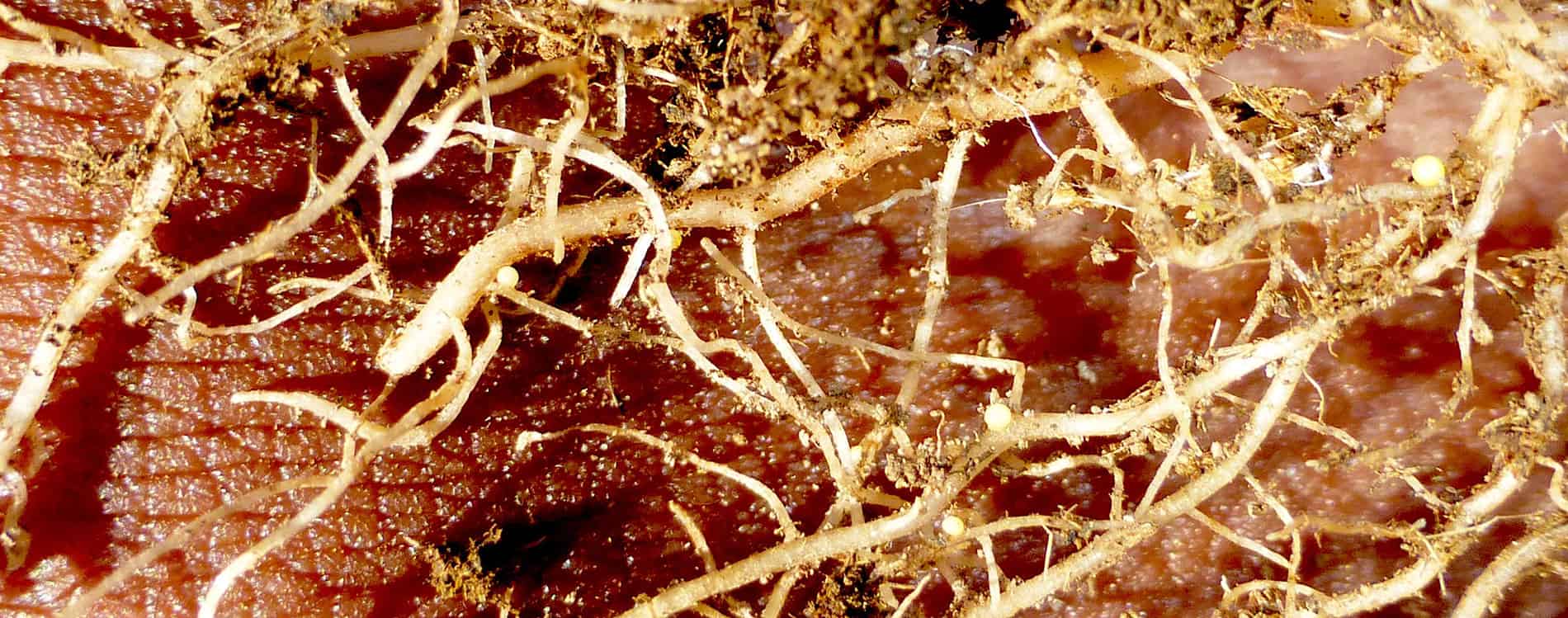
PCN cysts (white) on roots.
PCN consist mostly of two species, Globodera rostochiensis and Globodera pallida, both of which have recently been discovered attacking potato in Kenya. G. rostochiensis however, has since been shown to be widespread across Kenya and has additionally been detected further afield in Uganda and Rwanda.
“PCNs are among the most destructive potato pests globally. They are particularly lethal because each female nematode produces hundreds of eggs—between 300 and 500, which remain protected in a cyst formed by their body after they die. These cysts can remain dormant in the soil for years, awaiting the next potato crop host. Because of the dangers they pose, PCNs have been designated as quarantine pests in many countries, to strictly control their spread,” says Danny Coyne, a leading nematologist and Soil Health Scientist at IITA.
Establishing the prevalence of potato nematodes in the region
Following the detection of G. rostochiensis in Kenya in 2015, IITA scientists in partnership with their counterparts at icipe and Jomo Kenyatta University of Agriculture and Technology (JKUAT), among others, conducted a country-wide survey which found that G. rostochiensis was not only widespread throughout the country, including areas bordering Uganda and Tanzania, but also in very high concentrations. These findings were published in the paper, Potato Cyst Nematodes: A new threat to potato production in East Africa, published in May 2020 in Frontiers in Plant Science.
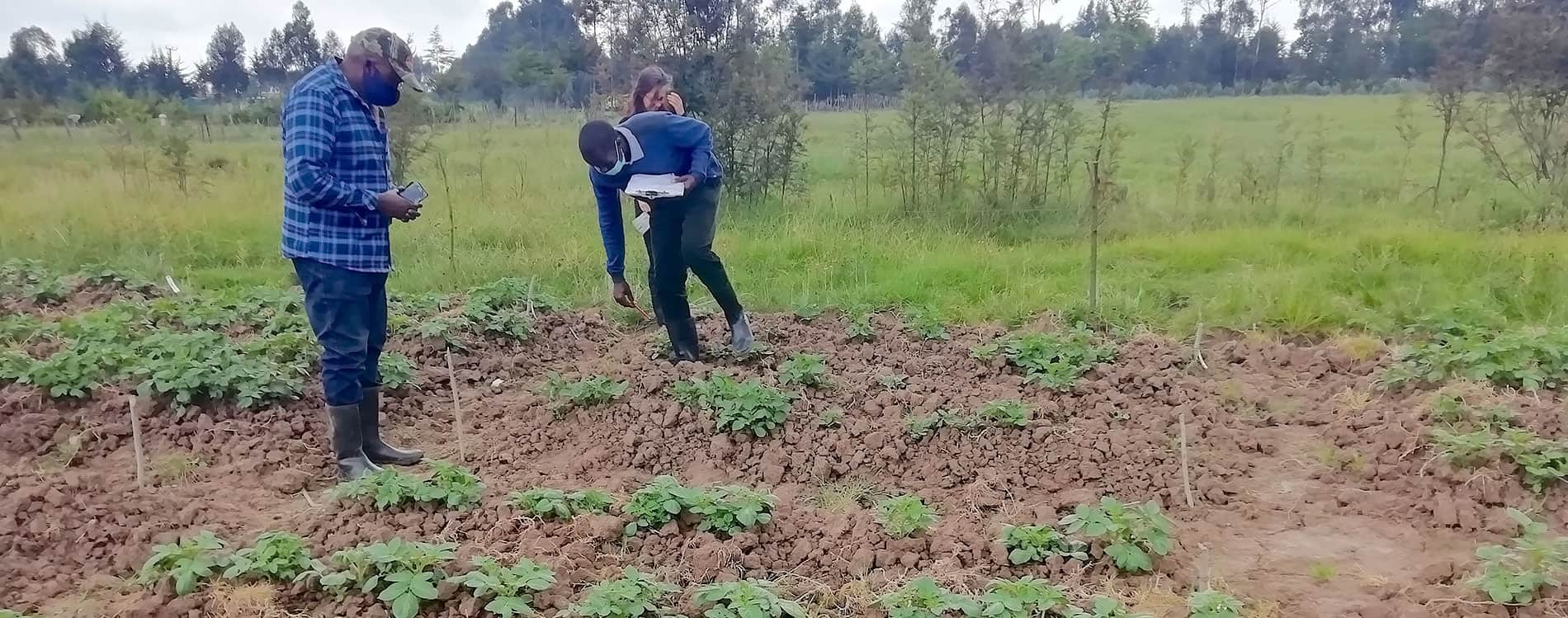
Researchers evaluating a potato field for resistance to PCN.
The team also established the presence of the pest in Uganda, and the findings were published as aFirst report of potato cyst nematodes Globodera rostochiensis (Wollenweber, 1923), infecting potato (Solanum tuberosum L.) in Uganda in June 2020 in Plant Disease. Researchers in Rwanda have also detected these nematodes in the country.
IITA scientists and their partners are also engaged in a study to explore an innovative approach to effectively control these pests using “suicide hatch”. The hatching of nematode eggs from their protective cyst into the soils, where they then find the host plant roots, is triggered by chemicals that are released by the potato roots. The newly hatched juvenile nematodes then use other chemical signals from the roots to locate and infect the potato roots.
Identifying these chemicals and synthetically producing them may offer possibilities for manipulating PCN to hatch in farmers’ fields before potatoes are planted, and in the absence of the host to feed on, the nematodes will starve to death—“suicide hatch”.
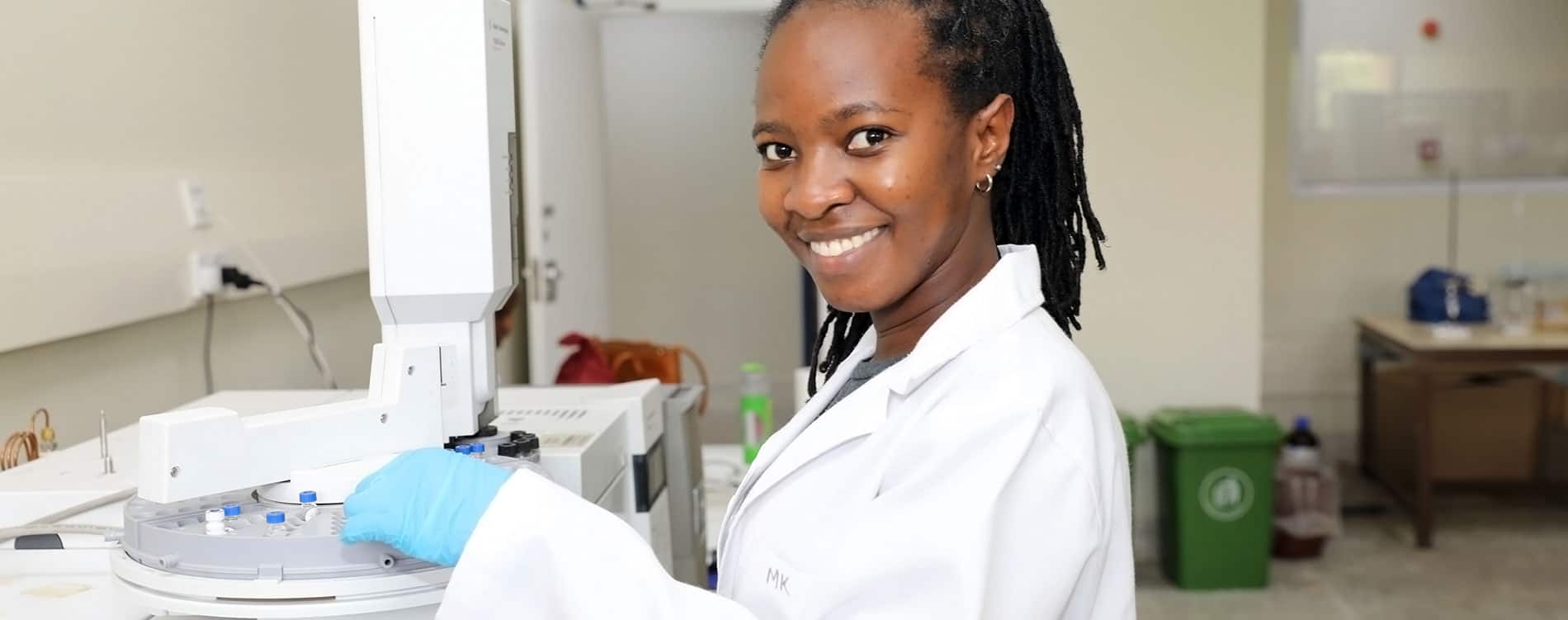
Msc student, Juliet Ochola, researching on “suicide hatching” as an effective ways to control nematode, looking at the pest with a microscope in the laboratory.
The study findings were published in the paper, Mediation of potato–Potato Cyst Nematode, G. rostochiensis interaction by specific root exudate compounds in Frontiers in Plant Science.
IITA researchers are also working with partners, including the Kenya Plant Health Inspectorate Service (KEPHIS), James Hutton Institute in UK, and the International Potato Center (CIP), among others, to identify suitable potato cultivars with resistance against the nematodes and similar attributes to farmers’ preferred varieties.
The team will increase its efforts to find an effective solution to this menace, which can spell doom for potato and the food and income of millions of people in the region.
Olamide Deborah Nwanze is a Senior Research Associate specializing in gender mainstreaming research to inform participatory and inclusive breeding, variety development, and seed systems policies regarding root, tuber, and banana (RTB) crops in the International Institute of Tropical Agriculture Headquarters, Ibadan, Nigeria. She is a PhD candidate at the University of Ibadan and holds an MSc and B. Agric in Agricultural Extension and Rural Development. Olamide is a fellow of the African Women in Agricultural Research and Development – Gender Responsive Agricultural Systems Policy (AWARD-GRASP) and the Gender Responsive Researchers Equipped for Agricultural Transformation (GREAT). She seeks to apply her gender-mainstreaming learnings, gender-responsive research, and policy development, and review expertise to facilitate women, youth, children, and vulnerable social group’s access to and adoption of agricultural Innovations that guarantee food, nutrition, income, and livelihood security in Africa. Her current roles include mentoring research fellows, development of guides and training manuals, implementation and adaptation of gender frameworks and tools, value chain actors’ engagement as citizen science partners, policy review and redesign, data management, and analysis. Her current research explores mixed methods and participatory and interdisciplinary approaches to capture and highlight gender dynamics, needs, preferences, and challenges stakeholders face within the agricultural livelihood value chain to prioritize gender-inclusive strategies in breeding programs, policy design, and implementation.
de Sousa, K., van Etten, J., Manners, R. Bello, A., Teeken, B., Olaosebikan, O., et al. 2024. The tricot approach: an agile framework for decentralized on-farm testing supported by citizen science. A retrospective. Agron. Sustain. Dev. 44, 8. https://doi.org/10.1007/s13593-023-00937-1
Madu, T., Onwuka, S., Nwafor, S., Onyemauwa, N., Ejechi, M., Ofoeze, M., Ukeje, B., Eluagu, C., Olaosebikan, O., Okoye, B., 2024. Gender-Inclusive Consumer Studies Improve Cassava Breeding in Nigeria in: Frontiers in Sociology, volume 9, number: 1224504, doi: 10.3389/fsoc.2024.1224504
Olaosebikan, O.; Bello, A.; Utoblo, O.; Okoye, B.; Olutegbe, N.; Garner, E.; Teeken, B.; Bryan, E.; Forsythe, L.; Cole, S.; Madu, T. 2023. Stressors and Resilience within the Cassava Value Chain in Nigeria: Preferred Cassava Variety Traits and Response Strategies of Men and Women to Inform Breeding. Sustainability 15, 7837. https://doi.org/10.3390/su15107837
Okoye, B., Ofoeze, M., Ejechi, M., Onwuka, S., Nwafor, S., Onyemauwa, N., Ukeje, B., Eluagu, C., Obidiegwu, J.*, Olaosebikan, O., Madu, T.* 2023. Prioritizing preferred traits in the yam value chain in Nigeria: a gender situation analysis in: Frontiers in Sociology, volume 8, number: 1232626, pages 1 – 9, ISSN 2297-7775, 2023. https://www.frontiersin.org/articles/10.3389/fsoc.2023.1232626/full
Olaosebikan, O., Bello, A. A., de Sousa, K., Ndjouenkeu, R., Adesokan, M., Alamu, E. O., Agbona, A., van Etten, J., Kegah, F. N.*, Dufour, D., Bouniol, A., Teeken, B. 2023. Consumer acceptability of cassava gari-eba food products across cultural and environmental settings using the triadic comparison of technologies approach (tricot) in: Journal of the Science of Food and Agriculture,
Teeken, B., Olaosebikan, O., Bello, A. A., Madu, T.*, Cole, S. M. 2023. Qualitative assessment on the positionality and preferences of dyads in relation to cassava-related activities: working with tricot trial citizen scientists https://hdl.handle.net/10568/138326 Type: Manual
Bouniol, A., Ceballos, H., Bello, A. A., Teeken, B., Olaosebikan, O., Owoade, D., Agbona, A., Fotso Kuate, A., Madu, T.*, Okoye, B.*, Ofoeze, M.*, Nwafor, S.*, Onyemauwa, N.*, Adinsi, L.*, Forsythe, L., Dufour, D. 2023. Varietal impact on women’s labour, workload and related drudgery in processing root, tuber and banana crops: focus on cassava in sub-Saharan Africa in: Journal of the Science of Food and Agriculture, pages 1 – 25, ISSN 0022-5142,
Bello, A. A., Agbona, A., Olaosebikan, O., Edughaen, G., Dufour, D., Bouniol, A., Iluebbey, P., Ndjouenkeu, R.*, Rabbi, I. Y., Teeken, B. 2023. Genetic and environmental effects on processing productivity and food product yield: drudgery of women’s work in: Journal of the Science of Food and Agriculture, pages 1 – 32, ISSN 0022-5142, 5
Cavicchioli, M., Zimbiti, T., Teeken, B., Nwanze, D.O., Liani, M., Parkes, E. & Bello, A. 2023. IITA-Gender Responsive Breeding Training Report. Genetic Resources Center, IITA-HQ, Ibadan, 21-23 September, 2022. Ibadan, Nigeria: IITA, (34 p.).https://hdl.handle.net/10568/131368
Agbona, A. Peteti P., Teeken B., Olaosebikan O. Bello, A. A., Parkes, E., Rabbi, I. Y., Mueller, L., Egesi, C., Kulakow, P. 2022. Data Management in Multi-disciplinary African RTB Crop Breeding Programs. In: Williamson, H.F., Leonelli, S. (eds) Towards Responsible Plant Data Linkage: Data Challenges for Agricultural Research and Development. Springer, Cham. https://doi.org/10.1007/978-3-031-13276-6_5
Lora Forsythe, Pricilla Marimo, Sarah Mayanja, Olamide D. Olaosebikan, Esme Stuart, Bela Teeken, Benjamin Okoye, Tessy Madu, (2021). Cross-product Gender Analysis of RTBfoods Step 2 Gendered Food Mapping on RTB Products. Understanding the Drivers of Trait Preferences and the Development of Multi-user RTB Product Profiles, WP1. London, UK: RTBfoods Field Scientific Report, 30 p.
Teeken, B., Garner, E., Agbona, A., Balogun, I., Olaosebikan, O., Bello, A., Madu, T., Okoye, B., Egesi, C., Kulakow, P. and Tufan, H.A. 2021. Beyond “Women’s Traits”: Exploring How Gender, Social Difference, and Household Characteristics Influence Trait Preferences. Frontiers Sustainable Food Systems 5:740926. https://doi.org/10.3389/fsufs.2021.740926
Teeken, B., Agbona, A., Bello, A., Olaosebikan, O., Alamu, E., Adesokan, M., Awoyale, W., Madu, T., Okoye, B., Chijioke, U., Owoade, D., Okoro, M., Bouniol, A., Dufour, D., Hershey, C., Rabbi, I., Maziya‐Dixon, B., Egesi, C., Tufan, H. and Kulakow, P. (020. Understanding cassava varietal preferences through pairwise ranking of gari‐eba and fufu prepared by local farmer–processors. Int J Food Sci Technol.https://doi.org/10.1111/ijfs.14862
Bela Teeken, Olamide Olaosebikan, Ireti Balogun, Benjamin Okoye, Tessy Madu, Steven Cole, Abolore Bello, Elizabeth Parkes. (2020). Piloting the G+ customer and product profile tools for gender-responsive cassava breeding in Nigeria. Nigeria: International Institute of Tropical Agriculture (IITA). https://hdl.handle.net/20.500.11766/13000