
IITA and Bayer launch modern breeding project
July 20, 2020
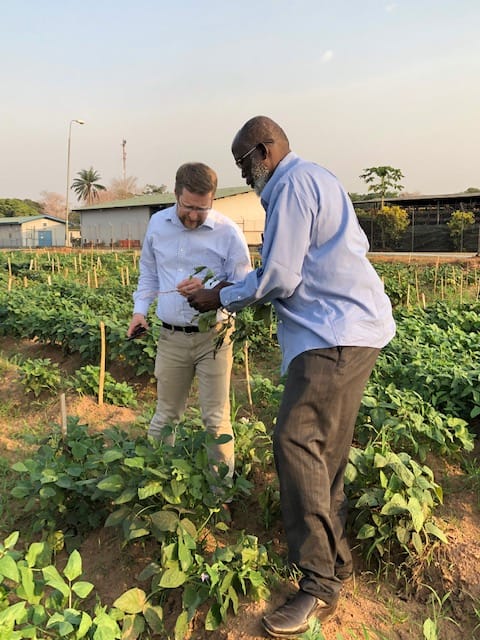 Yield improvement of important African food crops will get a boost with the launch of a new project to be implemented by the International Institute of Tropical Agriculture (IITA) in collaboration with Bayer.
Known as Modern Breeding Project (MBP), the project will focus on ensuring that IITA mandate crops—cassava, maize, cowpea, banana, yam, and soybean—achieve the highest yield possible, leading to increased crop productivity on farms.
Michael Abberton, Head of CGIAR-IITA’s Genetic Resources Center and the project lead, explains: “The 30-month project will build a more effective plant breeding system that develops superior cultivars for critical African crops through a partnership with a leading private-sector seed company—Bayer.”
Through this $1.2 million crop improvement project funded by the Bill & Melinda Gates Foundation, IITA will modernize its suite of breeding programs. Crop breeding is central for achieving IITA’s goals of increased productivity, economic growth, and poverty reduction to support the agricultural transformation of Africa. The project expects to improve both technical and organizational elements patterned after models and best practices from Bayer.
The Bayer partnership brings private sector perspective and approaches to the project to help create efficiency-driven programs in CGIAR. It will also leverage $1.2 M of in-kind support from Bayer, mostly in the form of time of skills-based volunteers to enable IITA to rapidly incorporate the tools and approaches from the CGIAR Excellence in Breeding (EiB) platform.
The project’s beneficiaries are the over 100 million smallholder farmers who grow IITA’s mandate crops on about 60 million hectares in the humid to semiarid zones of sub-Saharan Africa. These cover countries such as Burkina Faso, Democratic Republic of Congo, Ghana, Malawi, Mali, Niger, Nigeria, Rwanda, Tanzania, Uganda, and Zambia.
Bayer will assist IITA with research workflow management, product development, implementation of shared services, and general organizational insights. Over the last decade, Bayer has implemented protocols that have increased efficiency in their organization, and they will draw on these lessons to enable IITA to improve its organizational effectiveness as well.
“In supporting Bayer’s mission Health for All, Hunger for None, we look forward to continuing our engagement with IITA to help achieve food security in Africa,” added Mike Graham, Head of Breeding for the Crop Science division of Bayer. “By helping IITA scientists provide solutions for smallholder farmers, we can help be part of the solution to growth and progress for IITA and its partners.”
The project, which focuses on six crops, positions IITA for future investments that are more institutional and aligned to the anticipated One CGIAR.
Along with EiB, the project will ensure that the basic requirements of high-quality data from field experiments are in place and managed in a timely and efficient manner. It will further facilitate the implementation of the institutional Breeding Program Improvement Plan (BPIP).
Yield improvement of important African food crops will get a boost with the launch of a new project to be implemented by the International Institute of Tropical Agriculture (IITA) in collaboration with Bayer.
Known as Modern Breeding Project (MBP), the project will focus on ensuring that IITA mandate crops—cassava, maize, cowpea, banana, yam, and soybean—achieve the highest yield possible, leading to increased crop productivity on farms.
Michael Abberton, Head of CGIAR-IITA’s Genetic Resources Center and the project lead, explains: “The 30-month project will build a more effective plant breeding system that develops superior cultivars for critical African crops through a partnership with a leading private-sector seed company—Bayer.”
Through this $1.2 million crop improvement project funded by the Bill & Melinda Gates Foundation, IITA will modernize its suite of breeding programs. Crop breeding is central for achieving IITA’s goals of increased productivity, economic growth, and poverty reduction to support the agricultural transformation of Africa. The project expects to improve both technical and organizational elements patterned after models and best practices from Bayer.
The Bayer partnership brings private sector perspective and approaches to the project to help create efficiency-driven programs in CGIAR. It will also leverage $1.2 M of in-kind support from Bayer, mostly in the form of time of skills-based volunteers to enable IITA to rapidly incorporate the tools and approaches from the CGIAR Excellence in Breeding (EiB) platform.
The project’s beneficiaries are the over 100 million smallholder farmers who grow IITA’s mandate crops on about 60 million hectares in the humid to semiarid zones of sub-Saharan Africa. These cover countries such as Burkina Faso, Democratic Republic of Congo, Ghana, Malawi, Mali, Niger, Nigeria, Rwanda, Tanzania, Uganda, and Zambia.
Bayer will assist IITA with research workflow management, product development, implementation of shared services, and general organizational insights. Over the last decade, Bayer has implemented protocols that have increased efficiency in their organization, and they will draw on these lessons to enable IITA to improve its organizational effectiveness as well.
“In supporting Bayer’s mission Health for All, Hunger for None, we look forward to continuing our engagement with IITA to help achieve food security in Africa,” added Mike Graham, Head of Breeding for the Crop Science division of Bayer. “By helping IITA scientists provide solutions for smallholder farmers, we can help be part of the solution to growth and progress for IITA and its partners.”
The project, which focuses on six crops, positions IITA for future investments that are more institutional and aligned to the anticipated One CGIAR.
Along with EiB, the project will ensure that the basic requirements of high-quality data from field experiments are in place and managed in a timely and efficient manner. It will further facilitate the implementation of the institutional Breeding Program Improvement Plan (BPIP).
 The grant will help IITA to achieve the following outcomes:
- Improve the capacity of all IITA breeding programs to increase genetic gains
- Develop and deliver new products effectively through partnerships with public and private sectors
- Put in place systems for annual measurement of genetic gain and components that contribute to it
- Systems to track operational costs, e.g., cost per plot of preliminary and advanced trials
- Adopt improved phenotyping approaches, trial designs and agronomic management, as well as standardized use of molecular markers, and advanced data management tools.
About IITA
The International Institute of Tropical Agriculture (IITA) is a not-for-profit institution that generates agricultural innovations to meet Africa’s most pressing challenges of hunger, malnutrition, poverty, and natural resource degradation. Working with various partners across sub-Saharan Africa, we improve livelihoods, enhance food and nutrition security, increase employment, and preserve natural resource integrity. IITA is a member of CGIAR, a global agriculture research partnership for a food secure future. Hashtags #ModernBreeding #IITA_BayerModernBreeding #GeneticPotential #AfricanFoodCrops #IITA_BayerCowpea @iita_cgiar Media contacts IITA: Katherine Lopez, k.lopez@cgiar.org Bayer: Esra Guersel, esra.guersel@bayer.comContributed by
Recent stories
No items found