
IITA signs major project agreement with the EU to enhance livelihoods in Northern Uganda
February 1, 2020
IITA has signed an agreement with the European Union and Uganda Government to start the implementation of a three-year, multidisciplinary program that seeks to enhance food and nutrition security, increase household incomes, and improve maternal and child nutrition and health in Northern Uganda.
The project will, among others, promote diversified food (production; commercialization of agriculture; improved postharvest handling, food preparation, and consumption; and encourage family planning for improved and sustainable livelihoods in Northern Uganda.
 The program is funded by the European Union Uganda Delegation through the Development Initiative for Northern Uganda (DINU) and coordinated by the Office of the Prime Minister. It is a flagship program of the partnership between the EU and the Government of Uganda to support the consolidation of peace, stability, and socioeconomic development of Northern Uganda.
In this project, IITA is leading the consortium of different actors contributing to the delivery of the project’s multi-sector objectives. These include Kilimo Trust and Rikolto (for commercialization and trade); Volunteer Efforts for Development Concerns (VEDCO) that together with IITA are jointly responsible for the production of diversified foods; and Bioversity International and Ernest Cook Ultrasound Research and Education Institute (for nutrition, maternal and child, and reproductive and public health).
The project specifically targets over 50,000 households from the vulnerable farming households in Lango Region (Amalator, Apac, Dokolo, Kwania, and Otuke districts) and Teso Region (Amuria and Kapelebyong districts). The overall budget is 5,578,949 Euros (EU contribution = 5,021,054 Euros and co-funding by IITA and Consortium members = 557,895 Euros).
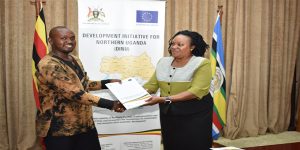
The signing event was held on 14 January 2020 in Kampala, Uganda, and was chaired by the Permanent Secretary of the Office of the Prime Minister (OPM), Christine Guwatudde. IITA was represented by Perez Muchunguzi, a multi-stakeholder specialist at IITA-Uganda on behalf of all actors involved in the IITA-led consortium.
The project is one of nine others led by different organizations being implemented as part of the DINU program—five are contributing to enhancing livelihood with a total budget of 26 million euros and four to good governance with a budget of one million euros.
“The project is an extremely exciting one for IITA. We are leading a team of development partners to make a difference among the vulnerable communities in Northern Uganda. We will be disseminating our proven technologies that address major challenges facing agriculture in the region. We will also address other critical aspects such as maternal and child health and nutrition,” says Regina Kapinga, IITA Uganda Country Representative who led the mobilization of partners to develop and bid for the project.
The project’s specific objectives are to a) improve nutrition and health of the general population, b) increase access to markets for agricultural products hence increase household incomes, and c) increase adoption and production of diversified foods.
IITA will lead efforts on the introduction of new improved varieties that are high yielding, disease-resistant, and nutrient-dense such as Orange fleshed sweet potato and soybean and improved agronomic practices to boost production for commercialization.
The initiative will also focus on improved production of vegetables and biofortified foods such as iron-rich beans to improve the nutrition of the people of the two sub-regions of Lango and Teso. Specific agribusiness activities will target women and youth.
The program is funded by the European Union Uganda Delegation through the Development Initiative for Northern Uganda (DINU) and coordinated by the Office of the Prime Minister. It is a flagship program of the partnership between the EU and the Government of Uganda to support the consolidation of peace, stability, and socioeconomic development of Northern Uganda.
In this project, IITA is leading the consortium of different actors contributing to the delivery of the project’s multi-sector objectives. These include Kilimo Trust and Rikolto (for commercialization and trade); Volunteer Efforts for Development Concerns (VEDCO) that together with IITA are jointly responsible for the production of diversified foods; and Bioversity International and Ernest Cook Ultrasound Research and Education Institute (for nutrition, maternal and child, and reproductive and public health).
The project specifically targets over 50,000 households from the vulnerable farming households in Lango Region (Amalator, Apac, Dokolo, Kwania, and Otuke districts) and Teso Region (Amuria and Kapelebyong districts). The overall budget is 5,578,949 Euros (EU contribution = 5,021,054 Euros and co-funding by IITA and Consortium members = 557,895 Euros).
The signing event was held on 14 January 2020 in Kampala, Uganda, and was chaired by the Permanent Secretary of the Office of the Prime Minister (OPM), Christine Guwatudde. IITA was represented by Perez Muchunguzi, a multi-stakeholder specialist at IITA-Uganda on behalf of all actors involved in the IITA-led consortium.
The project is one of nine others led by different organizations being implemented as part of the DINU program—five are contributing to enhancing livelihood with a total budget of 26 million euros and four to good governance with a budget of one million euros.
“The project is an extremely exciting one for IITA. We are leading a team of development partners to make a difference among the vulnerable communities in Northern Uganda. We will be disseminating our proven technologies that address major challenges facing agriculture in the region. We will also address other critical aspects such as maternal and child health and nutrition,” says Regina Kapinga, IITA Uganda Country Representative who led the mobilization of partners to develop and bid for the project.
The project’s specific objectives are to a) improve nutrition and health of the general population, b) increase access to markets for agricultural products hence increase household incomes, and c) increase adoption and production of diversified foods.
IITA will lead efforts on the introduction of new improved varieties that are high yielding, disease-resistant, and nutrient-dense such as Orange fleshed sweet potato and soybean and improved agronomic practices to boost production for commercialization.
The initiative will also focus on improved production of vegetables and biofortified foods such as iron-rich beans to improve the nutrition of the people of the two sub-regions of Lango and Teso. Specific agribusiness activities will target women and youth.
Perez Muchunguzi (left) with Christine Guwatudde, Permanent Secretary of the Office of the Prime Minister.
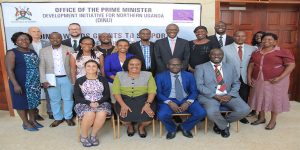 Participants at the project signing event.
Contributed by
Recent stories
No items found