
In focus: Forest Unit Manager discusses her experience as project comes to an end
January 20, 2018
Deni Bown, the Forest Unit Manager, is a writer, botanist, photographer, publisher, and consultant from Norfolk, England, who has a special interest in herbs, trees, gardening, and natural history. She has traveled to remote places worldwide for research to write her many books on plants. This prompted her to take up the position as a part-time volunteer in the Biodiversity and Forest Unit of IITA-Ibadan, where she became the Manager two years later.
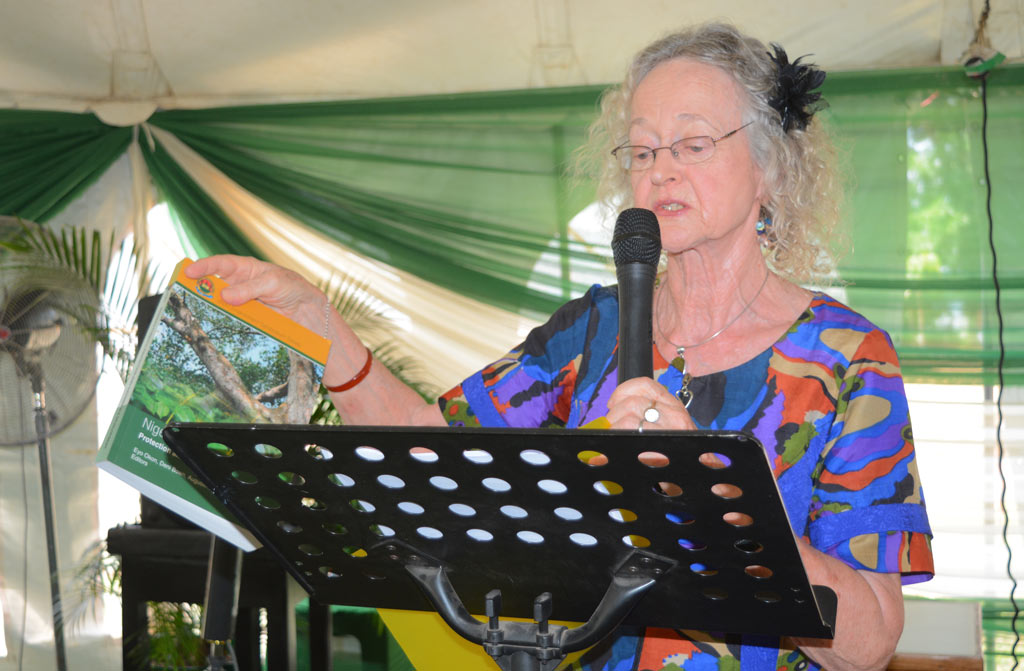 When asked about her achievements, she stated: “Within a period of seven years as Project Leader, I achieved the following with the help of my dedicated staff and partners: I transformed the nursery, which was largely set up by IITA from what it used to be to what it is now—the best nursery in Nigeria not only for ornamental plants and the gardens but especially for indigenous trees and medicinal plants.
Another milestone was the setting up of a national botanical garden in December 2016. We invited the Yorubas from villages around IITA and its perimeter that have never been to IITA, to educate and enlighten them on the importance of natural resources. After the project had elapsed in 2014, my contract was renewed for 2 years. During that time frame we did a lot, especially in the areas of biodiversity monitoring and forest conservation.
I also initiated a new project, which was planting trees. Looking at the situation in Nigeria, forest cover is down to 4% with forest clearing, and everybody knows that the loss of forest will continue to be a critical issue if not properly addressed; today the loss of forest is a significant factor in global warming and climate mitigation.
Another milestone was the launch of the written protocols as a manual for tree propagation, which is free and downloadable from the Forest Unit website. There are few ethnobotanical gardens in Nigeria and the manual for tree propagation is the first of its kind.
The Forest Unit has restored the Arboretum in the IITA-Ibadan campus as a Tree Heritage Park for the conservation of rare and endangered Nigerian trees. As time went on, the first forest school in Nigeria kicked off as students, families, and groups had the opportunity to come and have a glimpse of the natural environment, ranging from fishing to bird watching and identification. A citizen science initiative club comprising more than 30 members was also set up to enlighten people about birds, wildlife, and its habitats”.
In an interview with Bown, the talented horticulturist highlighted the challenges she encountered: “The best way to cope with challenges is when you have your own experience. Initially, my biggest challenge was the language and cultural barrier owing to the fact that I am a foreigner and also it was my first time coming to Nigeria. Amidst all this, I enjoyed having many people around from different nationalities, races, religions, and family backgrounds. From my experience, the best way to tackle challenges is to stay focused and keep learning.”
To enhance the sustainability of the project, Bown discussed some of the measures she took during its life span. “Management has assured me that both the Tree Heritage Park and the School Forest will be maintained and continued as campus assets, which will be used by all people, not only campus residents or the Institute’s staff. We have a lot of interest in the tree school and we take groups into the forest, including visitors to IITA. It is a unique, hands-on experience,” she narrated.
While appreciating IITA Management and staff for their support and commitment, Bown advised, “I think the most important thing for IITA and staff as a whole is to realize the value of the natural environment. The wealth of the nation is through resources and I believe the management of natural resources faces challenges on water shift and deforestation. If these are not addressed, realizing the value of natural resources and its practical value to people, the natural resources will become extinct. I strongly hope that IITA will help sustain and improve the already laid foundation. I think we need to realize the urgency of this. Yes, we need research but far more than a person doing research, you need a thousand people on the ground doing something about it, starting to propagate, protect, replant.”
When asked about her achievements, she stated: “Within a period of seven years as Project Leader, I achieved the following with the help of my dedicated staff and partners: I transformed the nursery, which was largely set up by IITA from what it used to be to what it is now—the best nursery in Nigeria not only for ornamental plants and the gardens but especially for indigenous trees and medicinal plants.
Another milestone was the setting up of a national botanical garden in December 2016. We invited the Yorubas from villages around IITA and its perimeter that have never been to IITA, to educate and enlighten them on the importance of natural resources. After the project had elapsed in 2014, my contract was renewed for 2 years. During that time frame we did a lot, especially in the areas of biodiversity monitoring and forest conservation.
I also initiated a new project, which was planting trees. Looking at the situation in Nigeria, forest cover is down to 4% with forest clearing, and everybody knows that the loss of forest will continue to be a critical issue if not properly addressed; today the loss of forest is a significant factor in global warming and climate mitigation.
Another milestone was the launch of the written protocols as a manual for tree propagation, which is free and downloadable from the Forest Unit website. There are few ethnobotanical gardens in Nigeria and the manual for tree propagation is the first of its kind.
The Forest Unit has restored the Arboretum in the IITA-Ibadan campus as a Tree Heritage Park for the conservation of rare and endangered Nigerian trees. As time went on, the first forest school in Nigeria kicked off as students, families, and groups had the opportunity to come and have a glimpse of the natural environment, ranging from fishing to bird watching and identification. A citizen science initiative club comprising more than 30 members was also set up to enlighten people about birds, wildlife, and its habitats”.
In an interview with Bown, the talented horticulturist highlighted the challenges she encountered: “The best way to cope with challenges is when you have your own experience. Initially, my biggest challenge was the language and cultural barrier owing to the fact that I am a foreigner and also it was my first time coming to Nigeria. Amidst all this, I enjoyed having many people around from different nationalities, races, religions, and family backgrounds. From my experience, the best way to tackle challenges is to stay focused and keep learning.”
To enhance the sustainability of the project, Bown discussed some of the measures she took during its life span. “Management has assured me that both the Tree Heritage Park and the School Forest will be maintained and continued as campus assets, which will be used by all people, not only campus residents or the Institute’s staff. We have a lot of interest in the tree school and we take groups into the forest, including visitors to IITA. It is a unique, hands-on experience,” she narrated.
While appreciating IITA Management and staff for their support and commitment, Bown advised, “I think the most important thing for IITA and staff as a whole is to realize the value of the natural environment. The wealth of the nation is through resources and I believe the management of natural resources faces challenges on water shift and deforestation. If these are not addressed, realizing the value of natural resources and its practical value to people, the natural resources will become extinct. I strongly hope that IITA will help sustain and improve the already laid foundation. I think we need to realize the urgency of this. Yes, we need research but far more than a person doing research, you need a thousand people on the ground doing something about it, starting to propagate, protect, replant.”
Bown is a self-taught botanist and long-term researcher.
Contributed by
Recent stories
No items found