Muhogo Bora Project trains local agricultural officers on management and gender integration in the Tanzanian cassava seed system
April 23, 2022
IITA and Tanzania Agricultural Research Institute (TARI), through the Muhogo Bora (Better Cassava) program, recently organized an intensive training for extension officers, district agricultural officers, and regional agricultural advisors working in the Western Zone of Tanzania. The training is part of efforts to support the development and expansion of seed systems in the cassava subsector.
The five-day-long training was held from 14 to 18 March in Kasulu District, Kigoma Region, with 61 participants from Katavi, Tabora, and Kigoma regions and training facilitators from IITA, TARI, and the Tanzania Official Seed Certification Institute (TOSCI). The training introduced the commercialized cassava seed systems model. Extension workers learned about good agricultural practices, management of pests and diseases, cassava varieties identification, seed multiplication, seed quality control, and the registration process. They also learned about the seed business to help them understand the cassava seed system and better support the farmers they serve, and digital tools such as Seed Tracker and PlantVillage Nuru.
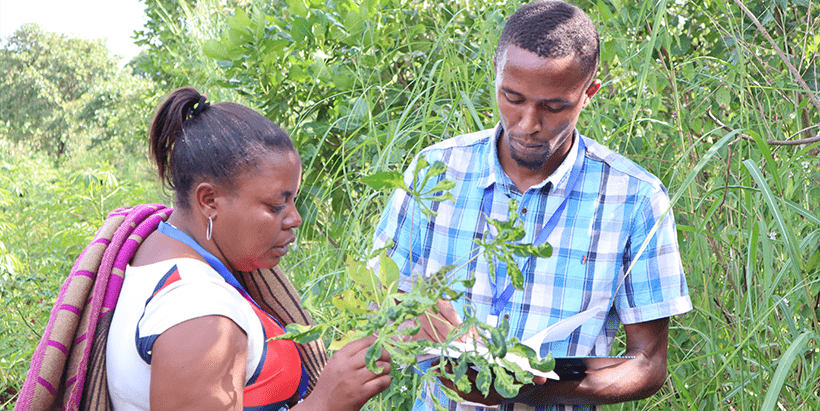
Participants noting the type of disease found on a cassava plant during the field visit. Photo credit: G. Ndibalema/IITA
The participants were also trained on gender integration in agricultural research. They understood basic concepts in gender research and how they are linked to agriculture and cassava seed systems. They learned to embrace gender and social inclusivity in cassava seed entrepreneurs’ work and became gender champions for the Muhogo Bora project and other related initiatives.
Training testimonials
Stephania Chiza is a female extension agent in Nsimbo District, Katavi Region. She welcomed more participatory sessions where trainers asked for feedback and input from the trainees. “I was surprised to be in participatory training where we were even tested on our understanding of the topics; many of us are not used to this style. I learned that a participatory meeting helps the participants have a sense of belonging and share their views openly,” said Stephania.
Charles Lembo, Senior Agricultural Field Officer and Cassava Focal Person in Uvinza District, Kigoma Region, believed he was fairly knowledgeable about good agronomic practices (GAP) in cassava management but was impressed with the newly gained knowledge on gender, of which he knew very little. “My take-home is the gender intersectionality, the real scenarios that are within our communities. Being aware of this will help us to be conscious and inclusive in selecting farmers to work with so that they all improve their livelihoods and community development. I will practice it starting with my family, then share it with people in my community,” said Charles.
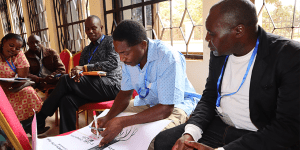
Trainees working on a problem tree analysis during the group work session. Photo credit: G. Ndibalema/IITA
Toligwe Msongwe, District Agricultural Irrigation and Cooperative Officer (DAICO) in Uvinza District, Kigoma Region, was more interested in gender and how it closely affects agricultural activities. She noted that agricultural officers notice some activities and technologies not being implemented because of gender-related issues. Toligwe is looking forward to integrating gender into her work plan so that information reaches the respective person for action.
During the field visit, the Crop Officer in Kaliua District, Tabora region, said: “I am excited about using the digital tools. I had challenges understanding and identifying the symptoms of cassava diseases, especially the Cassava Brown Streak Disease (CBSD), but using PlantVillage Nuru will help solve the challenge. Also, using the SeedTracker tool will help locate the nearest seed producers for my farmers.”
Funded by an anonymous foundation donor, Muhogo Bora is a three-year project aiming to provide support to develop and expand cassava seed systems in Tanzania, focusing on women, youth, and rural farmers’ participation in cassava seed systems and the value chain. Cornell CALS leads the project in collaboration with IITA, TARI, and TOSCI.
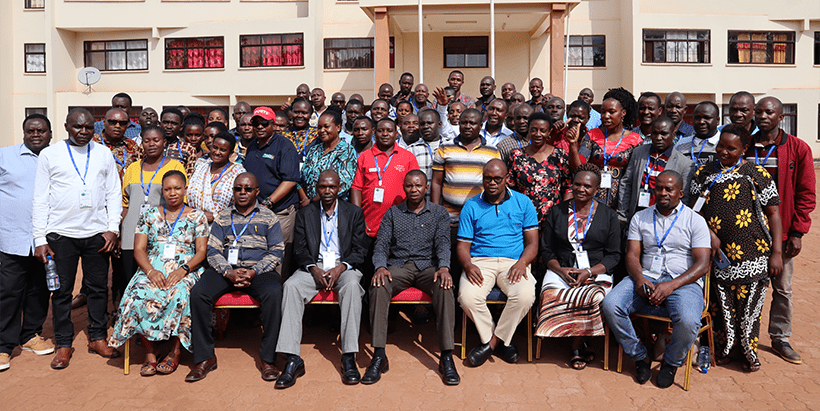
The participants during the cassava seed system management and gender training. Photo credit: G. Ndibalema/IITAContributed by Gloriana Ndibalema
Olamide Deborah Nwanze is a Senior Research Associate specializing in gender mainstreaming research to inform participatory and inclusive breeding, variety development, and seed systems policies regarding root, tuber, and banana (RTB) crops in the International Institute of Tropical Agriculture Headquarters, Ibadan, Nigeria. She is a PhD candidate at the University of Ibadan and holds an MSc and B. Agric in Agricultural Extension and Rural Development. Olamide is a fellow of the African Women in Agricultural Research and Development – Gender Responsive Agricultural Systems Policy (AWARD-GRASP) and the Gender Responsive Researchers Equipped for Agricultural Transformation (GREAT). She seeks to apply her gender-mainstreaming learnings, gender-responsive research, and policy development, and review expertise to facilitate women, youth, children, and vulnerable social group’s access to and adoption of agricultural Innovations that guarantee food, nutrition, income, and livelihood security in Africa. Her current roles include mentoring research fellows, development of guides and training manuals, implementation and adaptation of gender frameworks and tools, value chain actors’ engagement as citizen science partners, policy review and redesign, data management, and analysis. Her current research explores mixed methods and participatory and interdisciplinary approaches to capture and highlight gender dynamics, needs, preferences, and challenges stakeholders face within the agricultural livelihood value chain to prioritize gender-inclusive strategies in breeding programs, policy design, and implementation.
de Sousa, K., van Etten, J., Manners, R. Bello, A., Teeken, B., Olaosebikan, O., et al. 2024. The tricot approach: an agile framework for decentralized on-farm testing supported by citizen science. A retrospective. Agron. Sustain. Dev. 44, 8. https://doi.org/10.1007/s13593-023-00937-1
Madu, T., Onwuka, S., Nwafor, S., Onyemauwa, N., Ejechi, M., Ofoeze, M., Ukeje, B., Eluagu, C., Olaosebikan, O., Okoye, B., 2024. Gender-Inclusive Consumer Studies Improve Cassava Breeding in Nigeria in: Frontiers in Sociology, volume 9, number: 1224504, doi: 10.3389/fsoc.2024.1224504
Olaosebikan, O.; Bello, A.; Utoblo, O.; Okoye, B.; Olutegbe, N.; Garner, E.; Teeken, B.; Bryan, E.; Forsythe, L.; Cole, S.; Madu, T. 2023. Stressors and Resilience within the Cassava Value Chain in Nigeria: Preferred Cassava Variety Traits and Response Strategies of Men and Women to Inform Breeding. Sustainability 15, 7837. https://doi.org/10.3390/su15107837
Okoye, B., Ofoeze, M., Ejechi, M., Onwuka, S., Nwafor, S., Onyemauwa, N., Ukeje, B., Eluagu, C., Obidiegwu, J.*, Olaosebikan, O., Madu, T.* 2023. Prioritizing preferred traits in the yam value chain in Nigeria: a gender situation analysis in: Frontiers in Sociology, volume 8, number: 1232626, pages 1 – 9, ISSN 2297-7775, 2023. https://www.frontiersin.org/articles/10.3389/fsoc.2023.1232626/full
Olaosebikan, O., Bello, A. A., de Sousa, K., Ndjouenkeu, R., Adesokan, M., Alamu, E. O., Agbona, A., van Etten, J., Kegah, F. N.*, Dufour, D., Bouniol, A., Teeken, B. 2023. Consumer acceptability of cassava gari-eba food products across cultural and environmental settings using the triadic comparison of technologies approach (tricot) in: Journal of the Science of Food and Agriculture,
Teeken, B., Olaosebikan, O., Bello, A. A., Madu, T.*, Cole, S. M. 2023. Qualitative assessment on the positionality and preferences of dyads in relation to cassava-related activities: working with tricot trial citizen scientists https://hdl.handle.net/10568/138326 Type: Manual
Bouniol, A., Ceballos, H., Bello, A. A., Teeken, B., Olaosebikan, O., Owoade, D., Agbona, A., Fotso Kuate, A., Madu, T.*, Okoye, B.*, Ofoeze, M.*, Nwafor, S.*, Onyemauwa, N.*, Adinsi, L.*, Forsythe, L., Dufour, D. 2023. Varietal impact on women’s labour, workload and related drudgery in processing root, tuber and banana crops: focus on cassava in sub-Saharan Africa in: Journal of the Science of Food and Agriculture, pages 1 – 25, ISSN 0022-5142,
Bello, A. A., Agbona, A., Olaosebikan, O., Edughaen, G., Dufour, D., Bouniol, A., Iluebbey, P., Ndjouenkeu, R.*, Rabbi, I. Y., Teeken, B. 2023. Genetic and environmental effects on processing productivity and food product yield: drudgery of women’s work in: Journal of the Science of Food and Agriculture, pages 1 – 32, ISSN 0022-5142, 5
Cavicchioli, M., Zimbiti, T., Teeken, B., Nwanze, D.O., Liani, M., Parkes, E. & Bello, A. 2023. IITA-Gender Responsive Breeding Training Report. Genetic Resources Center, IITA-HQ, Ibadan, 21-23 September, 2022. Ibadan, Nigeria: IITA, (34 p.).https://hdl.handle.net/10568/131368
Agbona, A. Peteti P., Teeken B., Olaosebikan O. Bello, A. A., Parkes, E., Rabbi, I. Y., Mueller, L., Egesi, C., Kulakow, P. 2022. Data Management in Multi-disciplinary African RTB Crop Breeding Programs. In: Williamson, H.F., Leonelli, S. (eds) Towards Responsible Plant Data Linkage: Data Challenges for Agricultural Research and Development. Springer, Cham. https://doi.org/10.1007/978-3-031-13276-6_5
Lora Forsythe, Pricilla Marimo, Sarah Mayanja, Olamide D. Olaosebikan, Esme Stuart, Bela Teeken, Benjamin Okoye, Tessy Madu, (2021). Cross-product Gender Analysis of RTBfoods Step 2 Gendered Food Mapping on RTB Products. Understanding the Drivers of Trait Preferences and the Development of Multi-user RTB Product Profiles, WP1. London, UK: RTBfoods Field Scientific Report, 30 p.
Teeken, B., Garner, E., Agbona, A., Balogun, I., Olaosebikan, O., Bello, A., Madu, T., Okoye, B., Egesi, C., Kulakow, P. and Tufan, H.A. 2021. Beyond “Women’s Traits”: Exploring How Gender, Social Difference, and Household Characteristics Influence Trait Preferences. Frontiers Sustainable Food Systems 5:740926. https://doi.org/10.3389/fsufs.2021.740926
Teeken, B., Agbona, A., Bello, A., Olaosebikan, O., Alamu, E., Adesokan, M., Awoyale, W., Madu, T., Okoye, B., Chijioke, U., Owoade, D., Okoro, M., Bouniol, A., Dufour, D., Hershey, C., Rabbi, I., Maziya‐Dixon, B., Egesi, C., Tufan, H. and Kulakow, P. (020. Understanding cassava varietal preferences through pairwise ranking of gari‐eba and fufu prepared by local farmer–processors. Int J Food Sci Technol.https://doi.org/10.1111/ijfs.14862
Bela Teeken, Olamide Olaosebikan, Ireti Balogun, Benjamin Okoye, Tessy Madu, Steven Cole, Abolore Bello, Elizabeth Parkes. (2020). Piloting the G+ customer and product profile tools for gender-responsive cassava breeding in Nigeria. Nigeria: International Institute of Tropical Agriculture (IITA). https://hdl.handle.net/20.500.11766/13000