
IITA NEWS

Researchers develop new way to describe plantain diversity in DRC
March 30, 2018
Researchers studying the morphological (structure and form) diversity of plantain in the Democratic Republic of Congo (DRC) have developed an innovative way to describe plantain diversity using descriptors based on performance, grouping them into main, secondary, and rare descriptors. The morphological identification of plantain cultivars is of prime importance since molecular tools appear to have little value in supporting research in plantain taxonomy to differentiate plantain cultivars.
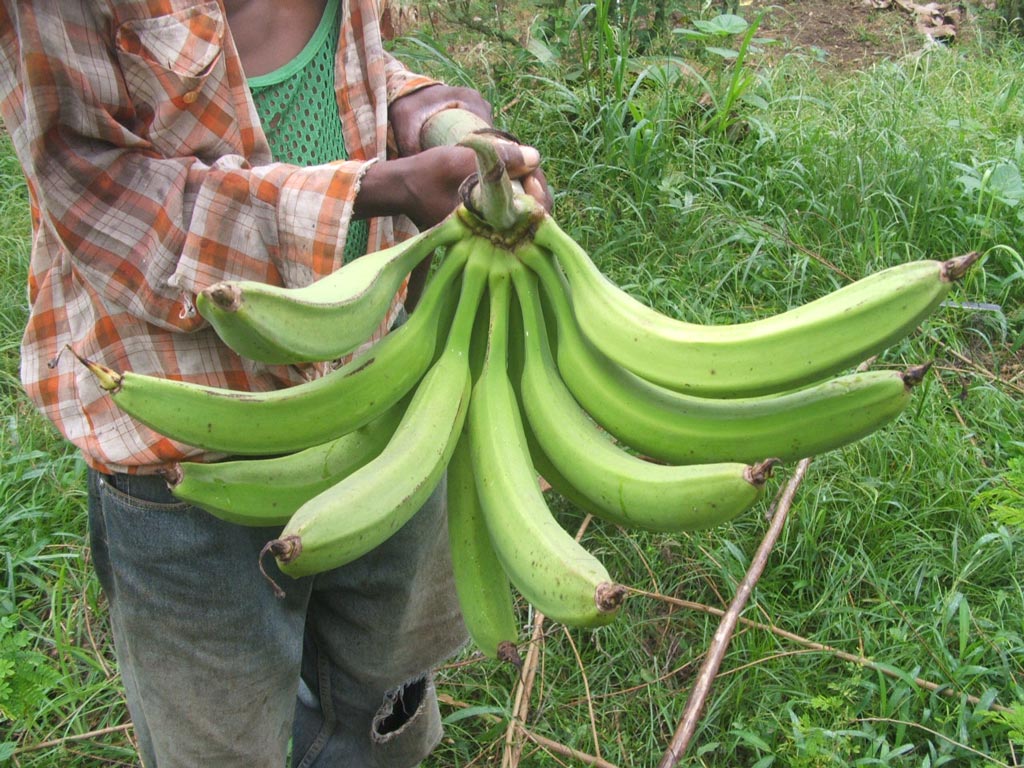
Picture of Horn plantain variety ‘Ikpolo Noir’ found in DR Congo

Horn plantain variety ‘Ikpolo Noir’ found in DR Congo

Three new descriptors

In the new system, three sets of descriptors are used: the first are the main descriptors such as bunch size and orientation, plant size and height, which allow a quick and easy separation of plantain cultivars. Bunch type was a major striking difference and quickly separated plantain cultivars into three main types. Other striking differences were the size of the pseudostem or trunk (giant, medium-sized, and small-sized) and the bunch orientation (which was generally pendulous or subhorizontal, and rarely horizontal and erect). The secondary descriptors allow the differentiation of one cultivar from another within the same main group of bunch type, pseudostem size, or bunch orientation. Multiple secondary descriptors include pseudostem color, immature fruit peel color, fruit shape, fruit apex, fruit position, number of hands, fruit size, number of fingers per hand, and flower relicts at the fruit apex. The third set are the rare descriptors which allow the differentiation of one cultivar from all the others in the subgroup. According to the researchers, this approach proved useful in differentiating the nearly 100 plantain accessions in the collection of the University of Kisangani (UNIKIS) in DRC. This approach makes cultivar description logical and faster because it moves from general to particular characteristics. The study titled The morphological diversity of plantain in the Democratic Republic of Congo by J.G. Adheka, D.B. Dhed’a, D. Karamura, G. Blomme, R. Swennen, and E. De Langhe, focused on the morphological characterization of plantain cultivars collected in the period 2005–2014 in 280 villages across nine provinces of DRC. These cultivars were established in two field collections at UNIKIS. Most of the collected cultivars were French plantains (64 out of 98), followed by False Horn (23) and Horn (10) plantains. Banana cultivars are usually described using Descriptors for bananas (Musa spp.) developed by IPGRI-INIBAP/ CIRAD in 1996. The researchers had adapted these existing descriptors to better differentiate the variation and improve future research on plantains. This new work, published in Scientia Horticulturae, showed that this descriptor list is not appropriate for describing variation within the plantain subgroup, with 77 out of a total of 117 descriptors not considered useful. The researchers believe that this existing descriptor list for banana will also not be appropriate in describing variation within other subgroups of banana, like the East African Highland banana, Pacific plantain, etc. The observed variation was reproduced in the collection during succeeding cycles and confirmed the stability of the cultivars, as well as the value of the new descriptors. The classification of the plantain cultivars at the UNIKIS collection can be used as a standard for investigating plantain diversity for the entire African continent.

Large plantain diversity in DRC

The study results showed that the humid zone of DRC contains an exceptionally large diversity of plantains among the edible Musa subgroups. This means that DRC also has the largest diversity of plantains in Africa. The 100 different cultivars covered in the study represent just a part of the entire plantain variability zone in DRC. More cultivars are expected to be found in regions of the country that still need to be explored. The researchers believe that the diversity of plantain in DRC could be substantially larger than 120 cultivars. Since the planting of all accessions in one location is not feasible due to financial constraints, the researchers encouraged plantain curators to be in continued and intensive contact, with regular exchange visits and discussions, to progressively reach an agreement on classification, synonymy, and uniqueness of all plantain cultivars. In sub-Saharan Africa, an estimated 30 million people depend on banana as the principal source of dietary carbohydrate, with small-scale farmers making up the vast majority of banana and plantain producers. They grow the crop mainly for home consumption or for local markets. In West and Central Africa, about two- thirds of the banana cultivated and produced are plantain, which need to be processed and/or cooked for consumption. The other third consists of dessert and other cooking bananas. In Africa, the major producing countries are Cameroon, Ghana, Nigeria, and Côte d’Ivoire. According to the FAO, production of plantain in these countries ranks high (12.3 million tons in 2014) among the starchy staples. The study is a collaboration of researchers from UNIKIS, IITA, Bioversity International and the Laboratory of Tropical Crop Improvement, Division of Crop Biotechnics, Katholieke Universiteit, Belgium.

Contributed by

Related news

No items found

Leave a Reply

Your email address will not be published. Required fields are marked *

Scroll to Top
Olaosebikan, Olamide

Olamide Deborah Nwanze is a Senior Research Associate specializing in gender mainstreaming research to inform participatory and inclusive breeding, variety development, and seed systems policies regarding root, tuber, and banana (RTB) crops in the International Institute of Tropical Agriculture Headquarters, Ibadan, Nigeria. She is a PhD candidate at the University of Ibadan and holds an MSc and B. Agric in Agricultural Extension and Rural Development. Olamide is a fellow of the African Women in Agricultural Research and Development – Gender Responsive Agricultural Systems Policy (AWARD-GRASP) and the Gender Responsive Researchers Equipped for Agricultural Transformation (GREAT). She seeks to apply her gender-mainstreaming learnings, gender-responsive research, and policy development, and review expertise to facilitate women, youth, children, and vulnerable social group’s access to and adoption of agricultural Innovations that guarantee food, nutrition, income, and livelihood security in Africa. Her current roles include mentoring research fellows, development of guides and training manuals, implementation and adaptation of gender frameworks and tools, value chain actors’ engagement as citizen science partners, policy review and redesign, data management, and analysis. Her current research explores mixed methods and participatory and interdisciplinary approaches to capture and highlight gender dynamics, needs, preferences, and challenges stakeholders face within the agricultural livelihood value chain to prioritize gender-inclusive strategies in breeding programs, policy design, and implementation.

At IITA, she contributes to the implementation of the CGIAR Accelerated Breeding Initiative and Genetic Innovation Programs; participatory and gender research within the NextGen CassavaHarvestPlusRTBFoods, and Tricot-ClimMob 1000Farms Projects; and gender knowledge communication via the G-LENS webinar series, video documentary, policy briefspublications, and blogs.


Recent publications

de Sousa, K., van Etten, J., Manners, R. Bello, A., Teeken, B., Olaosebikan, O., et al. 2024. The tricot approach: an agile framework for decentralized on-farm testing supported by citizen science. A retrospective. Agron. Sustain. Dev. 44, 8. https://doi.org/10.1007/s13593-023-00937-1

Madu, T., Onwuka, S., Nwafor, S., Onyemauwa, N., Ejechi, M., Ofoeze, M., Ukeje, B., Eluagu, C., Olaosebikan, O., Okoye, B., 2024. Gender-Inclusive Consumer Studies Improve Cassava Breeding in Nigeria in: Frontiers in Sociology, volume 9, number: 1224504, doi: 10.3389/fsoc.2024.1224504

Olaosebikan, O.; Bello, A.; Utoblo, O.; Okoye, B.; Olutegbe, N.; Garner, E.; Teeken, B.; Bryan, E.; Forsythe, L.; Cole, S.; Madu, T. 2023.  Stressors and Resilience within the Cassava Value Chain in Nigeria: Preferred Cassava Variety Traits and Response Strategies of Men and Women to Inform Breeding. Sustainability 15, 7837. https://doi.org/10.3390/su15107837

Okoye, B., Ofoeze, M., Ejechi, M., Onwuka, S., Nwafor, S., Onyemauwa, N., Ukeje, B., Eluagu, C., Obidiegwu, J.*, Olaosebikan, O., Madu, T.* 2023. Prioritizing preferred traits in the yam value chain in Nigeria: a gender situation analysis in: Frontiers in Sociology, volume 8, number: 1232626, pages 1 – 9, ISSN 2297-7775, 2023. https://www.frontiersin.org/articles/10.3389/fsoc.2023.1232626/full

Olaosebikan, O., Bello, A. A., de Sousa, K., Ndjouenkeu, R., Adesokan, M., Alamu, E. O., Agbona, A., van Etten, J., Kegah, F. N.*, Dufour, D., Bouniol, A., Teeken, B. 2023. Consumer acceptability of cassava gari-eba food products across cultural and environmental settings using the triadic comparison of technologies approach (tricot) in: Journal of the Science of Food and Agriculture,

Teeken, B., Olaosebikan, O., Bello, A. A., Madu, T.*, Cole, S. M. 2023. Qualitative assessment on the positionality and preferences of dyads in relation to cassava-related activities: working with tricot trial citizen scientists https://hdl.handle.net/10568/138326 Type: Manual

Bouniol, A., Ceballos, H., Bello, A. A., Teeken, B., Olaosebikan, O., Owoade, D., Agbona, A., Fotso Kuate, A., Madu, T.*, Okoye, B.*, Ofoeze, M.*, Nwafor, S.*, Onyemauwa, N.*, Adinsi, L.*, Forsythe, L., Dufour, D. 2023. Varietal impact on women’s labour, workload and related drudgery in processing root, tuber and banana crops: focus on cassava in sub-Saharan Africa in: Journal of the Science of Food and Agriculture, pages 1 – 25, ISSN 0022-5142,

Bello, A. A., Agbona, A., Olaosebikan, O., Edughaen, G., Dufour, D., Bouniol, A., Iluebbey, P., Ndjouenkeu, R.*, Rabbi, I. Y., Teeken, B. 2023. Genetic and environmental effects on processing productivity and food product yield: drudgery of women’s work in: Journal of the Science of Food and Agriculture, pages 1 – 32, ISSN 0022-5142, 5

Cavicchioli, M., Zimbiti, T., Teeken, B., Nwanze, D.O., Liani, M., Parkes, E. & Bello, A. 2023. IITA-Gender Responsive Breeding Training Report. Genetic Resources Center, IITA-HQ, Ibadan, 21-23 September, 2022. Ibadan, Nigeria: IITA, (34 p.).https://hdl.handle.net/10568/131368

Agbona, A. Peteti P., Teeken B., Olaosebikan O. Bello, A. A., Parkes, E., Rabbi, I. Y., Mueller, L., Egesi, C., Kulakow, P. 2022. Data Management in Multi-disciplinary African RTB Crop Breeding Programs. In: Williamson, H.F., Leonelli, S. (eds) Towards Responsible Plant Data Linkage: Data Challenges for Agricultural Research and Development. Springer, Cham. https://doi.org/10.1007/978-3-031-13276-6_5

Lora Forsythe, Pricilla Marimo, Sarah Mayanja, Olamide D. Olaosebikan, Esme Stuart, Bela Teeken, Benjamin Okoye, Tessy Madu, (2021). Cross-product Gender Analysis of RTBfoods Step 2 Gendered Food Mapping on RTB Products. Understanding the Drivers of Trait Preferences and the Development of Multi-user RTB Product Profiles, WP1. London, UK: RTBfoods Field Scientific Report, 30 p.

Teeken, B., Garner, E., Agbona, A., Balogun, I., Olaosebikan, O., Bello, A., Madu, T., Okoye, B., Egesi, C., Kulakow, P. and Tufan, H.A. 2021. Beyond “Women’s Traits”: Exploring How Gender, Social Difference, and Household Characteristics Influence Trait Preferences. Frontiers Sustainable Food Systems 5:740926. https://doi.org/10.3389/fsufs.2021.740926

Teeken, B., Agbona, A., Bello, A., Olaosebikan, O., Alamu, E., Adesokan, M., Awoyale, W., Madu, T., Okoye, B., Chijioke, U., Owoade, D., Okoro, M., Bouniol, A., Dufour, D., Hershey, C., Rabbi, I., Maziya‐Dixon, B., Egesi, C., Tufan, H. and Kulakow, P. (020. Understanding cassava varietal preferences through pairwise ranking of gari‐eba and fufu prepared by local farmer–processors. Int J Food Sci Technol. https://doi.org/10.1111/ijfs.14862

Bela Teeken, Olamide Olaosebikan, Ireti Balogun, Benjamin Okoye, Tessy Madu, Steven Cole, Abolore Bello, Elizabeth Parkes. (2020). Piloting the G+ customer and product profile tools for gender-responsive cassava breeding in Nigeria. Nigeria: International Institute of Tropical Agriculture (IITA). https://hdl.handle.net/20.500.11766/13000