
IITA NEWS

Rise from aspiring medical doctor to agribusiness leader: Azeezat’s inspiring journey to agricultural impact
November 4, 2024

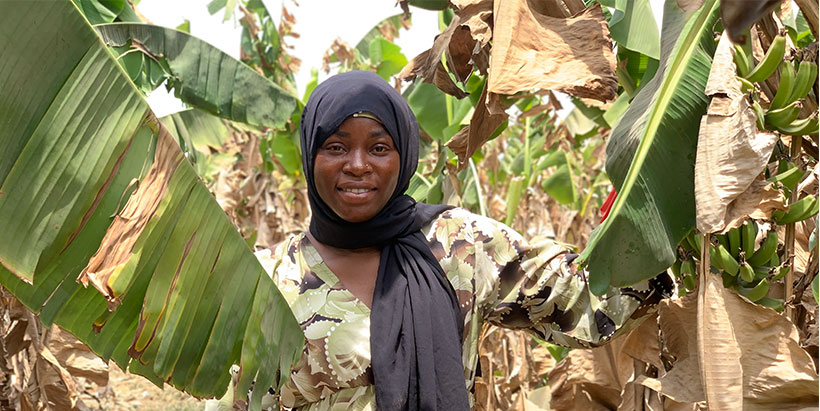
Azeezat on the banana farm.

The popular phrase, “When life throws lemons at you, make lemonade,” accurately captures Azeezat Olayinka Olatunji’s remarkable transition from an aspiring medical doctor to a successful full-time farmer.

Apart from owning a flourishing farm in her native Oyo State, she oversees a large agricultural enterprise, including a banana plantation of about nine acres, in Nigeria’s Federal Capital Territory.

Raised by parents and grandparents who were proud farmers, young Azeezat said she often protested anytime her father summoned her to follow him to the farm. Not only did she despise farming at the time, but she also could not see any compelling correlation between her dream career—medicine—and farming. Little did she know that the farming she once despised would eventually become her greatest passion.
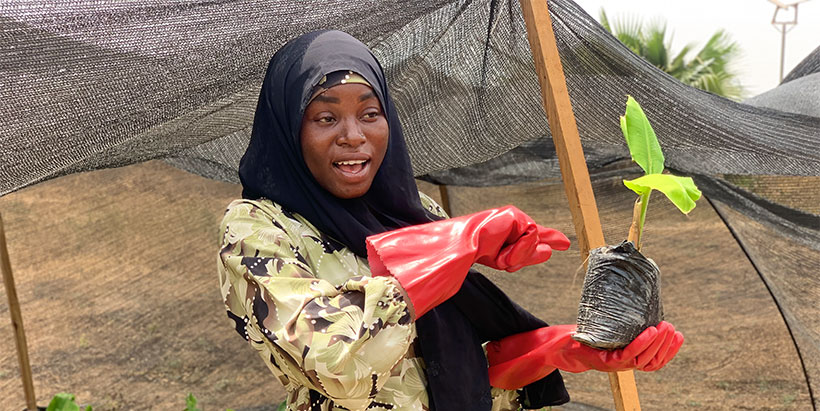
Azeezat in her banana nursery.

She said that when she applied for admission to study medicine at the university, the institution offered her Animal Production, which she rejected. However, with her father’s persuasion, she recalled that she grudgingly accepted the offer out of deference to him.

Today, 34-year-old Azeezat is a graduate of an agriculture course and a passionate farmer—a venture she cherishes above all else.

Meanwhile, despite a degree in Animal Production, Azeezat refused to confine herself to the realm of animals; she decided to explore other aspects of agribusiness, like horticulture. Thus, she applied to participate in the horticulture training for young people organized by the IITA YAS project, with support from the Embassy of the Kingdom of the Netherlands in Nigeria.

The intensive training enriched her knowledge and positioned her for her current role, where she oversees a large banana farm in Abuja.
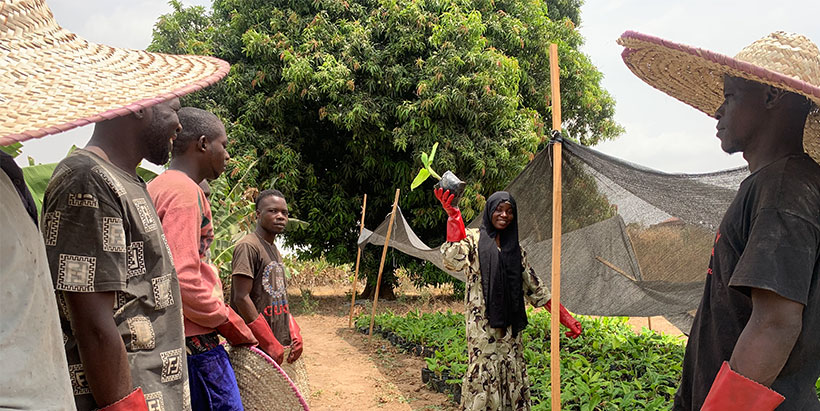
Azeezat addressing her workers.

She stated, “When I wanted to apply for my present job, it was through the YAS training certificate. During the interview, they asked me why I wanted to work with them since I studied animal science. I said that even though I studied animal science, I got a certificate in horticultural training from the

YAS project of IITA. They were impressed, knowing that IITA is a renowned organization with a good reputation. The certificate really helped me.”

“The impact of this training was self-employment, and the certificate has boosted my profile,” she added.

Under her leadership, the farm secured a four-year lucrative contract to supply one million banana suckers to the Niger State Government, a task she described as exciting. “Preparing one million seedlings is not an easy task, but it’s a challenge I’m excited about, and we are meeting our targets.”

Azeezat, who supervises seven youths employed by the farm, advocates for young people not to endure unemployment or underemployment when opportunities like the YAS training exist, where they are trained and supported to flourish in agribusiness.

Contributed by Babatunde Ajaja


Contributed by

Related news

No items found

Leave a Reply

Your email address will not be published. Required fields are marked *

Scroll to Top
Olaosebikan, Olamide

Olamide Deborah Nwanze is a Senior Research Associate specializing in gender mainstreaming research to inform participatory and inclusive breeding, variety development, and seed systems policies regarding root, tuber, and banana (RTB) crops in the International Institute of Tropical Agriculture Headquarters, Ibadan, Nigeria. She is a PhD candidate at the University of Ibadan and holds an MSc and B. Agric in Agricultural Extension and Rural Development. Olamide is a fellow of the African Women in Agricultural Research and Development – Gender Responsive Agricultural Systems Policy (AWARD-GRASP) and the Gender Responsive Researchers Equipped for Agricultural Transformation (GREAT). She seeks to apply her gender-mainstreaming learnings, gender-responsive research, and policy development, and review expertise to facilitate women, youth, children, and vulnerable social group’s access to and adoption of agricultural Innovations that guarantee food, nutrition, income, and livelihood security in Africa. Her current roles include mentoring research fellows, development of guides and training manuals, implementation and adaptation of gender frameworks and tools, value chain actors’ engagement as citizen science partners, policy review and redesign, data management, and analysis. Her current research explores mixed methods and participatory and interdisciplinary approaches to capture and highlight gender dynamics, needs, preferences, and challenges stakeholders face within the agricultural livelihood value chain to prioritize gender-inclusive strategies in breeding programs, policy design, and implementation.

At IITA, she contributes to the implementation of the CGIAR Accelerated Breeding Initiative and Genetic Innovation Programs; participatory and gender research within the NextGen CassavaHarvestPlusRTBFoods, and Tricot-ClimMob 1000Farms Projects; and gender knowledge communication via the G-LENS webinar series, video documentary, policy briefspublications, and blogs.


Recent publications

de Sousa, K., van Etten, J., Manners, R. Bello, A., Teeken, B., Olaosebikan, O., et al. 2024. The tricot approach: an agile framework for decentralized on-farm testing supported by citizen science. A retrospective. Agron. Sustain. Dev. 44, 8. https://doi.org/10.1007/s13593-023-00937-1

Madu, T., Onwuka, S., Nwafor, S., Onyemauwa, N., Ejechi, M., Ofoeze, M., Ukeje, B., Eluagu, C., Olaosebikan, O., Okoye, B., 2024. Gender-Inclusive Consumer Studies Improve Cassava Breeding in Nigeria in: Frontiers in Sociology, volume 9, number: 1224504, doi: 10.3389/fsoc.2024.1224504

Olaosebikan, O.; Bello, A.; Utoblo, O.; Okoye, B.; Olutegbe, N.; Garner, E.; Teeken, B.; Bryan, E.; Forsythe, L.; Cole, S.; Madu, T. 2023.  Stressors and Resilience within the Cassava Value Chain in Nigeria: Preferred Cassava Variety Traits and Response Strategies of Men and Women to Inform Breeding. Sustainability 15, 7837. https://doi.org/10.3390/su15107837

Okoye, B., Ofoeze, M., Ejechi, M., Onwuka, S., Nwafor, S., Onyemauwa, N., Ukeje, B., Eluagu, C., Obidiegwu, J.*, Olaosebikan, O., Madu, T.* 2023. Prioritizing preferred traits in the yam value chain in Nigeria: a gender situation analysis in: Frontiers in Sociology, volume 8, number: 1232626, pages 1 – 9, ISSN 2297-7775, 2023. https://www.frontiersin.org/articles/10.3389/fsoc.2023.1232626/full

Olaosebikan, O., Bello, A. A., de Sousa, K., Ndjouenkeu, R., Adesokan, M., Alamu, E. O., Agbona, A., van Etten, J., Kegah, F. N.*, Dufour, D., Bouniol, A., Teeken, B. 2023. Consumer acceptability of cassava gari-eba food products across cultural and environmental settings using the triadic comparison of technologies approach (tricot) in: Journal of the Science of Food and Agriculture,

Teeken, B., Olaosebikan, O., Bello, A. A., Madu, T.*, Cole, S. M. 2023. Qualitative assessment on the positionality and preferences of dyads in relation to cassava-related activities: working with tricot trial citizen scientists https://hdl.handle.net/10568/138326 Type: Manual

Bouniol, A., Ceballos, H., Bello, A. A., Teeken, B., Olaosebikan, O., Owoade, D., Agbona, A., Fotso Kuate, A., Madu, T.*, Okoye, B.*, Ofoeze, M.*, Nwafor, S.*, Onyemauwa, N.*, Adinsi, L.*, Forsythe, L., Dufour, D. 2023. Varietal impact on women’s labour, workload and related drudgery in processing root, tuber and banana crops: focus on cassava in sub-Saharan Africa in: Journal of the Science of Food and Agriculture, pages 1 – 25, ISSN 0022-5142,

Bello, A. A., Agbona, A., Olaosebikan, O., Edughaen, G., Dufour, D., Bouniol, A., Iluebbey, P., Ndjouenkeu, R.*, Rabbi, I. Y., Teeken, B. 2023. Genetic and environmental effects on processing productivity and food product yield: drudgery of women’s work in: Journal of the Science of Food and Agriculture, pages 1 – 32, ISSN 0022-5142, 5

Cavicchioli, M., Zimbiti, T., Teeken, B., Nwanze, D.O., Liani, M., Parkes, E. & Bello, A. 2023. IITA-Gender Responsive Breeding Training Report. Genetic Resources Center, IITA-HQ, Ibadan, 21-23 September, 2022. Ibadan, Nigeria: IITA, (34 p.).https://hdl.handle.net/10568/131368

Agbona, A. Peteti P., Teeken B., Olaosebikan O. Bello, A. A., Parkes, E., Rabbi, I. Y., Mueller, L., Egesi, C., Kulakow, P. 2022. Data Management in Multi-disciplinary African RTB Crop Breeding Programs. In: Williamson, H.F., Leonelli, S. (eds) Towards Responsible Plant Data Linkage: Data Challenges for Agricultural Research and Development. Springer, Cham. https://doi.org/10.1007/978-3-031-13276-6_5

Lora Forsythe, Pricilla Marimo, Sarah Mayanja, Olamide D. Olaosebikan, Esme Stuart, Bela Teeken, Benjamin Okoye, Tessy Madu, (2021). Cross-product Gender Analysis of RTBfoods Step 2 Gendered Food Mapping on RTB Products. Understanding the Drivers of Trait Preferences and the Development of Multi-user RTB Product Profiles, WP1. London, UK: RTBfoods Field Scientific Report, 30 p.

Teeken, B., Garner, E., Agbona, A., Balogun, I., Olaosebikan, O., Bello, A., Madu, T., Okoye, B., Egesi, C., Kulakow, P. and Tufan, H.A. 2021. Beyond “Women’s Traits”: Exploring How Gender, Social Difference, and Household Characteristics Influence Trait Preferences. Frontiers Sustainable Food Systems 5:740926. https://doi.org/10.3389/fsufs.2021.740926

Teeken, B., Agbona, A., Bello, A., Olaosebikan, O., Alamu, E., Adesokan, M., Awoyale, W., Madu, T., Okoye, B., Chijioke, U., Owoade, D., Okoro, M., Bouniol, A., Dufour, D., Hershey, C., Rabbi, I., Maziya‐Dixon, B., Egesi, C., Tufan, H. and Kulakow, P. (020. Understanding cassava varietal preferences through pairwise ranking of gari‐eba and fufu prepared by local farmer–processors. Int J Food Sci Technol. https://doi.org/10.1111/ijfs.14862

Bela Teeken, Olamide Olaosebikan, Ireti Balogun, Benjamin Okoye, Tessy Madu, Steven Cole, Abolore Bello, Elizabeth Parkes. (2020). Piloting the G+ customer and product profile tools for gender-responsive cassava breeding in Nigeria. Nigeria: International Institute of Tropical Agriculture (IITA). https://hdl.handle.net/20.500.11766/13000