
Survey identifies Black Sigatoka banana disease hotspots in Uganda and Tanzania
February 4, 2020
Survey also finds disease is well established and more widespread than previously thought Both Luwero District in Uganda and Mbarara District, Kagera Region in Tanzania have been identified as the areas most affected by the deadly banana disease, black Sigatoka which is caused by a fungus. The disease, which was found to be more severe in Uganda than in Tanzania, was also more widespread than previously thought.
This was established by a survey on the distribution and severity of the Sigatoka leaf diseases and its pathogens conducted in the two countries as part of efforts to control its spread to protect the food and income of millions of smallholder farmers growing the crop.
 Banana, and especially the cooking type known as East Africa highland banana, is a vital staple food and income crop for over 80 million people in East Africa. However, productivity has been declining, partly due to diseases such as Sigatoka leaf diseases. Furthermore, all banana varieties grown in the two countries are susceptible to the disease.
While there are three pathogens that cause Sigatoka-leaf symptoms, the study established black Sigatoka, caused by Pseudocercospora fijiensis, as the most widespread. Black Sigatoka was first reported in Tanzania in 1987 and, in Uganda in 1990, but was only present at low altitudes.
However, the pathogen distribution has recently expanded, and it is now found at higher elevations that were previously considered unsuitable for their survival. This expansion reveals a gradual adaptation of the pathogen to cooler conditions of the higher altitudes.
The study also looked at historical data and established that the temperatures have increased in the past three decades, creating a favorable environment at high altitude areas for pathogen proliferation.
Njeri Kimunye, an IITA-sponsored PhD student at Stellenbosch University, South Africa, led the study.
“Our findings are a big step forward in efforts to control this disease of banana as they have helped us to understand better where the disease is, its severity, the pathogens, and factors for its spread,” said George Mahuku, IITA Senior Plant Pathologist and also a member of the international research team.
The research findings call for the deployment of an integrated disease management strategy that includes the use of resistant varieties and good agronomic practices to safeguard the livelihood of smallholder farmers in the region.
It also recommends creating awareness among the smallholder farmers on effective practices to stop the spread of the diseases as the use of fungicides is not an option for the resource-constrained, smallholder farmers growing the crop.
The study conducted between April and July 2016 surveyed 43 farms in Uganda and 81 in Tanzania. Sigatoka-like leaf diseases were observed in all the farms and plants surveyed. However, the disease severity varied significantly between countries, districts/regions within countries, altitudinal ranges, and banana cultivars.
The study was carried out by a team of researchers from IITA in Uganda and Tanzania in cooperation with researchers from the Department of Plant Pathology, Stellenbosch University, South Africa; and the Laboratory of Tropical Crop Improvement, KU Leuven, Belgium.
The survey was conducted as part of the project ‘Improvement of banana for smallholder farmers in the Great Lakes Region of Africa’ project. Details of the findings can be found in a paper “Distribution of Pseudocercospora species causing Sigatoka leaf diseases of banana in Uganda and Tanzania” published in Plant Pathology Journal, in January 2020 (issue 69, pages 50‒59) (https://doi.org/10.1111/ppa.13105)
Banana, and especially the cooking type known as East Africa highland banana, is a vital staple food and income crop for over 80 million people in East Africa. However, productivity has been declining, partly due to diseases such as Sigatoka leaf diseases. Furthermore, all banana varieties grown in the two countries are susceptible to the disease.
While there are three pathogens that cause Sigatoka-leaf symptoms, the study established black Sigatoka, caused by Pseudocercospora fijiensis, as the most widespread. Black Sigatoka was first reported in Tanzania in 1987 and, in Uganda in 1990, but was only present at low altitudes.
However, the pathogen distribution has recently expanded, and it is now found at higher elevations that were previously considered unsuitable for their survival. This expansion reveals a gradual adaptation of the pathogen to cooler conditions of the higher altitudes.
The study also looked at historical data and established that the temperatures have increased in the past three decades, creating a favorable environment at high altitude areas for pathogen proliferation.
Njeri Kimunye, an IITA-sponsored PhD student at Stellenbosch University, South Africa, led the study.
“Our findings are a big step forward in efforts to control this disease of banana as they have helped us to understand better where the disease is, its severity, the pathogens, and factors for its spread,” said George Mahuku, IITA Senior Plant Pathologist and also a member of the international research team.
The research findings call for the deployment of an integrated disease management strategy that includes the use of resistant varieties and good agronomic practices to safeguard the livelihood of smallholder farmers in the region.
It also recommends creating awareness among the smallholder farmers on effective practices to stop the spread of the diseases as the use of fungicides is not an option for the resource-constrained, smallholder farmers growing the crop.
The study conducted between April and July 2016 surveyed 43 farms in Uganda and 81 in Tanzania. Sigatoka-like leaf diseases were observed in all the farms and plants surveyed. However, the disease severity varied significantly between countries, districts/regions within countries, altitudinal ranges, and banana cultivars.
The study was carried out by a team of researchers from IITA in Uganda and Tanzania in cooperation with researchers from the Department of Plant Pathology, Stellenbosch University, South Africa; and the Laboratory of Tropical Crop Improvement, KU Leuven, Belgium.
The survey was conducted as part of the project ‘Improvement of banana for smallholder farmers in the Great Lakes Region of Africa’ project. Details of the findings can be found in a paper “Distribution of Pseudocercospora species causing Sigatoka leaf diseases of banana in Uganda and Tanzania” published in Plant Pathology Journal, in January 2020 (issue 69, pages 50‒59) (https://doi.org/10.1111/ppa.13105)
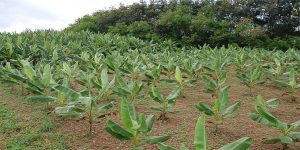
Banana inflorescence and fruits infected with black sigatoka disease.
Banana inflorescence and fruits infected with black sigatoka disease.
Contributed by
Recent stories
No items found