
IITA NEWS

Unlocking the future of crop improvement: IITA champions genome editing for African agriculture
April 15, 2025

In transforming African agriculture, the International Institute of Tropical Agriculture (IITA) is tapping into cutting-edge genome editing tools to fast-track crop improvement. With technologies like CRISPR at its core, IITA is pioneering a new era in plant breeding—where precision, speed, and innovation are driving the development of resilient, high-yielding crops tailored for the continent’s toughest challenges.
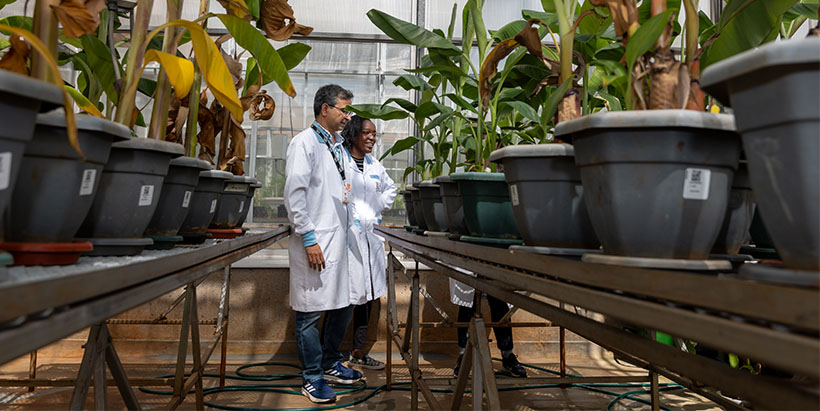
Dr Jaindra Tripathi attending to the plants being screened in the greenhouse.

For decades, conventional breeding has served as the backbone of crop improvement. By crossing parent plants with desirable traits, breeders have been able to gradually improve yields, enhance disease resistance, and adapt crops to local conditions. However, this process can be time-consuming, unpredictable, and limited particularly for clonally propagated crops. It is often inadequate when addressing complex traits like drought tolerance or resistance to evolving pathogens. For tropical crops like banana, yam, and cassava—staples for millions across Africa—the challenges are even more pronounced due to limited genetic diversity and complex inheritance patterns.

Now, genome editing is offering a powerful alternative. Unlike traditional genetic modification, genome editing—especially using tools like CRISPR/Cas—allows scientists to make precise, targeted changes to a plant’s DNA without introducing foreign genes. It is like using molecular scissors, snipping out or tweaking specific genes to confer desired traits.

At IITA, a state-of-the-art genome editing platform is leveraging this technology to accelerate crop improvement. IITA’s dedicated laboratory team works on the entire gene editing process—from target identification and cloning to transformation—offering comprehensive support for agricultural research. By pinpointing and modifying specific genes responsible for disease susceptibility or poor yield, we can develop improved varieties faster, more efficiently, and more predictably than ever before. Genome editing does not replace conventional breeding, it enhances it.

It is a pre-breeding tool that helps breeders start the race from halfway up the track. By removing bottlenecks early in the process, like knocking out genomes that make plants vulnerable to disease, we empower breeders to focus on combining these improved lines with other elite traits.
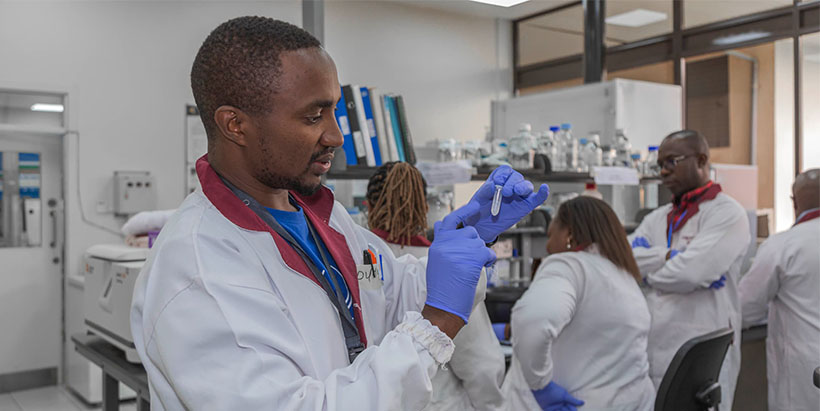
PhD student Duncan Njora conducting molecular analysis in the lab.

“Genome editing is giving us a head start in breeding. By removing key barriers at the genetic level, we’re able to develop improved varieties faster – varieties that are not only more resilient and productive but also better aligned with the needs of African farmers,”  said Dr. Leena Tripathi, Eastern Africa Hub Director and Biotechnology Program Lead, IITA

One major breakthrough is in banana, where IITA researchers are using genome editing to control banana xanthomonas wilt (BXW), a devastating disease capable of wiping out entire plantations. By knocking out susceptibility genes and activating endogenous defense genes, IITA is developing disease-resistant banana varieties that could secure the livelihoods of millions of smallholder farmers across East and Central Africa.

For yam, IITA scientists are exploring how genome editing can optimize plant architecture, potentially reducing labor and environmental damage associated with staking of yam vines.

ITA’s commitment goes beyond research. The institute is cultivating a new generation of African genome editing experts. IITA is offering a comprehensive five-year training program in collaboration with Africa Plant Breeding Academy of UC Davis aimed at equipping African scientists with the knowledge and skills to use genome editing technologies. This training program, which combines theoretical lectures with practical laboratory experience, will train 100 scientists in genome editing and its regulation. The first group of students began their training in January 2023, with participants selected from various African countries. So far, 31 scientists have been trained, gaining valuable hands-on experience and knowledge, prepared to establish genome editing platforms at their own institutions.

In addition, IITA builds capacity of early-career scientists, training MSc and PhD students. Currently, 5 PhD students are actively being trained in the program, continuing to build their expertise in genome editing techniques, while others have already completed training.  Apart from the core training program, IITA is also collaborating with local universities in Kenya to provide technical support to PhD students working on genome editing projects. This collaboration allows for a more integrated approach to research and provides students with access to both IITA’s expertise and the resources of local academic institutions.

“Genome editing is not a silver bullet,” Dr. Tripathi emphasized. “But it represents a game-changing leap for crops that have long been neglected by global biotechnology. It’s about giving African farmers the tools they need to thrive in a rapidly changing world.”

With the dual focus on innovation and capacity building, IITA is positioning Africa at the forefront of agricultural biotechnology. From laboratories to farmlands, genome editing is unlocking a future where improved, resilient, and farmer-preferred varieties can become the norm—ensuring food security for generations to come.

Contributed by Rose Harriet Okech


Contributed by

Related news

No items found

Leave a Reply

Your email address will not be published. Required fields are marked *

Scroll to Top
Olaosebikan, Olamide

Olamide Deborah Nwanze is a Senior Research Associate specializing in gender mainstreaming research to inform participatory and inclusive breeding, variety development, and seed systems policies regarding root, tuber, and banana (RTB) crops in the International Institute of Tropical Agriculture Headquarters, Ibadan, Nigeria. She is a PhD candidate at the University of Ibadan and holds an MSc and B. Agric in Agricultural Extension and Rural Development. Olamide is a fellow of the African Women in Agricultural Research and Development – Gender Responsive Agricultural Systems Policy (AWARD-GRASP) and the Gender Responsive Researchers Equipped for Agricultural Transformation (GREAT). She seeks to apply her gender-mainstreaming learnings, gender-responsive research, and policy development, and review expertise to facilitate women, youth, children, and vulnerable social group’s access to and adoption of agricultural Innovations that guarantee food, nutrition, income, and livelihood security in Africa. Her current roles include mentoring research fellows, development of guides and training manuals, implementation and adaptation of gender frameworks and tools, value chain actors’ engagement as citizen science partners, policy review and redesign, data management, and analysis. Her current research explores mixed methods and participatory and interdisciplinary approaches to capture and highlight gender dynamics, needs, preferences, and challenges stakeholders face within the agricultural livelihood value chain to prioritize gender-inclusive strategies in breeding programs, policy design, and implementation.

At IITA, she contributes to the implementation of the CGIAR Accelerated Breeding Initiative and Genetic Innovation Programs; participatory and gender research within the NextGen CassavaHarvestPlusRTBFoods, and Tricot-ClimMob 1000Farms Projects; and gender knowledge communication via the G-LENS webinar series, video documentary, policy briefspublications, and blogs.


Recent publications

de Sousa, K., van Etten, J., Manners, R. Bello, A., Teeken, B., Olaosebikan, O., et al. 2024. The tricot approach: an agile framework for decentralized on-farm testing supported by citizen science. A retrospective. Agron. Sustain. Dev. 44, 8. https://doi.org/10.1007/s13593-023-00937-1

Madu, T., Onwuka, S., Nwafor, S., Onyemauwa, N., Ejechi, M., Ofoeze, M., Ukeje, B., Eluagu, C., Olaosebikan, O., Okoye, B., 2024. Gender-Inclusive Consumer Studies Improve Cassava Breeding in Nigeria in: Frontiers in Sociology, volume 9, number: 1224504, doi: 10.3389/fsoc.2024.1224504

Olaosebikan, O.; Bello, A.; Utoblo, O.; Okoye, B.; Olutegbe, N.; Garner, E.; Teeken, B.; Bryan, E.; Forsythe, L.; Cole, S.; Madu, T. 2023.  Stressors and Resilience within the Cassava Value Chain in Nigeria: Preferred Cassava Variety Traits and Response Strategies of Men and Women to Inform Breeding. Sustainability 15, 7837. https://doi.org/10.3390/su15107837

Okoye, B., Ofoeze, M., Ejechi, M., Onwuka, S., Nwafor, S., Onyemauwa, N., Ukeje, B., Eluagu, C., Obidiegwu, J.*, Olaosebikan, O., Madu, T.* 2023. Prioritizing preferred traits in the yam value chain in Nigeria: a gender situation analysis in: Frontiers in Sociology, volume 8, number: 1232626, pages 1 – 9, ISSN 2297-7775, 2023. https://www.frontiersin.org/articles/10.3389/fsoc.2023.1232626/full

Olaosebikan, O., Bello, A. A., de Sousa, K., Ndjouenkeu, R., Adesokan, M., Alamu, E. O., Agbona, A., van Etten, J., Kegah, F. N.*, Dufour, D., Bouniol, A., Teeken, B. 2023. Consumer acceptability of cassava gari-eba food products across cultural and environmental settings using the triadic comparison of technologies approach (tricot) in: Journal of the Science of Food and Agriculture,

Teeken, B., Olaosebikan, O., Bello, A. A., Madu, T.*, Cole, S. M. 2023. Qualitative assessment on the positionality and preferences of dyads in relation to cassava-related activities: working with tricot trial citizen scientists https://hdl.handle.net/10568/138326 Type: Manual

Bouniol, A., Ceballos, H., Bello, A. A., Teeken, B., Olaosebikan, O., Owoade, D., Agbona, A., Fotso Kuate, A., Madu, T.*, Okoye, B.*, Ofoeze, M.*, Nwafor, S.*, Onyemauwa, N.*, Adinsi, L.*, Forsythe, L., Dufour, D. 2023. Varietal impact on women’s labour, workload and related drudgery in processing root, tuber and banana crops: focus on cassava in sub-Saharan Africa in: Journal of the Science of Food and Agriculture, pages 1 – 25, ISSN 0022-5142,

Bello, A. A., Agbona, A., Olaosebikan, O., Edughaen, G., Dufour, D., Bouniol, A., Iluebbey, P., Ndjouenkeu, R.*, Rabbi, I. Y., Teeken, B. 2023. Genetic and environmental effects on processing productivity and food product yield: drudgery of women’s work in: Journal of the Science of Food and Agriculture, pages 1 – 32, ISSN 0022-5142, 5

Cavicchioli, M., Zimbiti, T., Teeken, B., Nwanze, D.O., Liani, M., Parkes, E. & Bello, A. 2023. IITA-Gender Responsive Breeding Training Report. Genetic Resources Center, IITA-HQ, Ibadan, 21-23 September, 2022. Ibadan, Nigeria: IITA, (34 p.).https://hdl.handle.net/10568/131368

Agbona, A. Peteti P., Teeken B., Olaosebikan O. Bello, A. A., Parkes, E., Rabbi, I. Y., Mueller, L., Egesi, C., Kulakow, P. 2022. Data Management in Multi-disciplinary African RTB Crop Breeding Programs. In: Williamson, H.F., Leonelli, S. (eds) Towards Responsible Plant Data Linkage: Data Challenges for Agricultural Research and Development. Springer, Cham. https://doi.org/10.1007/978-3-031-13276-6_5

Lora Forsythe, Pricilla Marimo, Sarah Mayanja, Olamide D. Olaosebikan, Esme Stuart, Bela Teeken, Benjamin Okoye, Tessy Madu, (2021). Cross-product Gender Analysis of RTBfoods Step 2 Gendered Food Mapping on RTB Products. Understanding the Drivers of Trait Preferences and the Development of Multi-user RTB Product Profiles, WP1. London, UK: RTBfoods Field Scientific Report, 30 p.

Teeken, B., Garner, E., Agbona, A., Balogun, I., Olaosebikan, O., Bello, A., Madu, T., Okoye, B., Egesi, C., Kulakow, P. and Tufan, H.A. 2021. Beyond “Women’s Traits”: Exploring How Gender, Social Difference, and Household Characteristics Influence Trait Preferences. Frontiers Sustainable Food Systems 5:740926. https://doi.org/10.3389/fsufs.2021.740926

Teeken, B., Agbona, A., Bello, A., Olaosebikan, O., Alamu, E., Adesokan, M., Awoyale, W., Madu, T., Okoye, B., Chijioke, U., Owoade, D., Okoro, M., Bouniol, A., Dufour, D., Hershey, C., Rabbi, I., Maziya‐Dixon, B., Egesi, C., Tufan, H. and Kulakow, P. (020. Understanding cassava varietal preferences through pairwise ranking of gari‐eba and fufu prepared by local farmer–processors. Int J Food Sci Technol. https://doi.org/10.1111/ijfs.14862

Bela Teeken, Olamide Olaosebikan, Ireti Balogun, Benjamin Okoye, Tessy Madu, Steven Cole, Abolore Bello, Elizabeth Parkes. (2020). Piloting the G+ customer and product profile tools for gender-responsive cassava breeding in Nigeria. Nigeria: International Institute of Tropical Agriculture (IITA). https://hdl.handle.net/20.500.11766/13000