Belgian high-level delegation explores IITA research platforms in Kenya
April 23, 2025
A high-level Belgian delegation, led by CGIAR Executive Managing Director (EMD) Dr Ismahane Elouafi, visited IITA’s Hub in Nairobi recently, offering a front-row seat to the institute’s research and innovations. The visit showcased IITA’s work in agricultural research, from biotechnology to soil health and youth engagement in agriculture.
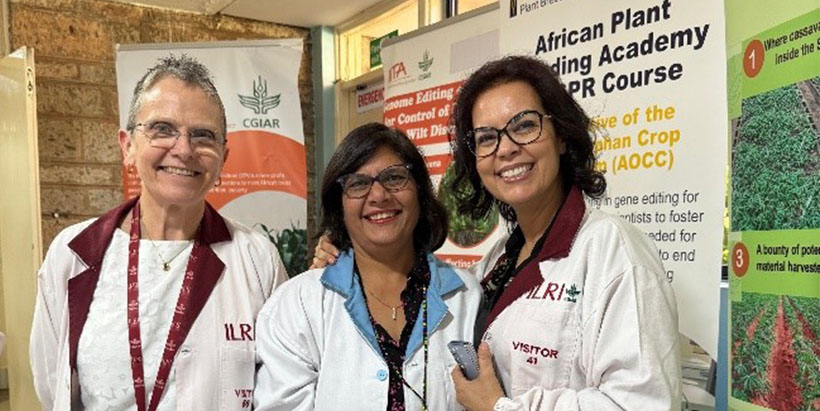
Dr Leena Tripathi with Ismahane and ILRI’s Assistant DG, Shirley Tarawali, during the lab tour.
On the first day, the delegation received by the Eastern Africa Hub Director, Dr Leena Tripathi toured IITA’s gene editing platform at the ILRI Campus.
The lab team took the delegation through the work in genome editing, demonstrating how this technology is shaping the future of agriculture. The visitors saw first-hand how IITA harnesses advanced biotech solutions to enhance crop resilience and boost food security across Africa.
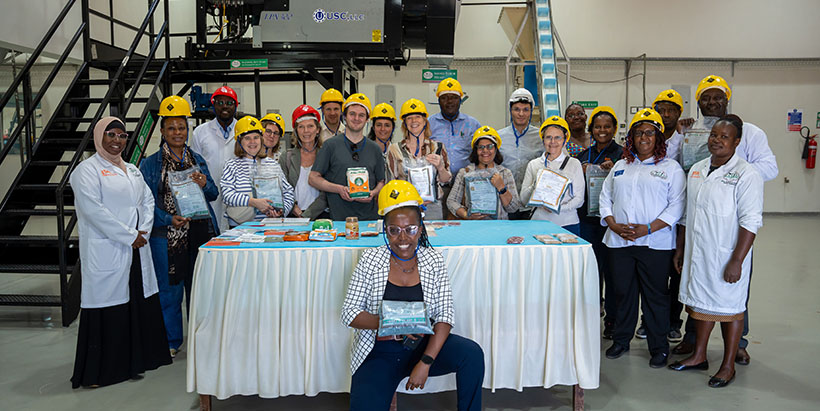
The delegation also visited the Aflasafe factory at Katumani, where they saw the science behind this innovative biocontrol product designed to combat aflatoxin contamination. The tour showed the production process and highlighted the collaboration between IITA and KALRO. A key takeaway for the delegation was the ‘invisibility’ of aflatoxin—how its presence cannot be detected just by looking at the grain, emphasizing the need for rigorous testing and biocontrol solutions like Aflasafe to ensure food safety. Inside the quality control lab, they observed the rigorous testing protocols ensuring product efficacy. While KALRO currently manages the factory, IITA provides technical support to maintain high standards and innovation in aflatoxin control.
Dr Leena Tripathi emphasized the impact of IITA’s work, stating, “Gene editing and biocontrol solutions like Aflasafe are game changers for African agriculture. It was a privilege to showcase our research and discuss how these technologies can be scaled up through strategic collaborations.”
The final leg of the visit took the delegation to the ICIPE Campus, where they were welcomed by the Deputy Director General for Research, Dr Bernard Vanlauwe. A special project showcase was curated to highlight IITA’s diverse research initiatives, each presented in concise, engaging segments:
The Belgian delegation alongside teams from CGIAR and KALRO.
Agronomy and Soil Health: Researchers outlined ongoing efforts to improve soil fertility and sustainable farming practices, critical for long-term agricultural productivity.
TAAT (Technologies for African Agricultural Transformation) and Youth Engagement in Agriculture: This session illuminated initiatives empowering young agripreneurs, featuring success stories from program beneficiaries who have transformed their lives through agricultural innovation.
Nematology: A deep dive into IITA’s pioneering work in nematology followed, where the delegation toured the state-of-the-art nematology lab. Scientists explained ongoing research in managing soil-borne pests that impact crop yields, demonstrating practical solutions to boost farmers’ productivity.
Dr Vanlauwe reflected on the visit’s significance, stating, “This engagement underscores the critical role of collaborative research in addressing Africa’s agricultural challenges. The partnerships we cultivate today will drive the innovations needed for a more resilient and food-secure future.”
The visit ended with reflecting on IITA’s role in African agricultural transformation. The Belgian delegation left with a deeper appreciation of IITA’s commitment to research excellence, collaboration, and impact-driven solutions for Africa’s food security. Their engagement with researchers and project leads sparked discussions on potential areas of future partnership.
Contributed by Rose Harriet Okech
Olamide Deborah Nwanze is a Senior Research Associate specializing in gender mainstreaming research to inform participatory and inclusive breeding, variety development, and seed systems policies regarding root, tuber, and banana (RTB) crops in the International Institute of Tropical Agriculture Headquarters, Ibadan, Nigeria. She is a PhD candidate at the University of Ibadan and holds an MSc and B. Agric in Agricultural Extension and Rural Development. Olamide is a fellow of the African Women in Agricultural Research and Development – Gender Responsive Agricultural Systems Policy (AWARD-GRASP) and the Gender Responsive Researchers Equipped for Agricultural Transformation (GREAT). She seeks to apply her gender-mainstreaming learnings, gender-responsive research, and policy development, and review expertise to facilitate women, youth, children, and vulnerable social group’s access to and adoption of agricultural Innovations that guarantee food, nutrition, income, and livelihood security in Africa. Her current roles include mentoring research fellows, development of guides and training manuals, implementation and adaptation of gender frameworks and tools, value chain actors’ engagement as citizen science partners, policy review and redesign, data management, and analysis. Her current research explores mixed methods and participatory and interdisciplinary approaches to capture and highlight gender dynamics, needs, preferences, and challenges stakeholders face within the agricultural livelihood value chain to prioritize gender-inclusive strategies in breeding programs, policy design, and implementation.
de Sousa, K., van Etten, J., Manners, R. Bello, A., Teeken, B., Olaosebikan, O., et al. 2024. The tricot approach: an agile framework for decentralized on-farm testing supported by citizen science. A retrospective. Agron. Sustain. Dev. 44, 8. https://doi.org/10.1007/s13593-023-00937-1
Madu, T., Onwuka, S., Nwafor, S., Onyemauwa, N., Ejechi, M., Ofoeze, M., Ukeje, B., Eluagu, C., Olaosebikan, O., Okoye, B., 2024. Gender-Inclusive Consumer Studies Improve Cassava Breeding in Nigeria in: Frontiers in Sociology, volume 9, number: 1224504, doi: 10.3389/fsoc.2024.1224504
Olaosebikan, O.; Bello, A.; Utoblo, O.; Okoye, B.; Olutegbe, N.; Garner, E.; Teeken, B.; Bryan, E.; Forsythe, L.; Cole, S.; Madu, T. 2023. Stressors and Resilience within the Cassava Value Chain in Nigeria: Preferred Cassava Variety Traits and Response Strategies of Men and Women to Inform Breeding. Sustainability 15, 7837. https://doi.org/10.3390/su15107837
Okoye, B., Ofoeze, M., Ejechi, M., Onwuka, S., Nwafor, S., Onyemauwa, N., Ukeje, B., Eluagu, C., Obidiegwu, J.*, Olaosebikan, O., Madu, T.* 2023. Prioritizing preferred traits in the yam value chain in Nigeria: a gender situation analysis in: Frontiers in Sociology, volume 8, number: 1232626, pages 1 – 9, ISSN 2297-7775, 2023. https://www.frontiersin.org/articles/10.3389/fsoc.2023.1232626/full
Olaosebikan, O., Bello, A. A., de Sousa, K., Ndjouenkeu, R., Adesokan, M., Alamu, E. O., Agbona, A., van Etten, J., Kegah, F. N.*, Dufour, D., Bouniol, A., Teeken, B. 2023. Consumer acceptability of cassava gari-eba food products across cultural and environmental settings using the triadic comparison of technologies approach (tricot) in: Journal of the Science of Food and Agriculture,
Teeken, B., Olaosebikan, O., Bello, A. A., Madu, T.*, Cole, S. M. 2023. Qualitative assessment on the positionality and preferences of dyads in relation to cassava-related activities: working with tricot trial citizen scientists https://hdl.handle.net/10568/138326 Type: Manual
Bouniol, A., Ceballos, H., Bello, A. A., Teeken, B., Olaosebikan, O., Owoade, D., Agbona, A., Fotso Kuate, A., Madu, T.*, Okoye, B.*, Ofoeze, M.*, Nwafor, S.*, Onyemauwa, N.*, Adinsi, L.*, Forsythe, L., Dufour, D. 2023. Varietal impact on women’s labour, workload and related drudgery in processing root, tuber and banana crops: focus on cassava in sub-Saharan Africa in: Journal of the Science of Food and Agriculture, pages 1 – 25, ISSN 0022-5142,
Bello, A. A., Agbona, A., Olaosebikan, O., Edughaen, G., Dufour, D., Bouniol, A., Iluebbey, P., Ndjouenkeu, R.*, Rabbi, I. Y., Teeken, B. 2023. Genetic and environmental effects on processing productivity and food product yield: drudgery of women’s work in: Journal of the Science of Food and Agriculture, pages 1 – 32, ISSN 0022-5142, 5
Cavicchioli, M., Zimbiti, T., Teeken, B., Nwanze, D.O., Liani, M., Parkes, E. & Bello, A. 2023. IITA-Gender Responsive Breeding Training Report. Genetic Resources Center, IITA-HQ, Ibadan, 21-23 September, 2022. Ibadan, Nigeria: IITA, (34 p.).https://hdl.handle.net/10568/131368
Agbona, A. Peteti P., Teeken B., Olaosebikan O. Bello, A. A., Parkes, E., Rabbi, I. Y., Mueller, L., Egesi, C., Kulakow, P. 2022. Data Management in Multi-disciplinary African RTB Crop Breeding Programs. In: Williamson, H.F., Leonelli, S. (eds) Towards Responsible Plant Data Linkage: Data Challenges for Agricultural Research and Development. Springer, Cham. https://doi.org/10.1007/978-3-031-13276-6_5
Lora Forsythe, Pricilla Marimo, Sarah Mayanja, Olamide D. Olaosebikan, Esme Stuart, Bela Teeken, Benjamin Okoye, Tessy Madu, (2021). Cross-product Gender Analysis of RTBfoods Step 2 Gendered Food Mapping on RTB Products. Understanding the Drivers of Trait Preferences and the Development of Multi-user RTB Product Profiles, WP1. London, UK: RTBfoods Field Scientific Report, 30 p.
Teeken, B., Garner, E., Agbona, A., Balogun, I., Olaosebikan, O., Bello, A., Madu, T., Okoye, B., Egesi, C., Kulakow, P. and Tufan, H.A. 2021. Beyond “Women’s Traits”: Exploring How Gender, Social Difference, and Household Characteristics Influence Trait Preferences. Frontiers Sustainable Food Systems 5:740926. https://doi.org/10.3389/fsufs.2021.740926
Teeken, B., Agbona, A., Bello, A., Olaosebikan, O., Alamu, E., Adesokan, M., Awoyale, W., Madu, T., Okoye, B., Chijioke, U., Owoade, D., Okoro, M., Bouniol, A., Dufour, D., Hershey, C., Rabbi, I., Maziya‐Dixon, B., Egesi, C., Tufan, H. and Kulakow, P. (020. Understanding cassava varietal preferences through pairwise ranking of gari‐eba and fufu prepared by local farmer–processors. Int J Food Sci Technol.https://doi.org/10.1111/ijfs.14862
Bela Teeken, Olamide Olaosebikan, Ireti Balogun, Benjamin Okoye, Tessy Madu, Steven Cole, Abolore Bello, Elizabeth Parkes. (2020). Piloting the G+ customer and product profile tools for gender-responsive cassava breeding in Nigeria. Nigeria: International Institute of Tropical Agriculture (IITA). https://hdl.handle.net/20.500.11766/13000