
IITA NEWS

VACS Fellows strengthen capacity through regional learning tour in Zimbabwe
April 17, 2026

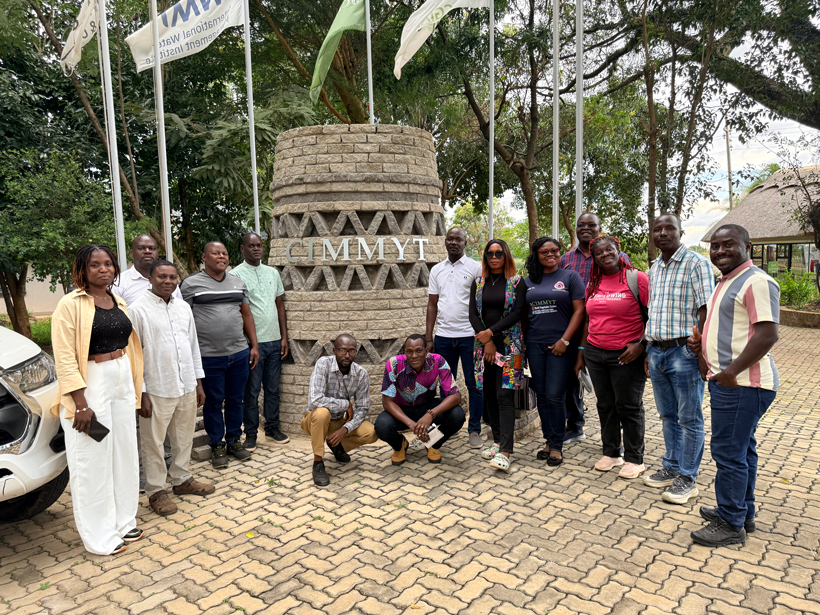
VACS Fellows at the CIMMYT office in Harare, Zimbabwe.

Across Africa, crops such as taro, amaranth, sesame, Bambara groundnut, pigeon pea, finger millet and okra, often referred to as “opportunity” or underutilized crops remain central to local diets, nutrition, and climate resilience, yet they continue to receive limited investment in research, breeding, and seed system development. As climate, variability intensifies and food systems face increasing pressure, these crops offer significant potential to diversify production, improve nutrition, and strengthen resilience for smallholder farmers.

The Vision for Adapted Crops and Soils (VACS) project is working to unlock this potential by prioritizing these crops within a broader effort to build more diverse and resilient food systems in Africa.

Central to this effort is strengthening the capacity of researchers and practitioners to develop test, and scale improved varieties that meet farmers’ needs.

It is within this context that IITA-CGIAR collaborated with the International Maize and Wheat Improvement Center (CIMMYT) to draw professional trainees from Benin Republic, Ghana, Mali, Nigeria, and Senegal.

The VACS Fellows convened in Zimbabwe from the 13-17 April, 2026, for a learning tour, designed to equip them with practical skills and insights needed to advance the breeding and promotion of these critical crops.

Speaking during the learning tour, Dean Muungani, IITA Product Manager for Grain Crops, said with the changing climate, and Africa continuing to experience drier conditions, it was time to look to crops that are more adapted to extreme weather conditions and manage them towards market requirements.

“The whole idea is to build capacity of breeders that are going to be breeding these crops. We want them to learn from industry experts and get them exposed to how to manage trials, demonstrations and also how to engage farmers in breeding for these crops,” he said.

The learning journey began with a visit to Seed Co Research Centre, where Fellows explored hybrid seed development systems, including trial design, management, and quality assurance processes. A key takeaway was the critical role of well-managed trials in generating reliable data that informs effective breeding decisions. Participants were also introduced to advanced techniques such as doubled haploid technology, disease screening protocols, and the use of molecular tools to ensure seed purity and quality.

“I cannot overemphasis the importance of the cross pollination of ideas. I hope what they have seen here will inspire them to replicate what we are doing here in their respective crops. What we aim to demonstrate here is the discipline required to consistently produce reliable, high-performing varieties,” said Gorden Mabuyaye, the Global Head of Research and Development at Seed Co.

The tour continued at the Agricultural Research Trust (ART), where the Fellows gained insights into sustainable models for agricultural research, including partnerships and contract research. They were also exposed to innovative fertilizer solutions, including emerging on-farm nitrogen generation technologies aimed at reducing input costs.

A key highlight of the tour was the visit to Farmer Field Schools in Mudzi, facilitated by the Community Technology Development Organization (CTDO), during which the Fellows witnessed participatory plant breeding in practice. Farmers were actively engaged in testing and selecting crop varieties still under development, ensuring that final products align with local needs and preferences.

CTDO Programs Coordinator, Patrick Kasasa said, “When farmers are involved from the beginning, adoption becomes much easier. They are not just recipients of technology they are co-creators of solutions that work for their realities.”

“Seeing farmers actively involved in the breeding process, from selecting traits and contributing to variety development, is both insightful and inspiring. It highlights the value of continuously engaging farmers in developing varieties suited to their environments,” said Mawulawoe Awity, one of the participating Fellows from Ghana.

Fellows also explored community seed banks, which play a critical role in conserving local varieties and maintaining genetic diversity. These systems provide farmers with a reliable fallback option, strengthening resilience while preserving important germplasm within communities.

Further engagements included visits to Seed Co’s vegetable production systems and CIMMYT, where Fellows wereintroduced to the maize breeding program and mechanization technologies. These experiences highlighted the importance of integrating improved varieties with efficient production systems to drive agricultural transformation.

“This VACS capacity-building program is ideal because agriculture is dynamic, we have new technologies that are coming on board, and in this climate change environment, there is need for breeders to learn and use these technologies for advanced breeding,” said Xaxier Mikeh, Program Development Lead at CIMMYT Southern Africa

Throughout the tour, partnerships emerged as a central theme. Engagements with institutions such as Seed Co, CTDO, ART, and CIMMYT demonstrated the critical role of collaboration in scaling innovation and delivering impact at farmer level.

By the end of the tour, the Fellows had gained not only technical knowledge but also practical insights into how agricultural innovations can be adapted and implemented within their respective countries, particularly for opportunity crops under the VACS initiative.

The learning tour underscored a clear message: strengthening human capacity is key to transforming agricultural systems. As the Fellows return to their location, they carry with them the tools, knowledge, and networks needed to drive the adoption of improved technologies, strengthen seed systems, and enhance farmer productivity and livelihoods across the region.

Contributed by Rachel Namukolo-Nali


Contributed by

Related news

No items found

Leave a Reply

Your email address will not be published. Required fields are marked *

Scroll to Top
Olaosebikan, Olamide

Olamide Deborah Nwanze is a Senior Research Associate specializing in gender mainstreaming research to inform participatory and inclusive breeding, variety development, and seed systems policies regarding root, tuber, and banana (RTB) crops in the International Institute of Tropical Agriculture Headquarters, Ibadan, Nigeria. She is a PhD candidate at the University of Ibadan and holds an MSc and B. Agric in Agricultural Extension and Rural Development. Olamide is a fellow of the African Women in Agricultural Research and Development – Gender Responsive Agricultural Systems Policy (AWARD-GRASP) and the Gender Responsive Researchers Equipped for Agricultural Transformation (GREAT). She seeks to apply her gender-mainstreaming learnings, gender-responsive research, and policy development, and review expertise to facilitate women, youth, children, and vulnerable social group’s access to and adoption of agricultural Innovations that guarantee food, nutrition, income, and livelihood security in Africa. Her current roles include mentoring research fellows, development of guides and training manuals, implementation and adaptation of gender frameworks and tools, value chain actors’ engagement as citizen science partners, policy review and redesign, data management, and analysis. Her current research explores mixed methods and participatory and interdisciplinary approaches to capture and highlight gender dynamics, needs, preferences, and challenges stakeholders face within the agricultural livelihood value chain to prioritize gender-inclusive strategies in breeding programs, policy design, and implementation.

At IITA, she contributes to the implementation of the CGIAR Accelerated Breeding Initiative and Genetic Innovation Programs; participatory and gender research within the NextGen CassavaHarvestPlusRTBFoods, and Tricot-ClimMob 1000Farms Projects; and gender knowledge communication via the G-LENS webinar series, video documentary, policy briefspublications, and blogs.


Recent publications

de Sousa, K., van Etten, J., Manners, R. Bello, A., Teeken, B., Olaosebikan, O., et al. 2024. The tricot approach: an agile framework for decentralized on-farm testing supported by citizen science. A retrospective. Agron. Sustain. Dev. 44, 8. https://doi.org/10.1007/s13593-023-00937-1

Madu, T., Onwuka, S., Nwafor, S., Onyemauwa, N., Ejechi, M., Ofoeze, M., Ukeje, B., Eluagu, C., Olaosebikan, O., Okoye, B., 2024. Gender-Inclusive Consumer Studies Improve Cassava Breeding in Nigeria in: Frontiers in Sociology, volume 9, number: 1224504, doi: 10.3389/fsoc.2024.1224504

Olaosebikan, O.; Bello, A.; Utoblo, O.; Okoye, B.; Olutegbe, N.; Garner, E.; Teeken, B.; Bryan, E.; Forsythe, L.; Cole, S.; Madu, T. 2023.  Stressors and Resilience within the Cassava Value Chain in Nigeria: Preferred Cassava Variety Traits and Response Strategies of Men and Women to Inform Breeding. Sustainability 15, 7837. https://doi.org/10.3390/su15107837

Okoye, B., Ofoeze, M., Ejechi, M., Onwuka, S., Nwafor, S., Onyemauwa, N., Ukeje, B., Eluagu, C., Obidiegwu, J.*, Olaosebikan, O., Madu, T.* 2023. Prioritizing preferred traits in the yam value chain in Nigeria: a gender situation analysis in: Frontiers in Sociology, volume 8, number: 1232626, pages 1 – 9, ISSN 2297-7775, 2023. https://www.frontiersin.org/articles/10.3389/fsoc.2023.1232626/full

Olaosebikan, O., Bello, A. A., de Sousa, K., Ndjouenkeu, R., Adesokan, M., Alamu, E. O., Agbona, A., van Etten, J., Kegah, F. N.*, Dufour, D., Bouniol, A., Teeken, B. 2023. Consumer acceptability of cassava gari-eba food products across cultural and environmental settings using the triadic comparison of technologies approach (tricot) in: Journal of the Science of Food and Agriculture,

Teeken, B., Olaosebikan, O., Bello, A. A., Madu, T.*, Cole, S. M. 2023. Qualitative assessment on the positionality and preferences of dyads in relation to cassava-related activities: working with tricot trial citizen scientists https://hdl.handle.net/10568/138326 Type: Manual

Bouniol, A., Ceballos, H., Bello, A. A., Teeken, B., Olaosebikan, O., Owoade, D., Agbona, A., Fotso Kuate, A., Madu, T.*, Okoye, B.*, Ofoeze, M.*, Nwafor, S.*, Onyemauwa, N.*, Adinsi, L.*, Forsythe, L., Dufour, D. 2023. Varietal impact on women’s labour, workload and related drudgery in processing root, tuber and banana crops: focus on cassava in sub-Saharan Africa in: Journal of the Science of Food and Agriculture, pages 1 – 25, ISSN 0022-5142,

Bello, A. A., Agbona, A., Olaosebikan, O., Edughaen, G., Dufour, D., Bouniol, A., Iluebbey, P., Ndjouenkeu, R.*, Rabbi, I. Y., Teeken, B. 2023. Genetic and environmental effects on processing productivity and food product yield: drudgery of women’s work in: Journal of the Science of Food and Agriculture, pages 1 – 32, ISSN 0022-5142, 5

Cavicchioli, M., Zimbiti, T., Teeken, B., Nwanze, D.O., Liani, M., Parkes, E. & Bello, A. 2023. IITA-Gender Responsive Breeding Training Report. Genetic Resources Center, IITA-HQ, Ibadan, 21-23 September, 2022. Ibadan, Nigeria: IITA, (34 p.).https://hdl.handle.net/10568/131368

Agbona, A. Peteti P., Teeken B., Olaosebikan O. Bello, A. A., Parkes, E., Rabbi, I. Y., Mueller, L., Egesi, C., Kulakow, P. 2022. Data Management in Multi-disciplinary African RTB Crop Breeding Programs. In: Williamson, H.F., Leonelli, S. (eds) Towards Responsible Plant Data Linkage: Data Challenges for Agricultural Research and Development. Springer, Cham. https://doi.org/10.1007/978-3-031-13276-6_5

Lora Forsythe, Pricilla Marimo, Sarah Mayanja, Olamide D. Olaosebikan, Esme Stuart, Bela Teeken, Benjamin Okoye, Tessy Madu, (2021). Cross-product Gender Analysis of RTBfoods Step 2 Gendered Food Mapping on RTB Products. Understanding the Drivers of Trait Preferences and the Development of Multi-user RTB Product Profiles, WP1. London, UK: RTBfoods Field Scientific Report, 30 p.

Teeken, B., Garner, E., Agbona, A., Balogun, I., Olaosebikan, O., Bello, A., Madu, T., Okoye, B., Egesi, C., Kulakow, P. and Tufan, H.A. 2021. Beyond “Women’s Traits”: Exploring How Gender, Social Difference, and Household Characteristics Influence Trait Preferences. Frontiers Sustainable Food Systems 5:740926. https://doi.org/10.3389/fsufs.2021.740926

Teeken, B., Agbona, A., Bello, A., Olaosebikan, O., Alamu, E., Adesokan, M., Awoyale, W., Madu, T., Okoye, B., Chijioke, U., Owoade, D., Okoro, M., Bouniol, A., Dufour, D., Hershey, C., Rabbi, I., Maziya‐Dixon, B., Egesi, C., Tufan, H. and Kulakow, P. (020. Understanding cassava varietal preferences through pairwise ranking of gari‐eba and fufu prepared by local farmer–processors. Int J Food Sci Technol. https://doi.org/10.1111/ijfs.14862

Bela Teeken, Olamide Olaosebikan, Ireti Balogun, Benjamin Okoye, Tessy Madu, Steven Cole, Abolore Bello, Elizabeth Parkes. (2020). Piloting the G+ customer and product profile tools for gender-responsive cassava breeding in Nigeria. Nigeria: International Institute of Tropical Agriculture (IITA). https://hdl.handle.net/20.500.11766/13000