
IITA NEWS

Farmers drive soybean variety selection as IITA strengthens breeding efforts
April 16, 2026

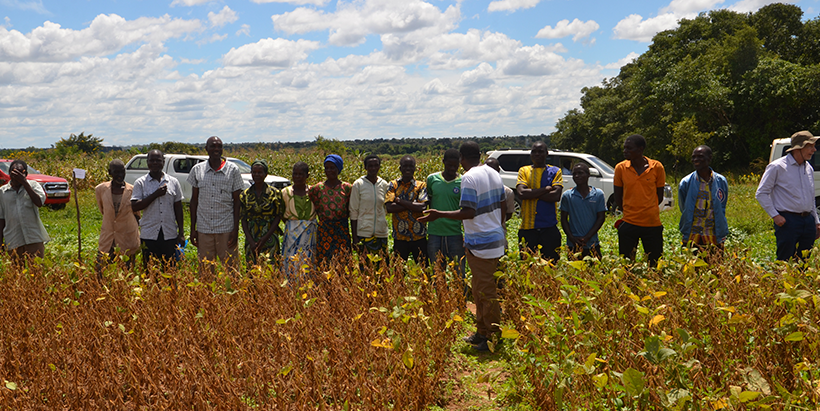
A soybean farmer in Mchinji Malawi showcases his Tricot trials.

Farmers in Zambia and Malawi are playing a central role in shaping the next generation of soybean varieties through participatory field evaluations under IITA’s soybean improvement program, ensuring that the varieties developed are not only high-performing but also practical and relevant to real farming conditions across Southern Africa.

The IITA soybean team recently conducted its annual soybean tour across Zambia and Malawi under the Gates Foundation-funded Soybean Crop Improvement Project for Africa. The tour provided an opportunity to assess progress in soybean trials and breeding activities, while engaging directly with farmers and stakeholders.

A key feature of the program is the use of the TRICOT approach, which enables farmers to test and compare multiple soybean varieties under their own farming conditions and select those that perform best. Unlike conventional approaches where varieties are selected primarily at research stations, TRICOT places farmers at the center of decision-making, ensuring that selected varieties reflect actual field performance and farmer preferences.

It is a method of testing for and with farmers.
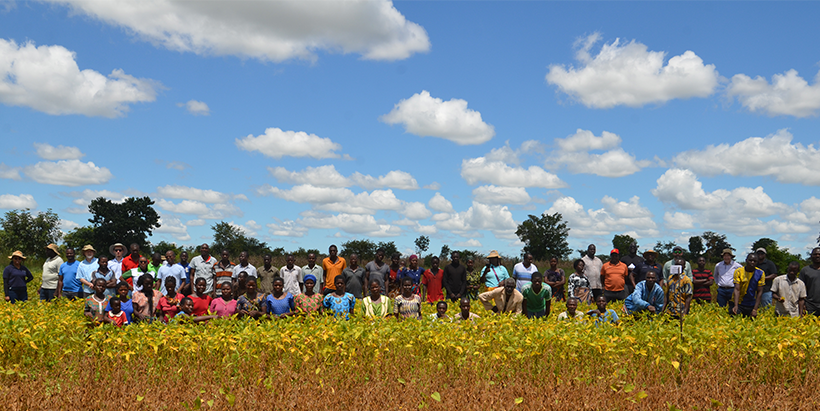
Farmers participating in TRICOT trials in Malawi, where they test and compare soybean varieties under real field conditions to identify those best suited to their environments.

Through this process, materials developed and tested at research stations are validated in farmers’ fields. This is important because performance at research stations does not always reflect outcomes under real farming conditions. Farmers plant and manage the trials themselves, allowing researchers to assess whether the same results can be achieved under farmer practices.

The model involves a large number of farmers across different locations, testing new materials alongside “check” varieties, which include previously released IITA varieties and those from commercial companies. These comparisons help determine whether new varieties consistently outperform existing options in terms of yield, disease tolerance, and adaptability.

“With this approach, we can see for ourselves which variety performs best on our farms and under our conditions, making it easier to decide what to plant,” said Mavuto Eliamu, a participating farmer from Mchinji district in Malawi.
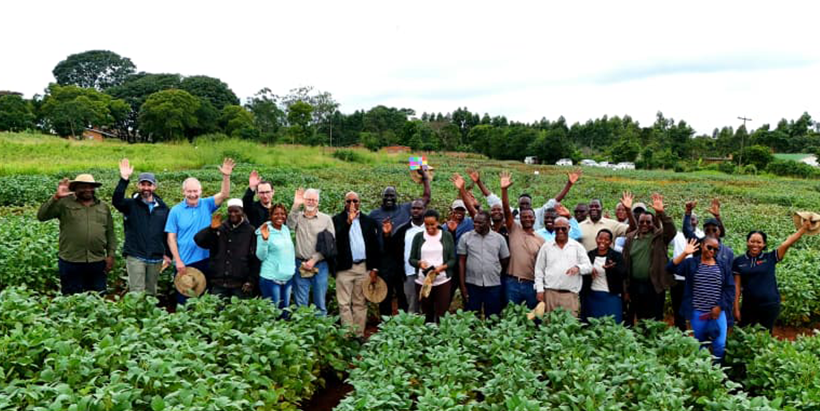
IITA and partners during the 2026 soybean tour, reviewing field trials and advancing efforts to develop resilient, high-performing soybean varieties for Southern Africa.

IITA Soybean Breeder Abush Tesfaye Abebe noted that significant progress has been made since the project started in 2023, particularly in identifying materials that are tolerant to diseases and have the potential to deliver improved yields.

“We have seen promising changes, especially in identifying materials that are more tolerant to diseases and show strong potential for better yields.”

IITA is working in collaboration with national research partners, including the Department of Agricultural Research Services (DARS) in Malawi and the Zambia Agricultural Research Institute (ZARI).

In Malawi, 150 farmers in Zomba, Mchinji, and Kasungu are participating in the project, while in Zambia, 240 farmers are engaged across Central, Eastern, and Southern provinces.

In addition to farmer-led selection, the program is advancing breeding efforts aimed at addressing critical production challenges. In Malawi, ongoing trials are focusing on developing soybean varieties with improved yields and resistance to soybean rust, a major disease with a devastating impact on production, causing up to an 80% yield loss.
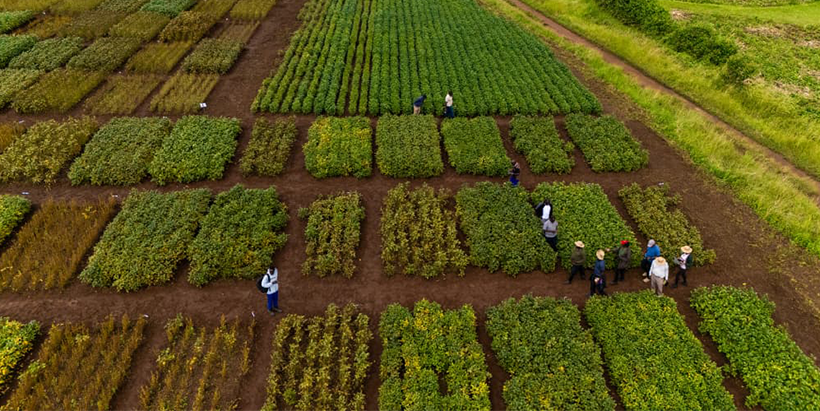
An aerial photo of soybean trial in Bvumbwe, Malawi.

Field visits during the tour enabled the team to review trial performance, monitor progress, and gather feedback from farmers. These trials are currently being conducted in Zambia at IITA-SARAH and ZARI, and in Malawi at the Bvumbwe Research Station in Blantyre and the IITA Chitedze station.

While the trials are presently concentrated in Zambia and Malawi, the breeding interventions are designed to generate soybean varieties suitable for wider adoption across the Southern African region, ensuring that the benefits extend beyond the current testing sites.

The tour, conducted from 30 March to 6 April 2026, included participation from stakeholders such as The Gates Foundation, Bayer, 2Blades, the Soybean Improvement Network for Africa, and the University of Illinois, who provided technical support and insights in the project.

By combining farmer insights with scientific innovation, the program is accelerating the development and adoption of resilient soybean varieties. This approach is expected to improve productivity, reduce losses from diseases such as soybean rust, and contribute to strengthened food security, farmer incomes, and sustainable agricultural growth across Southern Africa.

Contributed by Rachel Namukolo-Nali


Contributed by

Related news

No items found

Leave a Reply

Your email address will not be published. Required fields are marked *

Scroll to Top
Olaosebikan, Olamide

Olamide Deborah Nwanze is a Senior Research Associate specializing in gender mainstreaming research to inform participatory and inclusive breeding, variety development, and seed systems policies regarding root, tuber, and banana (RTB) crops in the International Institute of Tropical Agriculture Headquarters, Ibadan, Nigeria. She is a PhD candidate at the University of Ibadan and holds an MSc and B. Agric in Agricultural Extension and Rural Development. Olamide is a fellow of the African Women in Agricultural Research and Development – Gender Responsive Agricultural Systems Policy (AWARD-GRASP) and the Gender Responsive Researchers Equipped for Agricultural Transformation (GREAT). She seeks to apply her gender-mainstreaming learnings, gender-responsive research, and policy development, and review expertise to facilitate women, youth, children, and vulnerable social group’s access to and adoption of agricultural Innovations that guarantee food, nutrition, income, and livelihood security in Africa. Her current roles include mentoring research fellows, development of guides and training manuals, implementation and adaptation of gender frameworks and tools, value chain actors’ engagement as citizen science partners, policy review and redesign, data management, and analysis. Her current research explores mixed methods and participatory and interdisciplinary approaches to capture and highlight gender dynamics, needs, preferences, and challenges stakeholders face within the agricultural livelihood value chain to prioritize gender-inclusive strategies in breeding programs, policy design, and implementation.

At IITA, she contributes to the implementation of the CGIAR Accelerated Breeding Initiative and Genetic Innovation Programs; participatory and gender research within the NextGen CassavaHarvestPlusRTBFoods, and Tricot-ClimMob 1000Farms Projects; and gender knowledge communication via the G-LENS webinar series, video documentary, policy briefspublications, and blogs.


Recent publications

de Sousa, K., van Etten, J., Manners, R. Bello, A., Teeken, B., Olaosebikan, O., et al. 2024. The tricot approach: an agile framework for decentralized on-farm testing supported by citizen science. A retrospective. Agron. Sustain. Dev. 44, 8. https://doi.org/10.1007/s13593-023-00937-1

Madu, T., Onwuka, S., Nwafor, S., Onyemauwa, N., Ejechi, M., Ofoeze, M., Ukeje, B., Eluagu, C., Olaosebikan, O., Okoye, B., 2024. Gender-Inclusive Consumer Studies Improve Cassava Breeding in Nigeria in: Frontiers in Sociology, volume 9, number: 1224504, doi: 10.3389/fsoc.2024.1224504

Olaosebikan, O.; Bello, A.; Utoblo, O.; Okoye, B.; Olutegbe, N.; Garner, E.; Teeken, B.; Bryan, E.; Forsythe, L.; Cole, S.; Madu, T. 2023.  Stressors and Resilience within the Cassava Value Chain in Nigeria: Preferred Cassava Variety Traits and Response Strategies of Men and Women to Inform Breeding. Sustainability 15, 7837. https://doi.org/10.3390/su15107837

Okoye, B., Ofoeze, M., Ejechi, M., Onwuka, S., Nwafor, S., Onyemauwa, N., Ukeje, B., Eluagu, C., Obidiegwu, J.*, Olaosebikan, O., Madu, T.* 2023. Prioritizing preferred traits in the yam value chain in Nigeria: a gender situation analysis in: Frontiers in Sociology, volume 8, number: 1232626, pages 1 – 9, ISSN 2297-7775, 2023. https://www.frontiersin.org/articles/10.3389/fsoc.2023.1232626/full

Olaosebikan, O., Bello, A. A., de Sousa, K., Ndjouenkeu, R., Adesokan, M., Alamu, E. O., Agbona, A., van Etten, J., Kegah, F. N.*, Dufour, D., Bouniol, A., Teeken, B. 2023. Consumer acceptability of cassava gari-eba food products across cultural and environmental settings using the triadic comparison of technologies approach (tricot) in: Journal of the Science of Food and Agriculture,

Teeken, B., Olaosebikan, O., Bello, A. A., Madu, T.*, Cole, S. M. 2023. Qualitative assessment on the positionality and preferences of dyads in relation to cassava-related activities: working with tricot trial citizen scientists https://hdl.handle.net/10568/138326 Type: Manual

Bouniol, A., Ceballos, H., Bello, A. A., Teeken, B., Olaosebikan, O., Owoade, D., Agbona, A., Fotso Kuate, A., Madu, T.*, Okoye, B.*, Ofoeze, M.*, Nwafor, S.*, Onyemauwa, N.*, Adinsi, L.*, Forsythe, L., Dufour, D. 2023. Varietal impact on women’s labour, workload and related drudgery in processing root, tuber and banana crops: focus on cassava in sub-Saharan Africa in: Journal of the Science of Food and Agriculture, pages 1 – 25, ISSN 0022-5142,

Bello, A. A., Agbona, A., Olaosebikan, O., Edughaen, G., Dufour, D., Bouniol, A., Iluebbey, P., Ndjouenkeu, R.*, Rabbi, I. Y., Teeken, B. 2023. Genetic and environmental effects on processing productivity and food product yield: drudgery of women’s work in: Journal of the Science of Food and Agriculture, pages 1 – 32, ISSN 0022-5142, 5

Cavicchioli, M., Zimbiti, T., Teeken, B., Nwanze, D.O., Liani, M., Parkes, E. & Bello, A. 2023. IITA-Gender Responsive Breeding Training Report. Genetic Resources Center, IITA-HQ, Ibadan, 21-23 September, 2022. Ibadan, Nigeria: IITA, (34 p.).https://hdl.handle.net/10568/131368

Agbona, A. Peteti P., Teeken B., Olaosebikan O. Bello, A. A., Parkes, E., Rabbi, I. Y., Mueller, L., Egesi, C., Kulakow, P. 2022. Data Management in Multi-disciplinary African RTB Crop Breeding Programs. In: Williamson, H.F., Leonelli, S. (eds) Towards Responsible Plant Data Linkage: Data Challenges for Agricultural Research and Development. Springer, Cham. https://doi.org/10.1007/978-3-031-13276-6_5

Lora Forsythe, Pricilla Marimo, Sarah Mayanja, Olamide D. Olaosebikan, Esme Stuart, Bela Teeken, Benjamin Okoye, Tessy Madu, (2021). Cross-product Gender Analysis of RTBfoods Step 2 Gendered Food Mapping on RTB Products. Understanding the Drivers of Trait Preferences and the Development of Multi-user RTB Product Profiles, WP1. London, UK: RTBfoods Field Scientific Report, 30 p.

Teeken, B., Garner, E., Agbona, A., Balogun, I., Olaosebikan, O., Bello, A., Madu, T., Okoye, B., Egesi, C., Kulakow, P. and Tufan, H.A. 2021. Beyond “Women’s Traits”: Exploring How Gender, Social Difference, and Household Characteristics Influence Trait Preferences. Frontiers Sustainable Food Systems 5:740926. https://doi.org/10.3389/fsufs.2021.740926

Teeken, B., Agbona, A., Bello, A., Olaosebikan, O., Alamu, E., Adesokan, M., Awoyale, W., Madu, T., Okoye, B., Chijioke, U., Owoade, D., Okoro, M., Bouniol, A., Dufour, D., Hershey, C., Rabbi, I., Maziya‐Dixon, B., Egesi, C., Tufan, H. and Kulakow, P. (020. Understanding cassava varietal preferences through pairwise ranking of gari‐eba and fufu prepared by local farmer–processors. Int J Food Sci Technol. https://doi.org/10.1111/ijfs.14862

Bela Teeken, Olamide Olaosebikan, Ireti Balogun, Benjamin Okoye, Tessy Madu, Steven Cole, Abolore Bello, Elizabeth Parkes. (2020). Piloting the G+ customer and product profile tools for gender-responsive cassava breeding in Nigeria. Nigeria: International Institute of Tropical Agriculture (IITA). https://hdl.handle.net/20.500.11766/13000