
IITA NEWS

Weaver ants can boost cashew yield, study shows
July 18, 2015

The cashew (Anacardium occidentale) was introduced from Brazil in the 16th century and has become an economically important cash crop for a number of African countries. In the Benin Republic, for instance, raw cashew nuts have replaced cotton as the number one agricultural export produce and account for over 13% of export earnings. Production is, however, severely constrained by infestation by several insect pests, sap-sucking insects, leaf miners, branch borers, coreid bugs, mirid bugs, and thrips, which adversely affect the quality of harvestable nuts and causes yield losses of up to 80%.
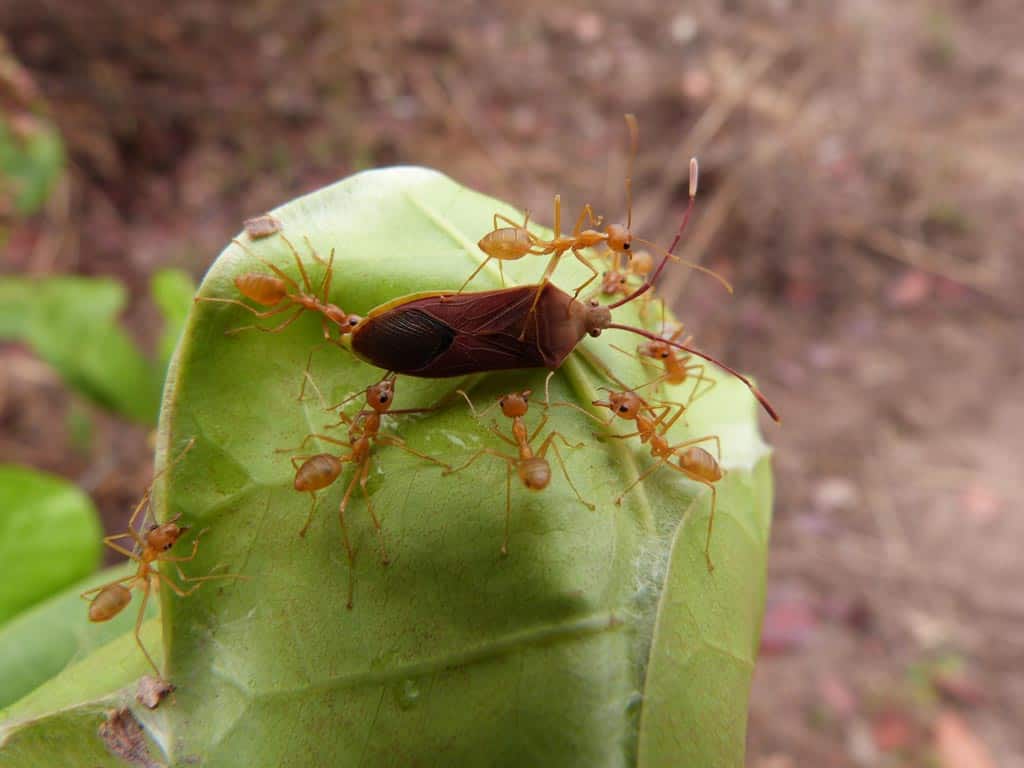
Capture of a coreid bug by O. longinoda on cashew leaves. Source: JF Vayssières, IITA

In a recent report published in the Journal of Agricultural and Forest Entomology, a team of researchers that includes Dr Jean-François Vayssières, IITA entomologist, present remarkable findings. Cashew nut yields can be boosted by as much as 78% with weaver ants only, and 151% with ants and GF-120 bait sprays, when treatments incorporating the African weaver ant (Oecophylla longinoda) are employed against Béninois insect cashew pests.

The researchers carried out their two-year study on a cashew orchard in the Parakou area of Bénin. First they divided the cashew trees into three blocks. Each block was then divided into four treatments, each with 72 trees. The treatments were as follows: a plot of trees colonized by weaver ants (ants); a plot of trees colonized by weaver ants fed with sugar solution (ant feeding); and an integrated pest management system (IPM) consisting of a plot of trees colonized by weaver ants and with spot application of GF-120. GF-120 is a biopesticide mixed with protein bait compatible with organic production but detrimental to cashew pests. Finally, the control treatment against which the performance of the other treatments was measured consisted of a plot of trees not subjected to any form of pest control.

Trees protected by weaver ants were compared with those without any form of protection. They found that nut yield and weight increased by 78% and 73% for the ants treatment, by 122% and 118% for the ant feeding treatment, and by 151% and 141% for the IPM treatment compared with the control.

“The presence of weaver ants patrolling the trees provides protection against pests,” said Dr Vayssières. “They can have a direct impact by capturing insect pests such as cashew bugs and also provide, ‘visual and olfactory cues’ that act as a repellent.”

The efficacy of weaver ants as natural biocontrol agents against a wide range of pests as shown by this study is in harmony with findings from previous studies carried out by Dr Vayssières in 2008. These demonstrated that Oecophylla Ionginoda was efficient in repelling and reducing damage caused by these dangerous fruit flies—Bactrocera dorsalis, Ceratitis capitata, and Ceratitis cosyra—in mango and citrus plantations.

An unexpected finding from the present study, however, revealed that treatments using weaver ants and sugar-fed weaver ants led to an increase in thrips activity which resulted in a higher than expected reduction in nut quality. Conversely, when weaver ants were used in conjunction with GF-120, nut quality was enhanced and thrips damage reduced.

Therefore an IPM program incorporating weaver ants and GF-120 or a similar pesticide is recommended. Because organic pesticides are expensive, more studies are required to determine the cost effectiveness of this kind of program to ensure that the gains from an increased yield are not eroded by the costs of the treatments.

Dr Vayssières also confirmed that there are other control methods focused on thrips to be tested in this way. He added “The red ants, O. longinoda, are particularly suitable for African developing countries where fruit trees are rarely monitored for pests and where IPM is hampered by high tree size and inadequate/insufficient farmer knowledge. Weaver ant technology is cost free, labor saving, self-regenerating, and requires few interventions of African growers. This conservative biological control method is thus especially suitable for smallholder growers in sub-Saharan Africa. The long history of the technology in Asia with Oecophylla smaragdina illustrates how this biological control of predators has great promise as a component of an efficient and sustainable IPM for smallholders (cashew, mango, citrus) in all sub-Saharan Africa.”

For more information:

Andrea Gros, Head of Communication, IITA HQ, a.gros@cgiar.org

About IITA www.iita.org
IITA is one of the world’s leading research partners in finding solutions for hunger, malnutrition, and poverty. Its award-winning research-for-development (R4D) approach addresses the development needs of tropical countries. IITA works with partners to enhance crop quality and productivity, reduce producer and consumer risks, and generate wealth from agriculture. IITA is a non-profit organization founded in 1967 in Nigeria and governed by a Board of Trustees. IITA works on the following crops: cowpea, soybean, banana/plantain, yam, cassava, and maize. It is a member of CGIAR, a global agriculture research partnership for a food secure future.


Contributed by

Related news

No items found

Leave a Reply

Your email address will not be published. Required fields are marked *

Scroll to Top
Olaosebikan, Olamide

Olamide Deborah Nwanze is a Senior Research Associate specializing in gender mainstreaming research to inform participatory and inclusive breeding, variety development, and seed systems policies regarding root, tuber, and banana (RTB) crops in the International Institute of Tropical Agriculture Headquarters, Ibadan, Nigeria. She is a PhD candidate at the University of Ibadan and holds an MSc and B. Agric in Agricultural Extension and Rural Development. Olamide is a fellow of the African Women in Agricultural Research and Development – Gender Responsive Agricultural Systems Policy (AWARD-GRASP) and the Gender Responsive Researchers Equipped for Agricultural Transformation (GREAT). She seeks to apply her gender-mainstreaming learnings, gender-responsive research, and policy development, and review expertise to facilitate women, youth, children, and vulnerable social group’s access to and adoption of agricultural Innovations that guarantee food, nutrition, income, and livelihood security in Africa. Her current roles include mentoring research fellows, development of guides and training manuals, implementation and adaptation of gender frameworks and tools, value chain actors’ engagement as citizen science partners, policy review and redesign, data management, and analysis. Her current research explores mixed methods and participatory and interdisciplinary approaches to capture and highlight gender dynamics, needs, preferences, and challenges stakeholders face within the agricultural livelihood value chain to prioritize gender-inclusive strategies in breeding programs, policy design, and implementation.

At IITA, she contributes to the implementation of the CGIAR Accelerated Breeding Initiative and Genetic Innovation Programs; participatory and gender research within the NextGen CassavaHarvestPlusRTBFoods, and Tricot-ClimMob 1000Farms Projects; and gender knowledge communication via the G-LENS webinar series, video documentary, policy briefspublications, and blogs.


Recent publications

de Sousa, K., van Etten, J., Manners, R. Bello, A., Teeken, B., Olaosebikan, O., et al. 2024. The tricot approach: an agile framework for decentralized on-farm testing supported by citizen science. A retrospective. Agron. Sustain. Dev. 44, 8. https://doi.org/10.1007/s13593-023-00937-1

Madu, T., Onwuka, S., Nwafor, S., Onyemauwa, N., Ejechi, M., Ofoeze, M., Ukeje, B., Eluagu, C., Olaosebikan, O., Okoye, B., 2024. Gender-Inclusive Consumer Studies Improve Cassava Breeding in Nigeria in: Frontiers in Sociology, volume 9, number: 1224504, doi: 10.3389/fsoc.2024.1224504

Olaosebikan, O.; Bello, A.; Utoblo, O.; Okoye, B.; Olutegbe, N.; Garner, E.; Teeken, B.; Bryan, E.; Forsythe, L.; Cole, S.; Madu, T. 2023.  Stressors and Resilience within the Cassava Value Chain in Nigeria: Preferred Cassava Variety Traits and Response Strategies of Men and Women to Inform Breeding. Sustainability 15, 7837. https://doi.org/10.3390/su15107837

Okoye, B., Ofoeze, M., Ejechi, M., Onwuka, S., Nwafor, S., Onyemauwa, N., Ukeje, B., Eluagu, C., Obidiegwu, J.*, Olaosebikan, O., Madu, T.* 2023. Prioritizing preferred traits in the yam value chain in Nigeria: a gender situation analysis in: Frontiers in Sociology, volume 8, number: 1232626, pages 1 – 9, ISSN 2297-7775, 2023. https://www.frontiersin.org/articles/10.3389/fsoc.2023.1232626/full

Olaosebikan, O., Bello, A. A., de Sousa, K., Ndjouenkeu, R., Adesokan, M., Alamu, E. O., Agbona, A., van Etten, J., Kegah, F. N.*, Dufour, D., Bouniol, A., Teeken, B. 2023. Consumer acceptability of cassava gari-eba food products across cultural and environmental settings using the triadic comparison of technologies approach (tricot) in: Journal of the Science of Food and Agriculture,

Teeken, B., Olaosebikan, O., Bello, A. A., Madu, T.*, Cole, S. M. 2023. Qualitative assessment on the positionality and preferences of dyads in relation to cassava-related activities: working with tricot trial citizen scientists https://hdl.handle.net/10568/138326 Type: Manual

Bouniol, A., Ceballos, H., Bello, A. A., Teeken, B., Olaosebikan, O., Owoade, D., Agbona, A., Fotso Kuate, A., Madu, T.*, Okoye, B.*, Ofoeze, M.*, Nwafor, S.*, Onyemauwa, N.*, Adinsi, L.*, Forsythe, L., Dufour, D. 2023. Varietal impact on women’s labour, workload and related drudgery in processing root, tuber and banana crops: focus on cassava in sub-Saharan Africa in: Journal of the Science of Food and Agriculture, pages 1 – 25, ISSN 0022-5142,

Bello, A. A., Agbona, A., Olaosebikan, O., Edughaen, G., Dufour, D., Bouniol, A., Iluebbey, P., Ndjouenkeu, R.*, Rabbi, I. Y., Teeken, B. 2023. Genetic and environmental effects on processing productivity and food product yield: drudgery of women’s work in: Journal of the Science of Food and Agriculture, pages 1 – 32, ISSN 0022-5142, 5

Cavicchioli, M., Zimbiti, T., Teeken, B., Nwanze, D.O., Liani, M., Parkes, E. & Bello, A. 2023. IITA-Gender Responsive Breeding Training Report. Genetic Resources Center, IITA-HQ, Ibadan, 21-23 September, 2022. Ibadan, Nigeria: IITA, (34 p.).https://hdl.handle.net/10568/131368

Agbona, A. Peteti P., Teeken B., Olaosebikan O. Bello, A. A., Parkes, E., Rabbi, I. Y., Mueller, L., Egesi, C., Kulakow, P. 2022. Data Management in Multi-disciplinary African RTB Crop Breeding Programs. In: Williamson, H.F., Leonelli, S. (eds) Towards Responsible Plant Data Linkage: Data Challenges for Agricultural Research and Development. Springer, Cham. https://doi.org/10.1007/978-3-031-13276-6_5

Lora Forsythe, Pricilla Marimo, Sarah Mayanja, Olamide D. Olaosebikan, Esme Stuart, Bela Teeken, Benjamin Okoye, Tessy Madu, (2021). Cross-product Gender Analysis of RTBfoods Step 2 Gendered Food Mapping on RTB Products. Understanding the Drivers of Trait Preferences and the Development of Multi-user RTB Product Profiles, WP1. London, UK: RTBfoods Field Scientific Report, 30 p.

Teeken, B., Garner, E., Agbona, A., Balogun, I., Olaosebikan, O., Bello, A., Madu, T., Okoye, B., Egesi, C., Kulakow, P. and Tufan, H.A. 2021. Beyond “Women’s Traits”: Exploring How Gender, Social Difference, and Household Characteristics Influence Trait Preferences. Frontiers Sustainable Food Systems 5:740926. https://doi.org/10.3389/fsufs.2021.740926

Teeken, B., Agbona, A., Bello, A., Olaosebikan, O., Alamu, E., Adesokan, M., Awoyale, W., Madu, T., Okoye, B., Chijioke, U., Owoade, D., Okoro, M., Bouniol, A., Dufour, D., Hershey, C., Rabbi, I., Maziya‐Dixon, B., Egesi, C., Tufan, H. and Kulakow, P. (020. Understanding cassava varietal preferences through pairwise ranking of gari‐eba and fufu prepared by local farmer–processors. Int J Food Sci Technol. https://doi.org/10.1111/ijfs.14862

Bela Teeken, Olamide Olaosebikan, Ireti Balogun, Benjamin Okoye, Tessy Madu, Steven Cole, Abolore Bello, Elizabeth Parkes. (2020). Piloting the G+ customer and product profile tools for gender-responsive cassava breeding in Nigeria. Nigeria: International Institute of Tropical Agriculture (IITA). https://hdl.handle.net/20.500.11766/13000