Great Lakes AID-I in Burundi: Dispelling myths and transforming cattle reproduction through artificial insemination
March 19, 2024
Livestock farmers in Burundi face a significant challenge in improving livestock reproduction. This is mainly due to a lack of high-quality dairy breeds and bulls, leading to the spread of reproductive diseases through natural mounting and soaring bull maintenance costs.
Sezikeye Antoine, a lead farmer in Bugabira, Kirundo Province, noted, “Insemination is both expensive and sporadic.”
Recognizing the crucial role of a sustainable livestock system in Burundi’s development journey and the resultant impact on nutrition, health, and food security, the Great Lakes Accelerated Innovation Delivery Initiative Rapid Delivery Hub (AID-I GLR) has established two scaling partnerships: the first is spearheaded by La Confédération des Associations des Producteurs Agricoles pour le Développement (CAPAD), and the second is led by World Vision. Technical backstopping is provided by the International Livestock Research Institute (ILRI)—a technology developer. The aim is to revolutionize the national livestock system by strengthening the delivery of artificial insemination (AI) services.
AI is a meticulous process involving the insertion of semen from a bull into the reproductive tract of a female cow, typically using a specialized syringe – the AI gun. This makes it possible to rapidly, efficiently, and more predictably breed many cows with high-quality semen from genetically superior bulls.
AI implementation in Burundi is led by the National Centre for Artificial Insemination and Genetic Improvement (CNIAAG) – a division of the General Directorate of Livestock.
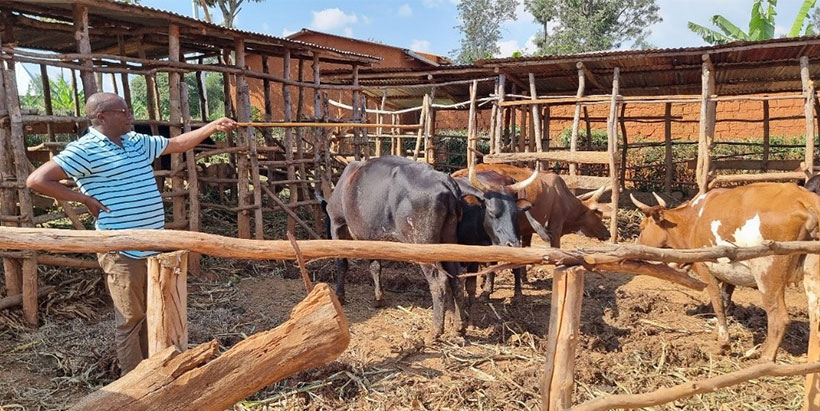
Sezikeye Antoine, a lead farmer in Bugabira (Kirundo Province), expresses satisfaction with three cows inseminated on his farm, previously relying on risky and budget-consuming bulls due to service disruptions. He commends AID-I GLR’s efforts to establish a regular AI service in his locality.
Pregnancy can be confirmed within less than a month (28 days) after service through the presence of pregnancy-associated glycoproteins in cow serum and by ultrasound techniques. This is a significant improvement over the traditional trans-rectal palpation technique, which can only provide reliable results after nearly three months (90 days). The pen-side tests are easy to perform using digital reporting and monitoring, with visually interpretable results. This also bolsters CNIAAG’s efforts to monitor genetic gains and prevent inbreeding.
The project also emphasizes the promotion of locally manufactured inputs to assure a sustainable supply chain, with locally produced semen straws and liquid nitrogen for semen conservation.
While AI is not new in Burundi, its previous scarcity, high costs, and associated rumors created resistance. AID-I GLR addresses this by providing comprehensive training for AI technicians and proper sensitization of farmers, dispelling misconceptions about AI as a cause of infertility, low success rates, weak products, and dystocia (difficult delivery). Since the AI program’s start in August 2023, more than 2,100 beneficiaries, including livestock farmers, private inseminators, and public- and private-sector partners, have been sensitized on AI.
The project trains and equips additional locally based AI technicians to operate in communities, thus reducing transport costs and ensuring service availability. The goal is to establish a community-based yet nationally connected AI service by:
training, monitoring, and equipping technicians
establishing a functional AI input supply chain
evaluating genetic gains at national and farm levels regularly
The AI service implemented by AID-I GLR begins with comprehensive farmer sensitization on cow reproduction physiology, AI requirements, the AI process, and the necessary follow-up. To assure efficacy, targeted AI females are carefully prepared and serviced.
For selected smallholder farmers, one or more of their cows are inseminated and monitored to confirm pregnancy. Farmers have expressed gratitude as AID-I GLR brings AI to remote villages and has helped with science-based facts, thereby dispelling widespread rumors about reproductive disorders allegedly caused by AI.
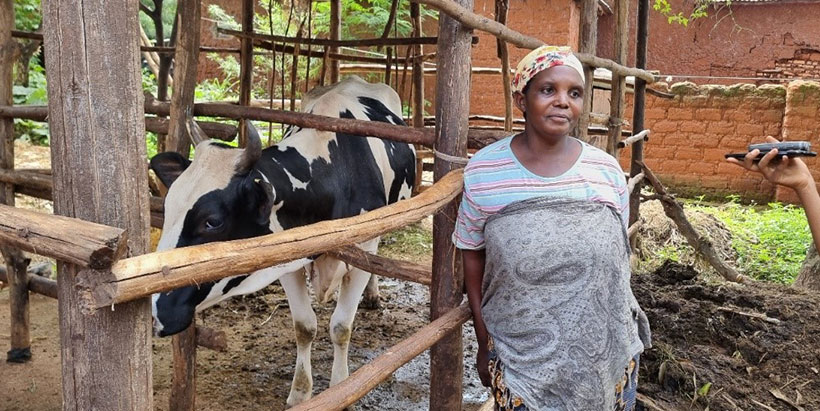
Ndayishimiye Sylvie in Muzinda (Bubanza Province) celebrates a successful pregnancy diagnosis, avoiding resorting to a bull after her cow exhibited blood drops post-insemination. She anticipates the birth of a calf valued at 300,000 BIF (USD 105) alongside the increased dairy production.
Farmers plan to contract trained AI technicians for regular insemination and pregnancy diagnoses, join farmer associations for easy access to AI services, and demand more training, equipment, and availability of quality semen straws in their villages, even if they would have to pay for them. This demonstrates their firm resolve, and assures post-intervention sustainability, with the farmers firmly in control.
Complementing farmer efforts and further buttressing the sustainability of the service, Burundi’s national artificial insemination center and provincial agriculture and livestock bureaus are actively pursuing the opportunity to establish community-based AI service providers. In the meantime, AID-I GLR has sown a seed of change to pave the way for this future by facilitating AI technician training, thus equipping them with essential practical skills and knowledge for this role in the short and long term.
Contributed by Ritha Bumwe
Olamide Deborah Nwanze is a Senior Research Associate specializing in gender mainstreaming research to inform participatory and inclusive breeding, variety development, and seed systems policies regarding root, tuber, and banana (RTB) crops in the International Institute of Tropical Agriculture Headquarters, Ibadan, Nigeria. She is a PhD candidate at the University of Ibadan and holds an MSc and B. Agric in Agricultural Extension and Rural Development. Olamide is a fellow of the African Women in Agricultural Research and Development – Gender Responsive Agricultural Systems Policy (AWARD-GRASP) and the Gender Responsive Researchers Equipped for Agricultural Transformation (GREAT). She seeks to apply her gender-mainstreaming learnings, gender-responsive research, and policy development, and review expertise to facilitate women, youth, children, and vulnerable social group’s access to and adoption of agricultural Innovations that guarantee food, nutrition, income, and livelihood security in Africa. Her current roles include mentoring research fellows, development of guides and training manuals, implementation and adaptation of gender frameworks and tools, value chain actors’ engagement as citizen science partners, policy review and redesign, data management, and analysis. Her current research explores mixed methods and participatory and interdisciplinary approaches to capture and highlight gender dynamics, needs, preferences, and challenges stakeholders face within the agricultural livelihood value chain to prioritize gender-inclusive strategies in breeding programs, policy design, and implementation.
de Sousa, K., van Etten, J., Manners, R. Bello, A., Teeken, B., Olaosebikan, O., et al. 2024. The tricot approach: an agile framework for decentralized on-farm testing supported by citizen science. A retrospective. Agron. Sustain. Dev. 44, 8. https://doi.org/10.1007/s13593-023-00937-1
Madu, T., Onwuka, S., Nwafor, S., Onyemauwa, N., Ejechi, M., Ofoeze, M., Ukeje, B., Eluagu, C., Olaosebikan, O., Okoye, B., 2024. Gender-Inclusive Consumer Studies Improve Cassava Breeding in Nigeria in: Frontiers in Sociology, volume 9, number: 1224504, doi: 10.3389/fsoc.2024.1224504
Olaosebikan, O.; Bello, A.; Utoblo, O.; Okoye, B.; Olutegbe, N.; Garner, E.; Teeken, B.; Bryan, E.; Forsythe, L.; Cole, S.; Madu, T. 2023. Stressors and Resilience within the Cassava Value Chain in Nigeria: Preferred Cassava Variety Traits and Response Strategies of Men and Women to Inform Breeding. Sustainability 15, 7837. https://doi.org/10.3390/su15107837
Okoye, B., Ofoeze, M., Ejechi, M., Onwuka, S., Nwafor, S., Onyemauwa, N., Ukeje, B., Eluagu, C., Obidiegwu, J.*, Olaosebikan, O., Madu, T.* 2023. Prioritizing preferred traits in the yam value chain in Nigeria: a gender situation analysis in: Frontiers in Sociology, volume 8, number: 1232626, pages 1 – 9, ISSN 2297-7775, 2023. https://www.frontiersin.org/articles/10.3389/fsoc.2023.1232626/full
Olaosebikan, O., Bello, A. A., de Sousa, K., Ndjouenkeu, R., Adesokan, M., Alamu, E. O., Agbona, A., van Etten, J., Kegah, F. N.*, Dufour, D., Bouniol, A., Teeken, B. 2023. Consumer acceptability of cassava gari-eba food products across cultural and environmental settings using the triadic comparison of technologies approach (tricot) in: Journal of the Science of Food and Agriculture,
Teeken, B., Olaosebikan, O., Bello, A. A., Madu, T.*, Cole, S. M. 2023. Qualitative assessment on the positionality and preferences of dyads in relation to cassava-related activities: working with tricot trial citizen scientists https://hdl.handle.net/10568/138326 Type: Manual
Bouniol, A., Ceballos, H., Bello, A. A., Teeken, B., Olaosebikan, O., Owoade, D., Agbona, A., Fotso Kuate, A., Madu, T.*, Okoye, B.*, Ofoeze, M.*, Nwafor, S.*, Onyemauwa, N.*, Adinsi, L.*, Forsythe, L., Dufour, D. 2023. Varietal impact on women’s labour, workload and related drudgery in processing root, tuber and banana crops: focus on cassava in sub-Saharan Africa in: Journal of the Science of Food and Agriculture, pages 1 – 25, ISSN 0022-5142,
Bello, A. A., Agbona, A., Olaosebikan, O., Edughaen, G., Dufour, D., Bouniol, A., Iluebbey, P., Ndjouenkeu, R.*, Rabbi, I. Y., Teeken, B. 2023. Genetic and environmental effects on processing productivity and food product yield: drudgery of women’s work in: Journal of the Science of Food and Agriculture, pages 1 – 32, ISSN 0022-5142, 5
Cavicchioli, M., Zimbiti, T., Teeken, B., Nwanze, D.O., Liani, M., Parkes, E. & Bello, A. 2023. IITA-Gender Responsive Breeding Training Report. Genetic Resources Center, IITA-HQ, Ibadan, 21-23 September, 2022. Ibadan, Nigeria: IITA, (34 p.).https://hdl.handle.net/10568/131368
Agbona, A. Peteti P., Teeken B., Olaosebikan O. Bello, A. A., Parkes, E., Rabbi, I. Y., Mueller, L., Egesi, C., Kulakow, P. 2022. Data Management in Multi-disciplinary African RTB Crop Breeding Programs. In: Williamson, H.F., Leonelli, S. (eds) Towards Responsible Plant Data Linkage: Data Challenges for Agricultural Research and Development. Springer, Cham. https://doi.org/10.1007/978-3-031-13276-6_5
Lora Forsythe, Pricilla Marimo, Sarah Mayanja, Olamide D. Olaosebikan, Esme Stuart, Bela Teeken, Benjamin Okoye, Tessy Madu, (2021). Cross-product Gender Analysis of RTBfoods Step 2 Gendered Food Mapping on RTB Products. Understanding the Drivers of Trait Preferences and the Development of Multi-user RTB Product Profiles, WP1. London, UK: RTBfoods Field Scientific Report, 30 p.
Teeken, B., Garner, E., Agbona, A., Balogun, I., Olaosebikan, O., Bello, A., Madu, T., Okoye, B., Egesi, C., Kulakow, P. and Tufan, H.A. 2021. Beyond “Women’s Traits”: Exploring How Gender, Social Difference, and Household Characteristics Influence Trait Preferences. Frontiers Sustainable Food Systems 5:740926. https://doi.org/10.3389/fsufs.2021.740926
Teeken, B., Agbona, A., Bello, A., Olaosebikan, O., Alamu, E., Adesokan, M., Awoyale, W., Madu, T., Okoye, B., Chijioke, U., Owoade, D., Okoro, M., Bouniol, A., Dufour, D., Hershey, C., Rabbi, I., Maziya‐Dixon, B., Egesi, C., Tufan, H. and Kulakow, P. (020. Understanding cassava varietal preferences through pairwise ranking of gari‐eba and fufu prepared by local farmer–processors. Int J Food Sci Technol.https://doi.org/10.1111/ijfs.14862
Bela Teeken, Olamide Olaosebikan, Ireti Balogun, Benjamin Okoye, Tessy Madu, Steven Cole, Abolore Bello, Elizabeth Parkes. (2020). Piloting the G+ customer and product profile tools for gender-responsive cassava breeding in Nigeria. Nigeria: International Institute of Tropical Agriculture (IITA). https://hdl.handle.net/20.500.11766/13000